By Stephanie Paige Ogburn and ClimateWire, Source: Scientific American
The amount of carbon dioxide in the tropical Pacific Ocean has increased surprisingly quickly over the past 14 years, according to new research from scientists at the National Oceanic and Atmospheric Administration and the University of Washington.
The reason for the rapid increase in carbon dioxide concentrations is a combination of natural variability and human-caused emissions of carbon dioxide into the atmosphere, said Adrienne Sutton, a research scientist with NOAA’s Joint Institute for the Study of the Atmosphere and Ocean at the University of Washington.
Although it is difficult to tease out exactly how much of the increase in carbon dioxide concentrations is due to human-caused climate change, “we assume that most of the carbon dioxide increase [in the tropical Pacific] is due to anthropogenic CO2,” Sutton said.
In fact, the rate of increase in carbon dioxide concentrations in parts of the tropical Pacific Ocean, a band of ocean along the equator between the coasts of South America and Southeast Asia, is greater than the rate of increase of atmospheric carbon dioxide.
Measurements by atmospheric scientists at NOAA show that atmospheric CO2 is increasing at a rate of about 2 parts per million per year. But in parts of the tropical Pacific, the rate of change in CO2 concentrations measured by the researchers reached 3.3 ppm per year.
“It was a big surprise. We were not expecting to see rates that strong,” Sutton said.
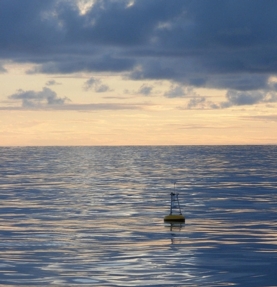
Current models do not predict such large increases in carbon dioxide concentrations in that part of the ocean, which is one of the reasons those findings were unexpected. The data were collected from a set of seven buoys in the tropical Pacific, starting in 1998.
Because that part of the ocean is dominated by many natural cycles, including the El Niño Southern Oscillation and the Pacific Decadal Oscillation, the researchers had to work to disentangle the overall signal of carbon dioxide concentrations from the variability caused by natural changes.
“One of the reasons why we were really interested in putting these CO2 systems on the buoys was so that we could see the incredible natural variability that occurs in this region,” Sutton said.
For the first few years of data collection, the researchers saw a clear signal of carbon dioxide growth rates changing as the ocean switched from El Niño to neutral to La Niña.
Read the full article at: Scientific American
7 Comments
Наша команда опытных специалистов подготовлена подать вам перспективные системы утепления, которые не только подарят прочную охрану от холодных воздействий, но и дарят вашему собственности оригинальный вид.
Мы занимаемся с последними материалами, сертифицируя постоянный срок службы работы и великолепные выходы. Изолирование наружных стен – это не только экономия ресурсов на подогреве, но и трепет о окружающей среде. Экологичные технологии, каковые мы применяем, способствуют не только зданию, но и сохранению экосистемы.
Самое основополагающее: [url=https://ppu-prof.ru/]Расценки утепления стен фасада[/url] у нас начинается всего от 1250 рублей за кв. м.! Это бюджетное решение, которое преобразит ваш домик в фактический комфортный местечко с скромными затратами.
Наши достижения – это не исключительно утепление, это созидание поля, в где каждый деталь показывает ваш особенный образ. Мы примем в расчет все твои желания, чтобы сделать ваш дом еще еще больше уютным и привлекательным.
Подробнее на [url=https://ppu-prof.ru/]официальном сайте[/url]
Не откладывайте занятия о своем доме на потом! Обращайтесь к квалифицированным работникам, и мы сделаем ваш дом не только комфортнее, но и стильнее. Заинтересовались? Подробнее о наших работах вы можете узнать на официальном сайте. Добро пожаловать в универсум удобства и высоких стандартов.
Gambling is the son of avarice and the father of despair.
Be on the alert like the red ant that moves with its claws wide open. Uganda
All that glitters is not gold.
If a man would live in peace he should be blind deaf and dumb.
Kind words will unlock an iron door
The first duty of a soldier is obedience.
Leave A Comment