
By Beth Gardiner, Source: The New York Times
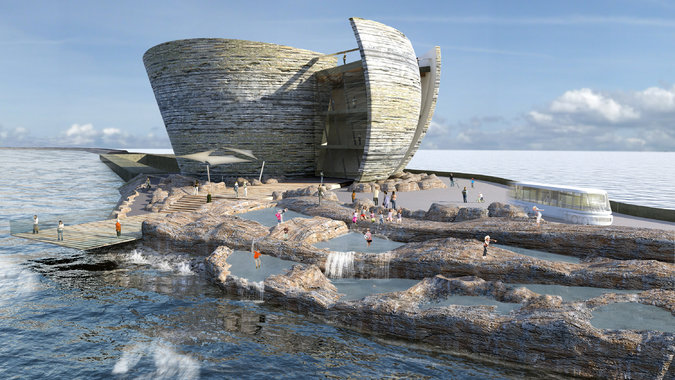
LONDON — Harvesting energy from the tides is hard to do, and the development of a new generation of sea-based power arrays lags far behind more widely used renewable technologies like wind and solar.
But the company pushing a new project on the coast of Wales thinks its twist — a 21st-century update of traditional dam-based hydropower — will be much easier to bring to fruition. If it wins government permission to go forward, Tidal Lagoon Power Limited says the approach, known as tidal lagoon generation, could provide as much as 10 percent of Britain’s power from six of its projects within a decade.
That is an optimistic assessment. Still, those hoping the seas will become a big contributor to the world’s future energy needs will be watching to see what happens in Swansea Bay, Wales.
Continue reading the main story
Related Coverage
Mexico’s State-Owned Oil Giant, Pemex, Is in Uncharted WatersOCT. 28, 2014
A member of a Ukrainian delegation posing at a gas compressor station in the Slovak town of Velke Kapusany, near the border with Ukraine.
Europe Strives to Overcome Its Reliance on Russian GasOCT. 28, 2014
A Chinese Coast Guard vessel near a drilling rig that China installed in disputed waters in May.
Beijing Zeroes In on Energy Potential of South China SeaOCT. 28, 2014
An Oyster wave energy generator is towed to a testing site in the Orkney Islands, Scotland.
I.H.T. Global Clean Energy: Marine Energy Projects Pick Up MomentumOCT. 1, 2012
“If it’s put together and it’s a success, people will look for other similar areas where there’s some development opportunity,” said Douglas J. Arent, executive director of the Joint Institute for Strategic Energy Analysis at the National Renewable Energy Laboratory in Colorado. Similarly, if the Swansea Bay project disappoints, that could quash hopes of similar efforts elsewhere, he said.
Even if the project succeeds, tidal lagoon power is unlikely to become more than a niche source of energy. Because it requires an unusually large difference between the levels of high and low tides, known as the tidal range, it is likely to be workable in only a few places, like Cook Inlet in Alaska and parts of South Korea.
“You have to find just the right site,” Mr. Arent said. Still, tidal lagoon could be a useful contributor, he said, because, unlike the wind and sun, tides are predictable. “This is one aspect of a broadening view of ‘How do we think about the use of energy from our water resources?”’
Tidal Lagoon Power’s plan, estimated to cost 1 billion pounds, or $1.6 billion, to build an 11.5-square-kilometer, or 4.4-square-mile, lagoon along Britain’s west coast emerged after proposals for a much larger project, stretching across the mouth of the nearby Severn river, foundered last year after decades of wrangling.
Read the rest at: The New York Times
0 Comments
Leave A Comment