
By Michael Graham Richard / Source: TreeHugger

I was reading an excellent piece by Chris Mooney about how much water and energy is wasted by inefficiencies when people take showers, and I was struck by the sheer amount of waste:
“Typically 20 percent of every shower, the duration, is essentially lost,” says Jonah Schein, technical coordinator for homes and buildings for the EPA’s WaterSense program. […] Showering drives almost 17 percent of water use in homes, and an average American family uses some 40 gallons of water per day in the shower. This amounts to 1.2 trillion gallons of water in the United States each year, says EPA, “enough to supply the water needs of New York and New Jersey” over the same time period. If 20 percent of that is wasted, well, you’re talking about over 200 billion gallons, in a world where gigantic states (California) and megacities (Sao Paulo, Brazil) are suffering from drought and water scarcity problems are expected to become still worse in the decades ahead.
What’s more, because water coming out of shower heads is supposed to be hot water, showers are also energy hogs. They’re typically one of the largest drags on the hot water heater in the home, and water heating itself accounts for almost 17 percent of total home electricity, according to the Department of Energy.
So it’s a triple-whammy of waste: Water and energy, and of course these cost money.
The same part is that most of this waste is purely behavioral. People wait for the hot water to come (which can take a while if the water heater is far away), and so they let the water run. So far, that’s a structural issue, and unless we can convince people to take cold showers (not such a bad idea), this won’t change much. But the problem is that even after the hot water has come, people don’t start taking a shower immediately. This looks like this:
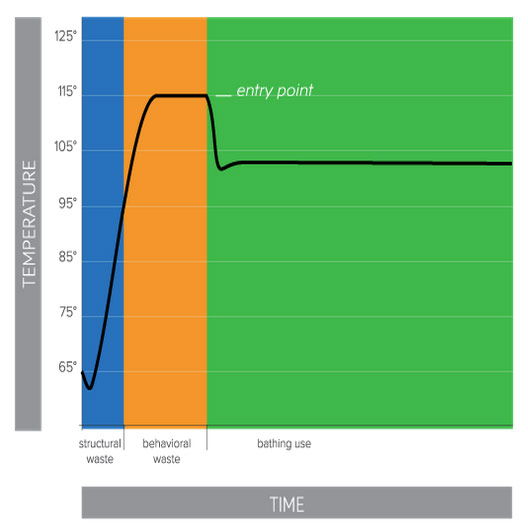
Making people aware of this behavior can probably help, but it’s very hard to change people’s routine, especially when they don’t perceive that there’s a problem.
That’s why I was so intrigued by a little piece of technology called a thermostatic shut-off valve.
Read more @ TreeHugger
0 Comments
Leave A Comment