
By Nell Greenfieldboyce / Source: NPR
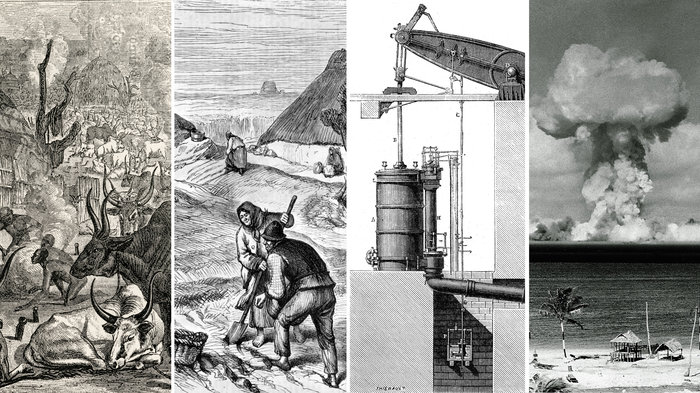
Humans have had such a huge impact on the Earth that some geologists think the human era should be enshrined in the official timeline of our planet.
They want to give the age of humans a formal name, just as scientists use terms like the Jurassic or the Cretaceous to talk about the age of dinosaurs.
But some researchers think that formally establishing an “Anthropocene” — as many call it — as part of the geologic time scale would be a big mistake.
The debate is heating up as a working group is getting closer to making recommendations to the scientific organization that decides such things — the International Union of Geological Sciences. The working group’s interim report is expected by next year.
“The Anthropocene does, the more you look at it, become more geologically real,” says Jan Zalasiewicz of the University of Leicester in the United Kingdom, who’s a member of the group. “We seem to be moving towards saying that the Anthropocene should be formalized.”
The Earth is about 4.5 billion years old. Scientists have divided up that vast stretch of time into categories and subcategories. There are eons and eras and periods and epochs, says Zalasiewicz. “Currently, formally, we live in something called the Holocene epoch.”
He says the push to give an official name to the time of human domination began about 15 years ago. A prominent atmospheric chemist named Paul Crutzen spontaneously came up with the term at a meeting where people were talking about environmental change in the Holocene, and he later learned that biologist Eugene Stoermer had been using it as well.
As an informal term, it’s really caught on, and all kinds of scientists are now using it. The question is whether or not to make it official. And that question is a lot trickier than it might seem. For example, scientists would first have to define when this new age began.
One early idea was that it began with the Industrial Revolution, says Zalasiewicz, “but the majority of us are beginning to favor a more recent time, in the mid-20th century.”
That’s because this is when human activities first left clear marks in the geologic record. Geologists like to see those kinds of unmistakable signals in the rock to mark the beginning of an official time period.
Earlier this year, scientists proposed pegging the start date of the Anthropocene at July 16, 1945 — the day of the first nuclear bomb explosion. Atom bomb tests produced fallout that can be detected in ice cores, soils and sediments all over the planet.
Read more @ NPR
0 Comments
Leave A Comment