by Jennifer Hattam, Istanbul, Turkey
Culture & Celebrity
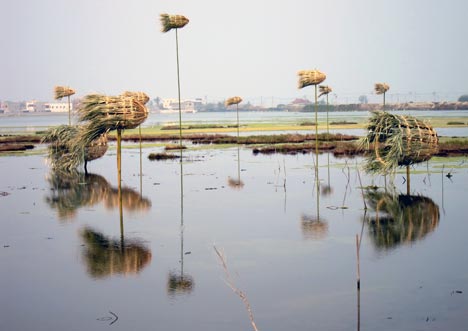
Artist Hsin-yu Huang’s installation “Let’s Nest.” Photo: 2011 Cheng Long Wetlands International Art Project.
In the small villages around the Cheng Long Wetlands in Taiwan’s poorest county, people make what living they can from fish farms and agriculture, though most young people these days leave to seek employment elsewhere. In this remote and little-known place, however, something is growing: Engagement with environmental issues is on the rise thanks in part to a community-based program that seeks to draw attention to the importance of the wetlands by turning them into a “gallery” for ecofriendly art.
Since early April, five international artists have been living in Cheng Long Village and working with children and adults in the community, as well as volunteers from throughout Taiwan, to create site-specific installations for the 2011 Cheng Long Wetlands International Art Project. Curated by American artist Jane Ingram Allen, who wrote to Treehugger to tell us about the project, the large installations incorporate natural materials from the area and include living plants that can serve as habitat and resting places for birds, crabs, and other wildlife.
Improving Habitat With Art
“It was great to have artists this year that understood the importance of using only natural materials and techniques that would not harm the environment of the wetlands nature preserve and help to improve the habitat for the wildlife,” Allen wrote on the project’s blog. The wetland, taken under government protection in 2005, is an important habitat for water birds.
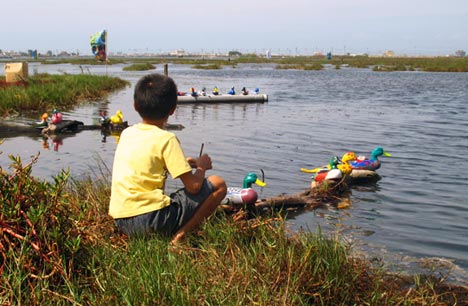
The Cheng Long Wetlands in Yunlin, Taiwan. Photo: 2011 Cheng Long Wetlands International Art Project.
The artists, who came from Bulgaria, Indonesia, Peru, and other parts of Taiwan, collected recycled bamboo from old oyster platforms on a nearby beach and learned from a village elder how to bend and join it in the traditional way, using the heat from a torch. Driftwood and wetlands grasses also became materials for many of the art pieces; some works may even end up growing more oysters for locals to harvest.
Large-Scale Installations
“All of the artists made their works larger than they had proposed. When they got to Cheng Long Wetlands and saw that vast expanse of water, they realized that the art needed to be very large in order to make an impact,” Allen wrote on the blog.
Artist Hsin-yu Huang, for example, created a total of 30 “nests” for her installation “Let’s Nest” — 21 more than proposed in her initial sketch. “The mass of nests of various sizes and placed on poles at different heights creates a big impact artwork that can be seen well from the highway going past Cheng Long,” Allen wrote. “It is great to have such a large visible work as this that can attract people to stop and see the wetlands.”
(Source: www.treehugger.com )
0 Comments
Leave A Comment