By Will Nichols, Source: BusinessGreen
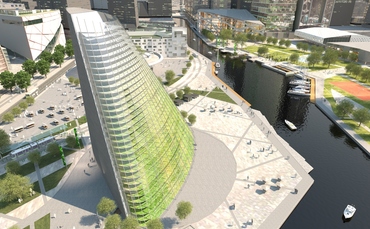
If the world is to feed over nine billion people by the middle of the century, solutions are going to have to present themselves pretty quickly.
By some estimates, 80 per cent of the Earth’s arable land has already been claimed for agriculture, while WWF estimates we will need two Earths by mid-century if consumption levels remain as they are and climate change continues to eat away at farmland.
But Plantagon, a Swedish social enterprise, thinks it may have come up with an answer to part of the conundrum: towering greenhouses in urban areas whose tightly controlled climate can produce thousands of tonnes of food a year. Enough, said Anders Modig, the company’s global sustainability director, to feed up to 30,000 people.
Plantagon has already begun building the first greenhouse, a 54m high cone in the city of Linköping, about 200km southwest of Stockholm, set to be complete in 2014. Much of the 200m Swedish Krona (£19m) pricetag has been covered by Plantagon and its backers, the Onondaga Nation, who were instrumental in founding the company with ethical business guru Hans Hassle in 2008.
Crops are grown on a spiral running through the heart of the building, moving slowly downwards over two to three months before being harvested at the bottom. As well as vastly increasing the growing area, yields can be increased without using more pesticides by controlling the temperature, levels of carbon dioxide and water vapour.
Placing the greenhouses in urban areas not only reduces the need for transport, but also has other advantages.
“The purpose is to make it sustainable and use the resources of a city that we don’t often see as resources,” said Carin Balfe Arbman, head of communications at Plantagon. “We use the excess heat from buildings to heat the greenhouse and also carbon dioxide from outside is turned into oxygen. And you can make biogas from what comes out of the greenhouse.”
The greenhouse could also help purify water if linked up to sewage networks and could become part of Sweden’s district heating systems.
Modig admits cities may not want to hand over valuable land for stand-alone agricultural production, but Plantagon has a plan.
“Of course you can build a skyscraper of 200m – there’s no limits,” said Modig. “But what’s also of interest is to combine it with some other type of services, like an office. Half could be a greenhouse, half could be an office or shopping area. Or maybe just build it on the top, so the vegetables come right to the supermarket.”
These would not have to be new buildings – Balfe Arbman insists it would be perfectly possible to retrofit greenhouses onto existing structures.
The greenhouse in Linköping will incorporate office space, which means it should be profitable before any vegetables are sold.
Modig said Plantagon has decided to grow pak choi, not only because green leafy vegetables are best suited to the greenhouse, but also in the hope of attracting the attention of markets in Asia.
Beyond China, the company is also targeting the US, currently besieged by drought, and predicts the greenhouses could revolutionise agriculture in Africa, where they would be spherical because of the higher levels of sunshine.
3 Comments
Monitoruj telefon z dowolnego miejsca i zobacz, co dzieje się na telefonie docelowym. Będziesz mógł monitorować i przechowywać dzienniki połączeń, wiadomości, działania społecznościowe, obrazy, filmy, WhatsApp i więcej. Monitorowanie w czasie rzeczywistym telefonów, nie jest wymagana wiedza techniczna, nie jest wymagane rootowanie. https://www.mycellspy.com/pl/tutorials/
Jeśli masz wątpliwości co do działań swoich dzieci lub bezpieczeństwa ich rodziców, możesz włamać się do ich telefonów z Androidem z komputera lub urządzenia mobilnego, aby zapewnić im bezpieczeństwo. Nikt nie może monitorować przez całą dobę, ale istnieje profesjonalne oprogramowanie szpiegowskie, które może potajemnie monitorować działania telefonów z Androidem, nie informując ich o tym.
Mass parsite http://bit.ly/2W9CVkn
Leave A Comment