By Julie Makinen, Source: Los Angeles Times
Photographer Wu Di’s studio, tucked away in a dusty corner of northeast Beijing, isn’t easy to find, but the mannequin out front wearing a military-style gas mask and a Roots sweatshirt is a sign you’re in the right place.
Inside, Wu showed off some of his work, like the stylized shot of mannequins in brand-name clothes posed near a swirling cesspool of discharge from garment factories. Recently, he photographed a child wearing 445 paper face masks stretching out like an elephant’s trunk.
“The government has promised the air quality will meet standards in 2030. So that means we’ll have about 1,500 days of air below the standard between now and then. If you need one mask every three days, that’s 445,” he said, explaining his calculation using the number of “good days” and “bad days” in those 16 years.

The backbeat to life in China these days is a drone of statistics about the degraded environment: State media have reported that nearly 60% of China’s groundwater is polluted and 19.4% of farmland is contaminated. Of 2,028 days between April 2008 and March 2014, Beijing had just 25 days of air quality considered “good” by U.S. standards, figures from the U.S. Embassy here showed.
The reports aim to inform and even shock citizens and officials into action, yet the effect can be the opposite — paralyzing.
Increasingly, though, artists are finding their muse in the ecological mire. With photos, paintings, conceptual pieces and performances, they’re piercing through the din of data, seizing the attention and imagination of both the authorities and the public.
Beijing artist Liang Kegang grabbed headlines recently when he auctioned off some fresh air from France; the small glass jam jar with a hinged top, rubber seal and simple sticker — “Aix en Provence, FRANCE” — sold for about $860.
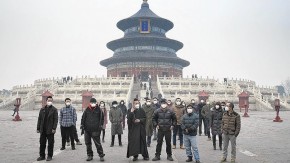
On a gloomy, bad-air day this winter, 20 artist friends wearing face masks convened at the capital’s Temple of Heaven and lay down on the ground. Later, they posed for a tourist-like group shot, each clutching a typical postcard of the historic site that showed the cake-like tiers of the structure stretching out against a blue sky.
On another smoggy day, Wu composed a photo of a young girl with an oxygen tube running from her nose to a green, heart-shaped balloon. It made the pages of Chinese Newsweek and other publications.
Recently, Wu has been tramping through nearby Hebei province, home to seven of China’s 10 most polluted cities. The factories and power plants that produce much of Beijing’s haze are there; Wu has posed people “camping” in a bleak field in front of one complex, and doctors dancing in another.
Read the rest at: Los Angeles Times
0 Comments
Leave A Comment