By Lisa Wang, Source: The Business of Fashion
After stagnating in the wake of the global economic crisis, in recent seasons, the premium denim market has seen an uptick in consumer demand. BoF examines the forces behind the rebound.
Pioneered and pushed forward by the likes of Gloria Vanderbilt and Calvin Klein in the 1970s and 1980s, Diesel in the 1990s, and 7 For All Mankind and its various offshoots in the 2000s, premium denim fell out of favour in 2007, in the wake of the global economic crisis, when many consumers balked at the thought of shelling out hundreds of dollars for a pair of jeans. And as demand fell, many brands were forced to slash prices and cut manufacturing costs just to stay afloat.
Fast forward to 2013 and renewed consumer appetite has put the premium denim market on the rebound. As consumer research group NPD reports, the fastest-growing segment of the denim market is premium ($75+) with an estimated market value of $1.4 billion for the year ended February 2013, up 17.3 percent from the year before; just two years ago, the premium denim market had not yet reached the $1 billion mark. What’s more, the total units of premium jeans sold grew 16.4 percent to 13.5 million pairs for the same period. By comparison, the overall denim market grew only 7.0 percent in value, while unit sales remained flat.
In just two indications that retailers are sensing the shift, last July, Selfridges hosted a month-long, store-wide shopping event entitled ‘Destination Denim,’ complete with workshops and talks, while earlier this year, Saks Fifth Avenue Beverley Hills launched a subterranean denim lounge dubbed D-Bar.
But where is the new growth coming from?
In the past, in the arrival of new styles and cuts have driven macro movements in the denim market, from the high-waisted flared jeans of the 1970s to the boot cut of the early 2000s. But with few new styles to challenge the decade-long dominance of the skinny jean, expansion is coming, instead, from new brand propositions and fabrics.
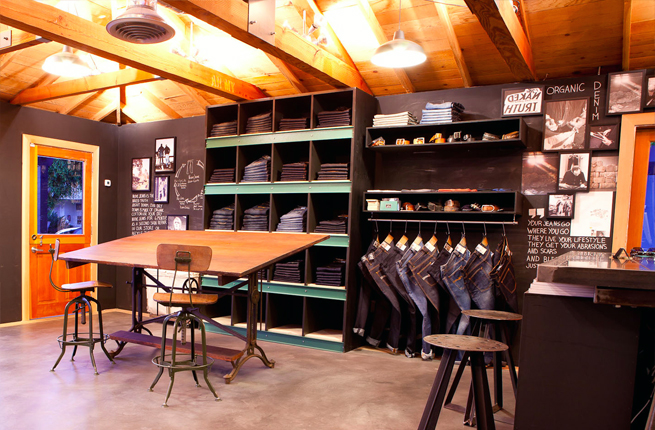
Where flailing denim labels exited the market, a number of new brands have emerged to fill the void. In recent years, Swedish cult hit Nudie Jeans, for example, has ascended steadily on the strength of its stylish, high quality product. Nudie devotees swear by the brand’s slim, five-pocket styles and raw denim, or ‘dry jeans,’ which mould and fade to the wearer’s shape, bringing to life the company’s philosophy of denim as second skin.
A sustainable approach has also helped to differentiate Nudie. Indeed, sustainability is a particularly pertinent question for denim makers, as jeans manufacturing consumes incredibly high quantities of water and produces caustic chemical runoff from synthetic indigo dyes, practices which Nudie avoids. In 2012, the company accomplished its goal to use 100 percent organic cotton across all ranges.
“For us, the future is in our philosophy. The philosophy has, for some reason, been a company secret for too many years. Now it’s time to tell the world,” commented Palle Stenberg, co-founder of Nudie Jeans, which, on the heels of a recent launch in Brisbane, Australia, is set to launch its latest concept store in London’s Soho, complete with an official repair station where customers can bring their Nudie jeans for free repair or alteration.
Another premium denim label pushing forward is MiH. The brand’s first incarnation, called Made in Heaven, was one of the UK’s earliest jeans companies, launched in 1969 by Tony O’Gorman, who opened Britain’s first specialty denim shop, Jean Machine, which, at its peak, had over 100 locations across London.
In 2007, O’Gorman’s goddaughter, Chloe Lonsdale, relaunched the label with meticulously crafted denim with a higher rise and slightly wider legs than the predominant styles. “My aim was not to create a 70s product, my aim was to make a relevant, modern product; to make timeless jeans,” she told BoF. “A beautiful pair of jeans is something that gets better with age and wear.”
Read the rest at: The Business of Fashion
0 Comments
Leave A Comment