
By Randal C. Archibold, Source: The New York Times
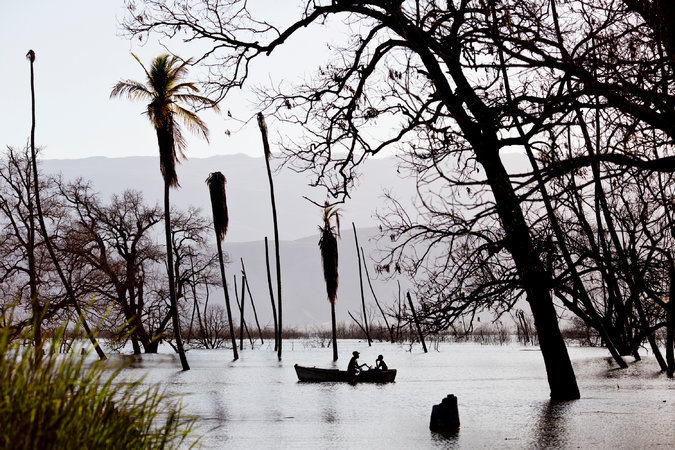
LAGO ENRIQUILLO, Dominican Republic — Steadily, mysteriously, like in an especially slow science fiction movie, the largest lake in the Caribbean has been rising and rising, devouring tens of thousands of acres of farmland, ranches and whatever else stands in its way.
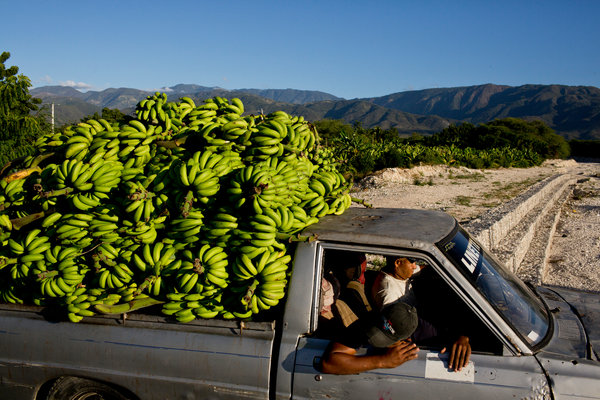
Lago Enriquillo swallowed Juan Malmolejos’s banana grove. It swamped Teodoro Peña’s yuccas and mango trees. In the low-lying city of Boca de Cachon, the lake so threatens to subsume the entire town that the government has sent the army to rebuild it from scratch on a dusty plain several miles away.
Jose Joaquin Diaz believes that the lake took the life of his brother, Victor. Victor committed suicide, he said, shortly after returning from a life abroad to see the family cattle farm, the one begun by his grandfather, underwater.
“He could not believe it was all gone, and the sadness was too much,” Mr. Diaz said, as a couple of men rowed a fishing boat over what had been a pasture.
Theories abound, but a conclusive answer remains elusive as to why the lake — as well as its nearby sibling in Haiti, Lac Azuei, which now spills over the border between the two on the island of Hispaniola — has risen so much. Researchers say the surge may have few if any precedents worldwide.
“There are no records, to the best of our knowledge, of such sudden growth of lakes of similar size,” said Jorge E. Gonzalez, a City College of New York engineering professor who is helping to lead a consortium of scientists from the United States and the Dominican Republic studying the phenomenon.
Other lakes have grown, from melting glaciers and other factors, Mr. Gonzalez said, but “the growth rates of these two lakes in Hispaniola has no precedent.”
The lakes, salty vestiges of an ancient oceanic channel known for their crocodiles and iguanas, have always had high and low periods, but researchers believe they have never before gotten this large. The waters began rising a decade ago, and now Enriquillo has nearly doubled in size to about 135 square miles, Mr. Gonzalez said, roughly the size of Atlanta, though relatively light rains in the past year have slowed its expansion. Azuei has grown nearly 40 percent in that time, to about 52 square miles, according to the consortium.
The scientists, partly financed by the National Science Foundation, are focusing on changing climate patterns as the main culprit, with a noted rise in rainfall in the area attributed to warming in the Caribbean Sea.
In reports, they have noted a series of particularly heavy storms in 2007 and 2008 that swamped the lakes and the watersheds that feed them, though other possible contributing factors are also being studied, including whether new underground springs have emerged.
“People talk about climate change adaptation, well, this is what’s coming, if it’s coming,” said Yolanda Leon, a Dominican scientist working on the lake research.
0 Comments
Leave A Comment