By Miguel Llanos, msnbc.com
Just last August the federal officials who track weather disasters said 2011 would go down as a record year with 9 events topping $1 billion in damages. On Wednesday, those same authorities upped the number to 12 events — totalling $52 billion in damages —and said there’s still a chance for one or two more to be added to the list.
“In my weather career spanning four decades, I’ve never seen a year quite like 2011 … record-breaking extremes of nearly every conceivable type of weather,” National Weather Service Director Jack Hayes said in a statement accompanying the new figures.
The National Climatic Data Center said more detailed accounting led to these newcomers:
Texas, New Mexico, Arizona wildfires (Spring-summer-fall). These had been incorporated into a broader disaster category in the August report (See below under Southern Plains/Southwest drought), but were pulled out when damages exceeded $1 billion, with five deaths.
Midwest/Southeast tornadoes (June 18-22). New numbers now put damages at $1.3 billion, with three deaths from an estimated 81 twisters.
And two other events are nearing that mark:
Northeast pre-Halloween storm (Fall). This “has a 50/50 chance of exceeding $1 billion,” center forecaster Adam Smith tells msnbc.com. “It may be a stretch to indicate that this winter storm is ‘likely’ to surpass the mark. But we will have an update on this in next month’s update.”
East Coast Tropical Storm Lee (Fall). “At this point, the data suggest that the damage from Tropical Storm Lee has an unlikely (less than 50/50) chance to reach the $1 billion mark,” Smith added.
The events followed a report last August that listed 9 events topping $1 billion for the year. A few days later, Hurricane Irene hit the East Coast, causing $7.3 billion in damages, claiming 45 lives, and bringing the total to 10 events.
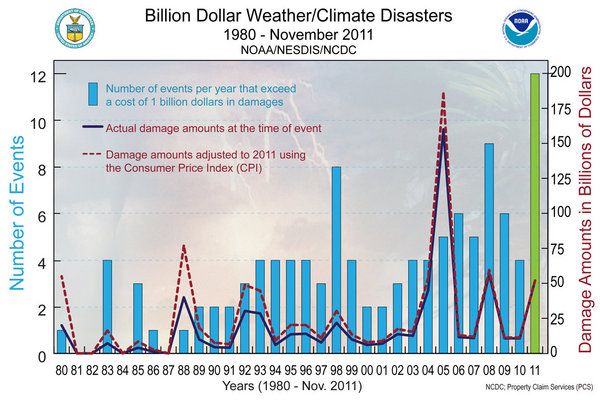
The old record was 9 events, set in 2008.
Moreover, the annual average has gone way up. In the 1980s, the U.S. averaged just over one weather disaster a year, the center stated. In the 1990s, the average was 3.8 a year — and that jumped to 4.6 in the 2000s and 7.5 in the past two years.
When the August report was released, Hayes called the rising frequency and cost of extreme weather a “new reality.”
(Source: www.msnbc.msn.com )
39 Comments
Профессиональный сервисный центр по ремонту бытовой техники с выездом на дом.
Мы предлагаем:ремонт бытовой техники в мск
Наши мастера оперативно устранят неисправности вашего устройства в сервисе или с выездом на дом!
Профессиональный сервисный центр по ремонту бытовой техники с выездом на дом.
Мы предлагаем:сервисные центры в москве
Наши мастера оперативно устранят неисправности вашего устройства в сервисе или с выездом на дом!
Thank you for always existing when we needed you. Your support and also kindness have been a true blessing.
buy hydroxychloroquine online https://hydroxychloroquinex.com/
hydroxychloroquine stock market https://hhydroxychloroquine.com/
generic tadalafil uk pharmacy https://cialis.cleckleyfloors.com/
cialis instructions for use 20mg https://cialis.adicbc.com/
cialis tab 5mg sale https://cialis.advantagetriseal.com/
online doctors in canada https://buymeds.mlsmalta.com/
zinc prophylaxis for coronavirus https://hydroxychloroquine.wisig.org/
side effects of tadalafil 5 mg https://cleckleyfloors.com/
zovirax cost https://www.herpessymptomsinmen.org/productacyclovir/
how to take sildenafil citrate https://viaplz.com/
keflex.webbfenix.com https://keflex.webbfenix.com/
Good post! We will be linking to this particularly great content on our website.
Keep up the great writing. https://www.azhydroxychloroquine.com/
As a class, although PDE5 inhibitors hindquarters make maximum ascertained plasm concentrations (Cmax) in as small as 30 minutes, the
median times to maximal engrossment (Tmax) are 60 proceedings for
Viagra and vardenafil and 2 hours for Cialis.
For avanafil, a median Tmax of 30 to 45 transactions is reported, maybe translating to
a quicker oncoming of action; however, the de facto
clinical implication has non been dictated. http://lm360.us/
viagra substitute over counter https://mymvrc.org/
online azithromycin https://azithromycinx250.com/
hydroxychloroquine covid https://chloroquine1st.com/
Thanks very interesting blog!|
My brother recommended I might like this web site. He was totally right. This post truly made my day. You cann't imagine just how much time I had spent for this info! Thanks!|
No matter if some one searches for his vital thing, thus he/she wishes to be available that in detail, therefore that thing is maintained over here.|
Pretty element of content. I just stumbled upon your site and in accession capital to assert that I get in fact enjoyed account your weblog posts. Anyway I'll be subscribing for your augment and even I achievement you get right of entry to consistently fast.|
viagra 100mg http://viacheapusa.com/
Hurrah, that's what I was exploring for, what a data! existing here at this blog, thanks admin of this website.|
Nice article
Nice article
Amazing
Nice article
Thanks
Thank you very much
Hey I am so happy I found your blog, I really found you by mistake, while I was searching on Yahoo for something else, Anyways I am here now and would just like to say cheers for a remarkable post and a all round enjoyable blog (I also love the theme/design), I don’t have time to browse it all at the moment but I have book-marked it and also added in your RSS feeds, so when I have time I will be back to read more, Please do keep up the excellent jo.|
Cool blog! Is your theme custom made or did you download it from somewhere? A theme like yours with a few simple tweeks would really make my blog stand out. Please let me know where you got your design. Thanks a lot|
This post is worth everyone's attention. When can I find out more?|
I do not even know how I ended up here, but I thought this post was great. I do not know who you are but certainly you're going to a famous blogger if you are not already ;) Cheers!|
Hi, I would like to subscribe for this webpage to obtain latest updates, so where can i do it please assist.|
Thanks for sharing your thought
Yes! Finally someone writes about keyword1.|
Attractive section of content. I just stumbled upon your site and in accession capital to assert that I get in fact enjoyed account your blog posts. Anyway I'll be subscribing to your augment and even I achievement you access consistently rapidly.|
Leave A Comment