By Nell Greenfieldboyce / Source: NPR
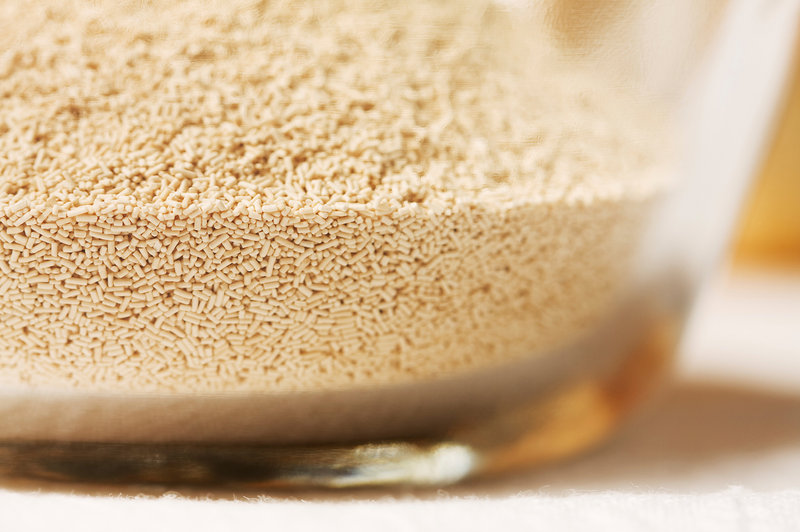
Rip open a little package of baker’s yeast from the supermarket, peer inside, and you’ll see your distant cousin.
That’s because we share a common ancestor with yeast, and a new study in the journal Science suggest that we also share hundreds of genes that haven’t really changed in a billion years.
Edward Marcotte, a biologist at the University of Texas at Austin, knew that humans and yeast have thousands of similar genes. But, he wondered, how similar are they?
“We’ve been separated by a billion years of evolution,” notes Marcotte. “Do those genes really work the same way?”
He figured the best way to answer that question would be to try swapping out the genetic material – basically, disable a gene in yeast, then replace it with the human version of that gene, and see if the yeast can survive.
Scientists had done this already with some individual genes, but Marcotte wanted to test a lot more — about 500 key genes that yeast need for life.
“There’s a postdoc in my laboratory named Aashiq Kachroo who was willing to tackle this slightly insane project,” says Marcotte. It was a brute force effort, he says, that took about three years.
What they found was that roughly half of these yeast genes could be readily replaced with the human version.
“The yeast were just fine,” says Marcotte.
The researchers next looked to see if they could figure out some rules that explained why some genes were interchangeable between people and yeast and others weren’t. They noted that genes tend to belong to sets that are related to specific jobs or processes in the cell — and genes in the same set tended to be either all replaceable, or not.
For example, the researchers looked at a whole bunch of genes involved in manufacturing cholesterol, which cells need to keep their shape. Almost all of the human genes for that job worked perfectly in yeast.
“Humans and yeast are doing not only the same thing as each other, but the same thing that their last common ancestor a billion years ago was doing,” says Marcotte. “It’s changed remarkably little over all of that time.”
But this work isn’t just a reminder of our deep evolutionary past, says Marcotte. Each yeast strain that’s been modified to contain a human gene allows scientists to test the function of that gene. They’ll be able to see if it’s related to disease, and perhaps develop drugs that could affect it.
Read more @ NPR
11 Comments
You really make it seem so easy with your presentation but I find this topic to be actually something which I think I would never understand. It seems too complicated and extremely broad for me. I'm looking forward for your next post, I'll try to get the hang of it!|
Hello! Do you know if they make any plugins to help with Search Engine Optimization? I'm trying to get my blog to rank for some targeted keywords but I'm not seeing very good results. If you know of any please share. Kudos!|
Hello there, You've done a great job. I will certainly digg it and personally recommend to my friends. I'm sure they will be benefited from this site.|
I appreciate, cause I found exactly what I was having a look for. You've ended my 4 day lengthy hunt! God Bless you man. Have a great day. Bye|
I got this web site from my buddy who told me on the topic of this web site and now this time I am browsing this web site and reading very informative articles at this time.|
This is my first time pay a visit at here and i am truly happy to read everthing at alone place.|
This website definitely has all of the info I wanted about this subject and didn't know who to ask. |
I visit day-to-day some sites and websites to read content, but this website presents quality based writing.|
Hi, I do believe this is an excellent site. I stumbledupon it ;) I am going to return yet again since i have saved as a favorite it. Money and freedom is the best way to change, may you be rich and continue to help other people.|
For the reason that the admin of this web site is working, no question very shortly it will be renowned, due to its feature contents.|
Mass parsite http://bit.ly/2W9CVkn
Leave A Comment