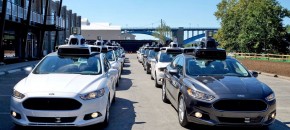
By Nathan Ingraham / Source: Engadget

“Did you do that, or did the car do that?” I first asked that of my self-driving Uber’s “safety driver” when the car pulled out of the lane it was in to go around a pedestrian on the side of the road. I then asked it another half-dozen times throughout the 30 minutes I spent as a passenger in one of Uber’s autonomous cars that are hitting the streets of Pittsburgh today. Nearly every time, the answer came back: “the car did that.”
Indeed, my time as a passenger in the self-driving Uber as it drove around downtown Pittsburgh was blessedly uneventful — and in that relative safety and peace, I got an up-close look at what the challenges will be in making autonomous vehicles a widespread reality. I even got behind the wheel to “not drive” the car for myself.
For starters, it’s important to note that I never once felt like the car made any unsafe maneuvers. It obeyed the speed limit, left plenty of space between it and the car in front of it, took turns slowly and smoothly and generally behaved like an excellent citizen in vehicular society. It decides on speed first by determining a safe driving distance from the vehicle in front of it, and then by going as fast as the speed limit when it was able to. Uber’s engineers are also able to call out roads in which the car can exceed the speed limit to drive safely with the flow of traffic.
All told, it was a pretty boring ride — aside from the fact that a freaking computer was driving me around downtown Pittsburgh. That’s all the more impressive when you consider how much harder making a self-driving car operate around a city is compared to on the highway (like Tesla’s autopilot feature does).
A freaking computer drove me around downtown Pittsburgh.
The times when my safety driver had to take control were less about the car doing something unsafe and more about it being confused about what its many sensors and cameras were recording. For example, the car didn’t know how to deal with a truck that was double-parked very well. It read the truck as a vehicle stopped in the road, but it didn’t have the context to know that it wasn’t going to move any time soon, so we just sat behind it until the driver pulled around it.
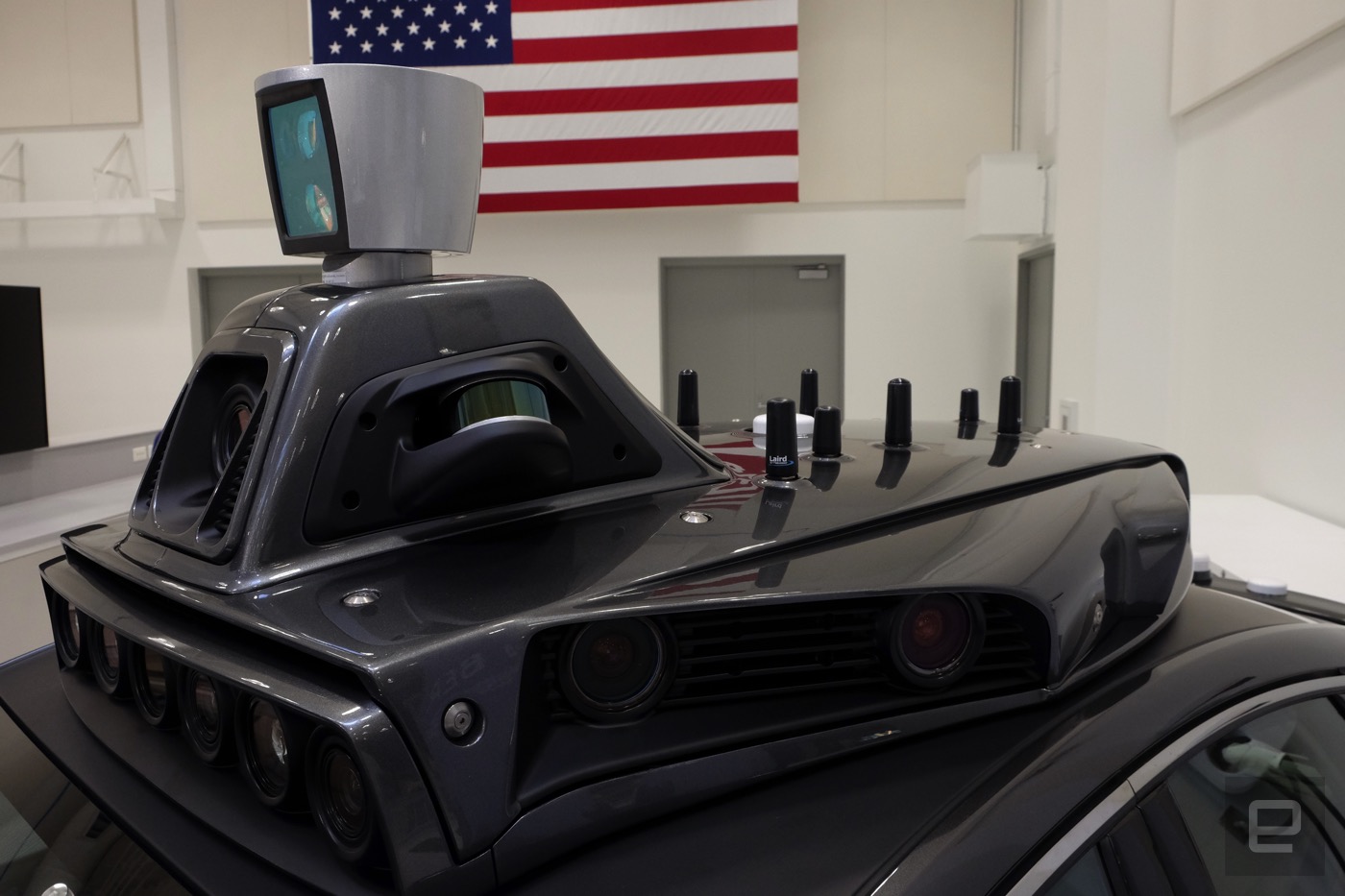
The car also had a tough time dealing with a four-way intersection — while an autonomous car will obey the letter of the law, humans don’t. So, with safety as a top priority, the car sat at the stop sign, waiting for crossing cars to come to a complete stop before it would enter the intersection. But most people out there don’t come to a complete stop at a stop sign, so we just sat and waited while multiple cars crossed in front of us, glancing curiously at the strange bed of sensors on top of the vehicle.
Uber’s cars will likely learn these intricacies sooner than later, and I got to see examples of that learning on display in my drive. Apparently, when you’re stopped at a red light in Pittsburgh, it’s customary to let the first car across from you take a left turn if they need to before continuing straight through the intersection (it’s called the “Pittsburgh left,” appropriately). The autonomous cars thus are programmed to take a little pause before continuing through an intersection when a car across from it has its left blinker on. That’s not about driving “right” or “wrong” — it’s about knowing local rules of the road and respecting them. Every area these cars go into will have their own quirky rules like this they’ll need to learn.
The few hiccups we encountered didn’t really detract from the experience; the overall ride was a smooth as I’ve ever had with a human driver behind the wheel. The autonomous system is finely tuned to provide a smooth and safe ride, and it never accelerated or decelerated in a way that made me feel uncomfortable. If you’ve taken a cab around any major city, you’ve probably experienced some car sickness from a driver with a heavy foot on both the brake and gas, but there was none of that here.
I’m someone with a rather sensitive stomach, but I felt fine for the rather lengthy ride I went on. In fact, the ride almost felt too smooth, too in control. Like a computer was driving — which, of course, it was. That’s not a bad thing, but you can definitely tell the difference between a human behind the wheel and the autonomous system.
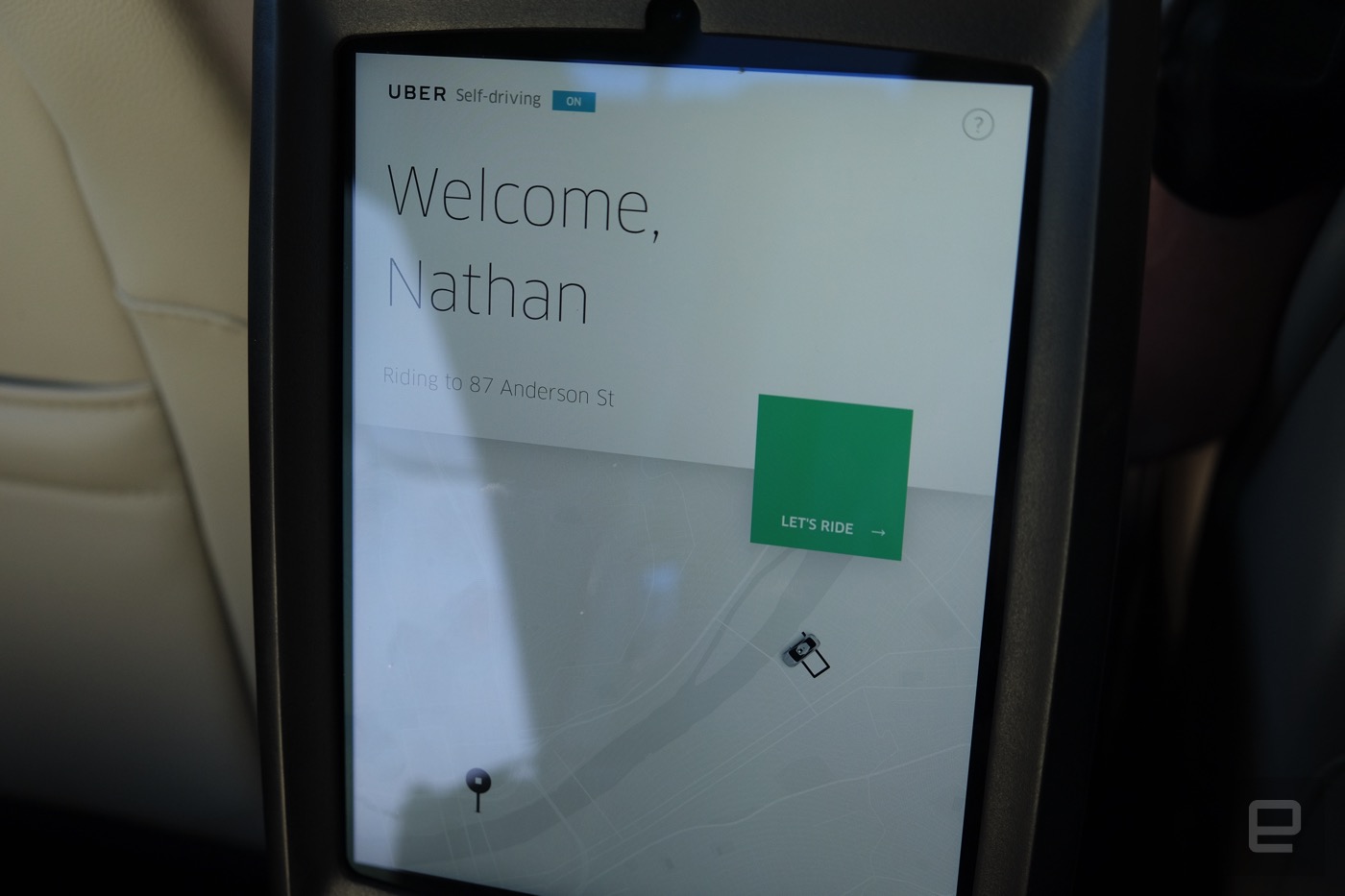
While sitting in the back of the Uber, I could look at an iPad mounted to show the riders some details on the car. You can see how far you’ve driven autonomously, the current speed and a graphic showing the movements of the steering wheel and when the brakes are applied. But most interesting was a view of what the car’s radar system is seeing at any given moment. You can see cars, buildings, pedestrians and anything else in range of the car. It’ll satisfy the curiosity of people interested in how the car works as well as provide some transparency and possible security to people skeptical about the system.
After cruising around Pittsburgh for a bit, I was offered my own chance to get behind the wheel. At first, I thought I was just getting a look at what the driver sees while they’re behind the wheel, but nope — I was getting a chance to sit up front while the car drove me around. The most interesting thing about that experience was the strange awareness I needed to keep while letting the car do its thing. I was tempted to look around and take in the sights of the city, because I felt totally comfortable letting the car do its thing.
Getting behind the wheel wasn’t any more nerve-wracking than riding in the back, because I was in complete control of the car.
Read more @ Engadget
19 Comments
Your point of view caught my eye and was very interesting. Thanks. I have a question for you. https://www.binance.bh/register?ref=JW3W4Y3A
Your article helped me a lot, is there any more related content? Thanks!
naza good website number 1
Your article helped me a lot, is there any more related content? Thanks!
We stumbled over here by a different page and thought I should
check things out. I like what I see so now i am
following you. Look forward to exploring your web page repeatedly.
I'm not sure exactly why but this site is loading very
slow for me. Is anyone else having this problem or is it a issue on my end?
I'll check back later on and see if the problem still exists.
Your means of explaining the whole thing in this paragraph is truly fastidious,
every one be capable of effortlessly know it, Thanks a lot.
It's amazing to pay a quick visit this web site
and reading the views of all mates regarding this post, while I am also eager of getting knowledge.
This is the perfect web site for anybody who would like to
find out about this topic. You understand a whole lot
its almost tough to argue with you (not that I really would want
to…HaHa). You certainly put a brand new spin on a topic that's been written about for many years.
Great stuff, just excellent! pof natalielise
Right here is the right webpage for anybody who would like to understand this topic.
You know so much its almost tough to argue with you (not that I really would want to…HaHa).
You definitely put a brand new spin on a topic which has been discussed for decades.
Excellent stuff, just great!
Greetings! Very helpful advice within this article! It is the little changes which will make the most significant changes.
Many thanks for sharing!
It's an amazing article designed for all the web viewers;
they will take advantage from it I am sure.
Hi there! I know this is somewhat off topic but I was wondering which blog platform are you using for this site?
I'm getting fed up of Wordpress because I've had problems with hackers and I'm looking at
options for another platform. I would be fantastic if you could point me in the direction of a good platform.
Paragraph writing is also a fun, if you know after that you can write if
not it is complicated to write.
It's difficult to find well-informed people on this subject,
but you seem like you know what you're talking about!
Thanks
Hi there, I desire to subscribe for this webpage to
take most recent updates, thus where can i do it please
help out.
Thanks for your marvelous posting! I quite enjoyed reading it,
you are a great author. I will be sure to bookmark your blog and will often come back later
on. I want to encourage you to definitely continue your great posts, have
a nice afternoon!
Wonderful goods from you, man. I've understand your
stuff previous to and you're just extremely great.
I really like what you have acquired here, really like what you are stating and the way
in which you say it. You make it enjoyable and you still take care of to keep it sensible.
I can't wait to read far more from you. This is actually a
tremendous web site.
I go to see everyday a few web sites and blogs to read content, but this weblog gives
feature based articles.
Leave A Comment