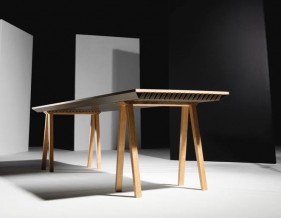
By Lloyd Alter / Source: TreeHugger
The physics are straightforward: when a material changes phase, like ice changing to water, a great deal of heat is absorbed. When it goes from water to ice, heat is released. That’s why ice doesn’t instantly melt in your drink and why it does such a good job of keeping it cool; it takes time.
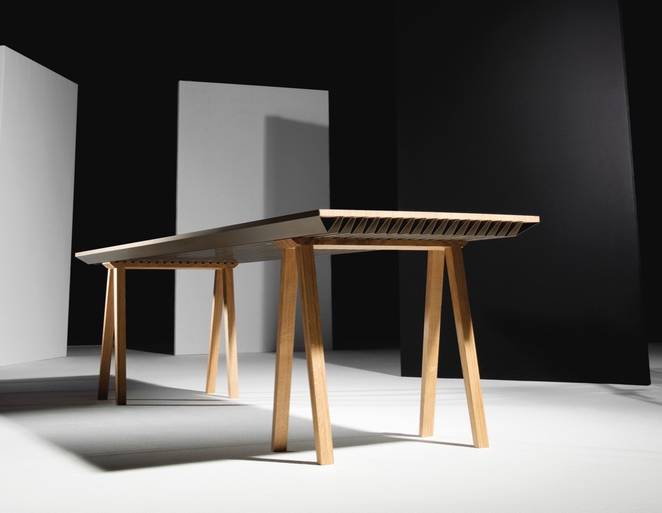
Phase Change Materials like paraffin are being used more often in buildings to act as thermal flywheels, storing heat in the day and releasing it at night, or vice versa. You can buy drywall impregnated with it. Architect and engineer Raphaël Ménard and designer Jean-Sébastien Lagrange are making it beautiful with their Zero Energy Furniture, of which the Climactic Table is the first project, now being shown in Milan. “The project represents a result from a dialogue between design and engineering, structural design and energy savings, thermal well-being and rational aesthetic.”
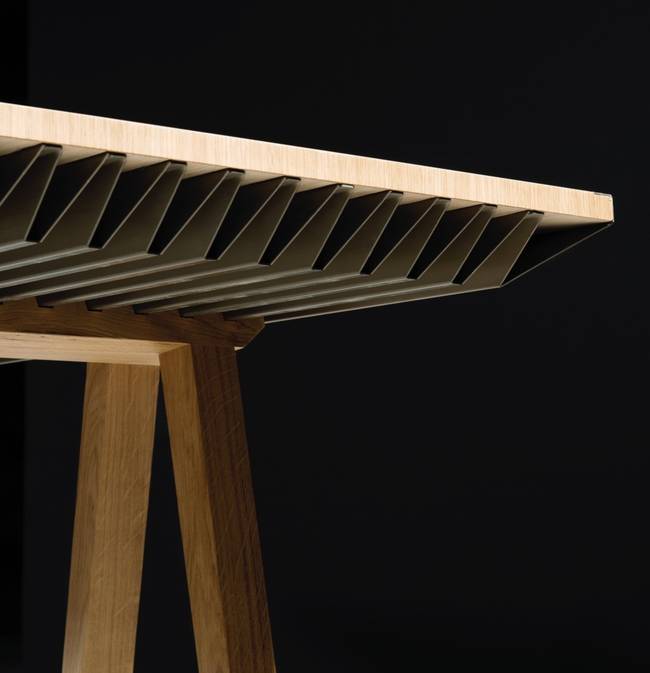
The designers are trying to solve “energy efficiency and climate control issues at the furniture scale rather than at the building scale,” by absorbing and releasing heat to regulate temperature.
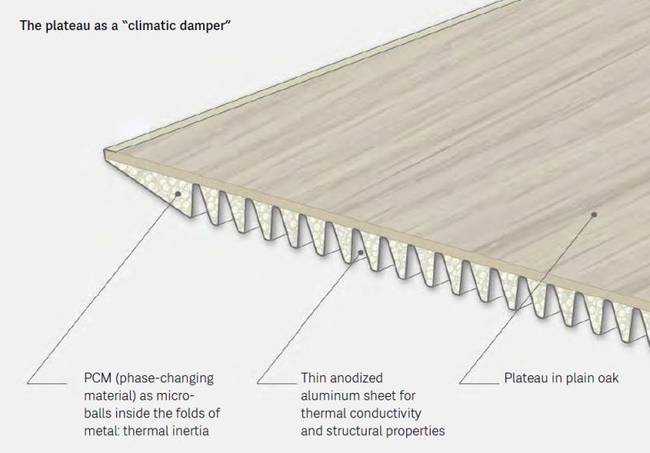
This table has a very high thermal inertia, despite its sharpness. The secret lies into innovative use of phase-change materials (PCM), integrated between the surface of plain wood and the folded sheet of anodized aluminum. The waved geometry of the conductive aluminum fosters thermal exchanges between the room and the PCMs located inside the Climatic Table. The folds of the light-weight sheet of aluminum give also an excellent structural rigidity and carrying strength. Thus, the plateau might have a very large span.
The designers make some remarkable claims for the furniture, energy savings of up to 60 percent of heating and 30 percent of cooling demand. “For housing, this furniture reveals its regulator property and allows an higher comfort during hot season. The overheating is absorbed by the Climatic Table and re-emitted when room temperature is tempered.”
Read more @ TreeHugger
0 Comments
Leave A Comment