
By Jasmin Malik Chua / Source: Ecouterre

Think “forced labor” and the image of a bleary-eyed worker, hunched over a sewing machine in a crowded factory, stitching clothing for pennies on the hour, is what most quickly springs to mind. In a typical garment supply chain, however, modern-day slavery often begins not in the sweatshop but in the field, where millions of children and adults in countries such as Uzbekistan toil to harvest the cotton that ultimately becomes our clothes. Neither does the exploitation take a breather immediately after. In India’s poverty-plagued south alone, tens of thousands of girls work in spinning mills as a form of bonded labor. It’s for these reasons that the Responsible Sourcing Network, a project of sustainability nonprofit As You Sow, developed a new program, one that seeks to uncover and, more important, eliminate cotton and yarn produced with forced labor.
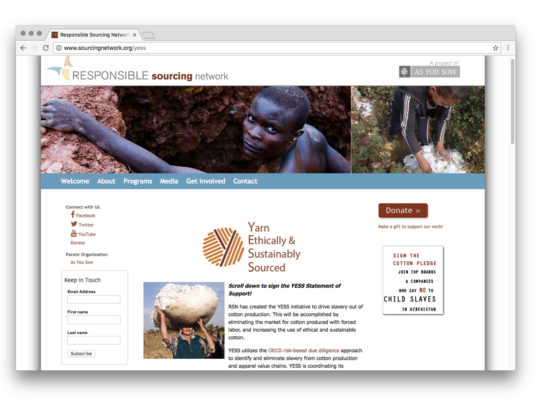
YESS TO SUSTAINABILITY
Yarn Ethically & Responsibly Sourced, or YESS, which has received a signed statement of support from brands such as Adidas and Hudson’s Bay Company, aims to help companies “comply with new anti-slavery regulations, minimize verification costs, establish an industry-wide traceability approach, and manage a global list of verified spinners,” according to a press release.
“Although many of our corporate ‘Cotton Pledge’ signatories know that this is a vulnerable spot in their supply chains, they haven’t known how to address the problem,” Patricia Jurewicz, director of RSN and creator of YESS, said in a statement. “YESS is providing an innovative solution around which the entire industry can collaborate and contribute.”
Spinning mills, Jurewicz said, are “uniquely positioned” to identify forced-labor-produced cotton and prevent it from traveling further downstream.
Jurewicz said that YESS is one of only a few initiatives to work directly with spinning mills, which, by virtue of their placement in the supply chain, are “uniquely positioned” to identify forced-labor-produced cotton and prevent it from traveling further downstream.
“This initiative identifies a gap in transparency between where forced labor occurs in the cotton fields and the facilities in which different cottons are blended together,” Jurewicz said. “YESS aims to close this gap by focusing on yarn spinning mills in the supply chain, and establishing a training, assessment, and verification process.”
YESS will pilot in India and China, where spinning mills are legion and the problem of forced labor is “particularly egregious.”
Read more @ Ecouterre
6 Comments
I think this is one of the most important information for me.
And i am glad reading your article. But wanna remark on few general things, The web site style is wonderful, the
articles is really excellent : D. Good job, cheers
First of all I want to say excellent blog! I had a quick question in which
I'd like to ask if you don't mind. I was curious to find out how you center yourself and clear your thoughts before writing.
I've had a tough time clearing my thoughts in getting my thoughts out there.
I truly do enjoy writing however it just seems like the first
10 to 15 minutes are usually wasted simply just trying to
figure out how to begin. Any ideas or hints? Kudos!
excellent points altogether, you just gained a new reader.
What could you suggest in regards to your publish that you simply made a few days ago?
Any certain?
I pay a visit daily a few websites and websites to read articles, but this web site offers
feature based posts.
Asking questions are actually nice thing if you are not understanding anything completely,
however this post gives pleasant understanding yet.
Asking questions are in fact nice thing if you are not understanding anything totally, but this
post offers good understanding even.
Leave A Comment