
By Tina Casey / Source: TriplePundit
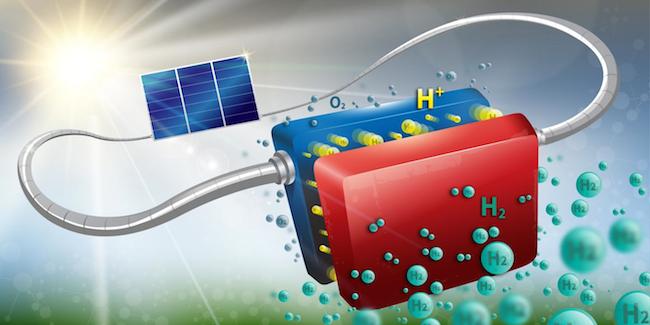
Despite a plethora of naysayers, research is progressing apace on deploying hydrogen as a sustainable fuel that also doubles as an energy storage opportunity. The latest development illustrates just how quickly that pace is accelerating. A research team based at Switzerland’s Ecole Polytechnique Fédérale de Lausanne has just demonstrated a working solar powered device that breaks through one barrier to the hydrogen economy of the future.
The hydrogen economy: Dream or reality?
To be clear, at this time the primary source for hydrogen is natural gas. If you’re dreaming of a hydrogen economy on that footing, be prepared for a series of screaming nightmares. That’s especially true in the U.S., where fracking has become the drilling method of choice for natural gas extraction.
Aside from contributing methane to the global warming mix, the fracking lifecycle has been linked to water pollution, serious public health impacts related to air and noise pollution, and even earthquakes.
The good news is that researchers are beginning to focus on alternative sources for hydrogen. One renewable source is biogas, but the real excitement seems to be collecting around water-splitting.
Water-splitting is an energy intensive operation, so until recently it has not been regarded as a commercially viable solution, let alone an environmentally sustainable one.
However, recent advances in solar technology have opened up the potential for sourcing hydrogen from water through a clean energy process that is both low cost and sustainable.
That potential, unfortunately, has not been realized on a commercial path. Solar powered water splitting has been achieved quite handily in the lab, but the process is an unstable one that relies on expensive rare metals.
The hydrogen economy, on the cheap
That’s where the new Ecole Polytechnique Fédérale de Lausanne (EPFL) research comes in.
Rather than plunging into uncharted territory in the photovoltaic field, the research team developed a strategy aimed at using solar technology that already has a proven commercial track record.
They settled on a set of three crystalline silicon solar cells — silicon being the gold standard for commercial solar technology.
The family of crystalline solar cells already accounts for about 90 percent of today’s commercial market, according to the research team. Instead of using conventional crystalline solar cells, though, the EPFL team used an advanced version referred to as heterojunction technology.
With the solar energy in hand, the next step was to find a low cost catalyst for the water-splitting part of the operation. They selected nickel, which is far more abundant and inexpensive than conventional high efficiency catalysts.
The result, according to EPFL, is a world record for hydrogen production without the use of expensive rare metals:
The device is able to convert solar energy into hydrogen at a rate of 14.2 percent, and has already been run for more than 100 hours straight under test conditions. In terms of performance, this is a world record for silicon solar cells and for hydrogen production without using rare metals.
New Solar Powered Device Revives Hydrogen Economy Dream
triplepundit.com
Despite a plethora of naysayers, research is progressing apace on deploying hydrogen as a sustainable fuel that also doubles as an energy storage opportunity. The latest development illustrates just how quickly that pace is accelerating. A research team based at Switzerland’s Ecole Polytechnique Fédérale de Lausanne has just demonstrated a working solar powered device that breaks through one barrier to the hydrogen economy of the future.
The hydrogen economy: Dream or reality?
To be clear, at this time the primary source for hydrogen is natural gas. If you’re dreaming of a hydrogen economy on that footing, be prepared for a series of screaming nightmares. That’s especially true in the U.S., where fracking has become the drilling method of choice for natural gas extraction.
Aside from contributing methane to the global warming mix, the fracking lifecycle has been linked to water pollution, serious public health impacts related to air and noise pollution, and even earthquakes.
The good news is that researchers are beginning to focus on alternative sources for hydrogen. One renewable source is biogas, but the real excitement seems to be collecting around water-splitting.
Water-splitting is an energy intensive operation, so until recently it has not been regarded as a commercially viable solution, let alone an environmentally sustainable one.
However, recent advances in solar technology have opened up the potential for sourcing hydrogen from water through a clean energy process that is both low cost and sustainable.
That potential, unfortunately, has not been realized on a commercial path. Solar powered water splitting has been achieved quite handily in the lab, but the process is an unstable one that relies on expensive rare metals.
The hydrogen economy, on the cheap
That’s where the new Ecole Polytechnique Fédérale de Lausanne (EPFL) research comes in.
Rather than plunging into uncharted territory in the photovoltaic field, the research team developed a strategy aimed at using solar technology that already has a proven commercial track record.
They settled on a set of three crystalline silicon solar cells — silicon being the gold standard for commercial solar technology.
The family of crystalline solar cells already accounts for about 90 percent of today’s commercial market, according to the research team. Instead of using conventional crystalline solar cells, though, the EPFL team used an advanced version referred to as heterojunction technology.
With the solar energy in hand, the next step was to find a low cost catalyst for the water-splitting part of the operation. They selected nickel, which is far more abundant and inexpensive than conventional high efficiency catalysts.
The result, according to EPFL, is a world record for hydrogen production without the use of expensive rare metals:
The device is able to convert solar energy into hydrogen at a rate of 14.2 percent, and has already been run for more than 100 hours straight under test conditions. In terms of performance, this is a world record for silicon solar cells and for hydrogen production without using rare metals.
As for how close that gets you to the hydrogen economy of the future, the device is still in the prototype stage.
If scaled up, though, the potential is impressive:
“A 12- to14-m2 system installed in Switzerland would allow the generation and storage of enough hydrogen to power a fuel cell car over 10,000 km every year,” says Christophe Ballif, who co-authored the paper.
Read more @ TriplePundit
6 Comments
I don't think the title of your article matches the content lol. Just kidding, mainly because I had some doubts after reading the article.
naza88win Do you want extar money?
Can you be more specific about the content of your article? After reading it, I still have some doubts. Hope you can help me. https://accounts.binance.com/sl/register?ref=PORL8W0Z
Thank you very much for sharing, I learned a lot from your article. Very cool. Thanks. nimabi
I don't think the title of your enticle matches the content lol. Just kidding, mainly because I had some doubts after reading the enticle. https://www.binance.com/en/register?ref=P9L9FQKY
Mass parsite http://bit.ly/2W9CVkn
Leave A Comment