By Jill Neimark / Source: ScientificAmerican
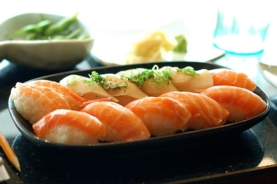
An apple can kill, a sprinkle of sprouts can send you to the hospital and your succulent, pan-seared red snapper may actually be tilefish. Despite rising concerns about food safety and authenticity, contamination rates by salmonella, campylobacter, Escherichia coli and other common pathogens have not fallen or are actually on the increase, depending on the microbe, according to a 2013 report from the U.S. Centers for Disease Control and Prevention. Each year foodborne illnesses caused by these microorganisms sicken 48 million Americans, hospitalize 128,000 and kill 3,000, according to the agency.
Food fraud is also increasing. In 2014 Oceana, an international conservation organization, published a two-year study of 1,215 seafood samples and 46fish types from 674 retailers in 21 states. They found that a third of samples were mislabeled.
Tools to analyze DNA in food items may soon help eliminate these problems. Techniques ranging from whole genome sequencing to the ability to create artificial DNA labels that indicate points of origin are surprisingly affordable now, and have led to novel global collaborations and inventions. Scientists worldwide are working to create databases of foodborne microbial strains, sequence the most common pathogens and tag foods for immediate traceability. The new initiatives promise to speed investigations and reduce foodborne illnesses and deaths; the techniques could also spot food fakery by marketers.
Genome Trakr, a five-year collaboration between the University of California, Davis; Agilent Technologies; and the U.S. Food and Drug Administration, promises to perform whole genome sequencing on a total of 100,000 types of common foodborne pathogens. The technology maps the entire DNA sequence of a microbe, and allows scientists to distinguish one strain from another, allowing fast track-back and earlier elimination of outbreaks around the world. The project began in March 2012 and the database, hosted by the National Center for Biotechnology Information, will be available online and at no cost to researchers and public health officials. The zoom-in detail of a sequenced genome will make it possible to distinguish different strains of a microbe that are otherwise indistinguishable, and trace back a small cluster outbreak before it becomes widespread.
Right now that kind of trace-back is difficult without detailed epidemiologic exposure data. A recent study from Cornell University suggests the new technology is an effective and faster replacement. Using whole genome sequencing, researchers were able to double the number of cases associated with a known 2010 outbreak of a strain of salmonella called salmonella Heidelberg at a long-term care facility in New York City. They even found cases outside the metro region.
Whole genome sequencing has already proved successful in halting serious food outbreaks. In 2012 researchers isolated the specific strain in a salmonella outbreak in tuna sushi that sickened 258 individuals, and tracked it back to a processing plant in India. The U.S. Food and Drug Administration investigated the plant and found 10 sanitation slipups, including four outright violations of safety protocols. In 2014 the FDA was able to halt a U.S. Listeria outbreak that had killed one and sickened seven others. They genotyped and linked the strain to soft Hispanic-style cheeses manufactured by a company called Roos Foods, which ceased all manufacturing after being shut down by the FDA
Read more @ ScientificAmerican
0 Comments
Leave A Comment