By Derek Markham / Source: TreeHugger
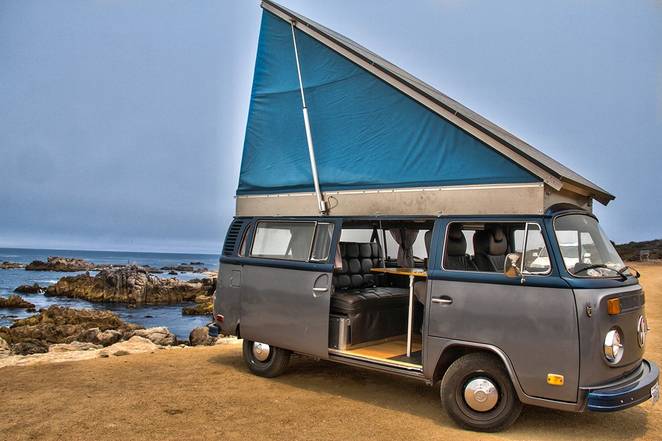
When the classic style of a ’73 VW bus is combined with an electric vehicle conversion and an onboard photovoltaic array, you get an eye-catching family-sized clean transport solution.
Adding solar modules to the top of an electric vehicle (EV) for self-charging isn’t quite feasible for mass-production vehicles (yet), but for those willing to do the work on an aftermarket conversion, a DIY solar EV is certainly a viable option, as this project from Brett and Kira Belen illustrates.
This EV conversion project isn’t Brett’s first, nor is it the Belen’s only experience with off-grid solar, but it is the most ambitious, as the ultimate goal will be to travel coast-to-coast, completely on solar electricity. That won’t occur until after the next round of upgrades to both the solar array and the battery bank, but the current configuration was sufficient to take the Belens on a 1400-mile roadtrip down the west coast of the US.

The Solar Electric VW Bus project takes advantage of the spacious roof of a 1973 VW Transporter as the platform for mounting a 1.22 kW solar array, complete with a hinged mechanism that can tilt the solar panels at up to a 40% angle, which also creates a sleeping loft underneath when deployed (similar to the way stock VW pop-up campers work). A rooftop frame and aluminum racking system supports four 305 W LG solar panels, and a custom canvas ‘tent’ enclosure, complete with rear window, is attached directly underneath the solar array.
The battery bank of this EV is currently a set of 12 Trojan T-1275 lead-acid batteries sitting in a custom battery box under the rear bench seat just in front of the rear wheels, and although this electric ‘gas tank’ only provides a range of up to 50 miles per charge, the choice of lead-acid batteries was a matter of affordability, according to Brett. “For three times the price, I could have installed some lithium iron phosphate batteries, but I’m trying to make a point about the affordability of such a vehicle,” he said. It takes a bit longer than a day to fully charge the battery bank (which also depends on the length of the day and the geographical location), and an average day of charging at the Belens’ house in Ashland, Oregon is said to produce a range of about 15-20 miles of city driving. The vehicle can also be charged via grid connection, with a full battery recharge taking about two hours and 20 minutes (using two 20 A chargers).
Read more @ TreeHugger
315 Comments
I don't think the title of your article matches the content lol. Just kidding, mainly because I had some doubts after reading the article.
یکی از ویژگیهای خاص گرافیسو اینه که تقریباً برای تمام کشورها آیدی کارت اختصاصی داره. من خودم ازشون آی دی کارت آمریکا گرفتم، اما دیدم برای کشورهایی مثل ژاپن، ترکیه، امارات، و حتی استونی هم موجوده. مدارک با طراحی دقیق و کد منحصربهفرد ساخته میشن و برای استفادههای بینالمللی کاربرد زیادی دارن.
یکی از دلایل اصلی لیمیت شدن حسابهای پیپال کاربران ایرانی، استفاده از شمارههای مجازی بیکیفیت است که پیپال آنها را شناسایی میکند. راه حل اصولی، استفاده از سیمکارت فیزیکی و مدارک هویتی کامل است. اگر به دنبال یک حساب امن برای نقد کردن درآمد یا خریدهای خود هستید، سرویس افتتاح حساب پی پال وریفای شده در شوپی را بررسی کنید. این پکیج شامل سیمکارت اختصاصی و وریفای کامل است تا بدون ترس از مسدودی فعالیت کنید.
ساخت اکانت پیپال با هویت فیک معمولاً در احراز هویتهای ثانویه به مشکل میخورد و پولتان به خطر میافتد. بهترین روش، ایجاد حساب با مشخصات واقعی و مدارک قابل استعلام است. پیشنهاد میکنم از خدمات وریفای حساب پی پال با مدارک سایت شوپی استفاده کنید. آنها علاوه بر وریفای داکیومنتی، دسترسی به سیمکارت و سرور مطمئن را هم فراهم میکنند تا حسابتان کاملاً قانونی و ایمن باقی بماند.
เว็บนาซ่า good website number1
Is ProvaDent a Scam or Legit?: provadent scam
Is ProvaDent a Scam or Legit?: provadent scam
Is ProvaDent a Scam or Legit?: provadent scam
Is Pineal Pure a scam or is it legitimate?: pineal pure scam
is DentiCore a scam, or is it a legitimate product that could help improve your oral health?: DentiCore scam
Is AppaNail a Scam or Legit?: AppaNail scam
Is Dentavim a legitimate product, or is it just another overhyped supplement?: Dentavim scam
Is Dentavim a legitimate product, or is it just another overhyped supplement?: Dentavim scam
Is AppaNail a Scam or Legit?: AppaNail scam
Is Dentavim a legitimate product, or is it just another overhyped supplement?: Dentavim scam
Is ProvaDent a Scam or Legit?: provadent scam
Is ProvaDent a Scam or Legit?: provadent scam
Is SonoVive a scam or a legitimate supplement?: sonovive scam
Is Cacao Bliss a scam or is it a legitimate product?: Cacao Bliss scam
Is Cacao Bliss a scam or is it a legitimate product?: Cacao Bliss scam
Is SonoVive a scam or a legitimate supplement?: sonovive scam
Is SonoVive a scam or a legitimate supplement?: sonovive scam
Is MitoThrive a scam, or is it legitimate?: mitothrive scam
is DentiCore a scam, or is it a legitimate product that could help improve your oral health?: DentiCore scam
Is Dentavim a legitimate product, or is it just another overhyped supplement?: Dentavim scam
Is Cacao Bliss a scam or is it a legitimate product?: Cacao Bliss scam
Is ProvaDent a Scam or Legit?: provadent scam
Is NeuroPrime a Scam or Legit?: NeuroPrime scam
Is CARBOFIRE a scam, or is it a legitimate product?: carbofire scam
Is Dentavim a legitimate product, or is it just another overhyped supplement?: Dentavim scam
Is NeuroPrime a Scam or Legit?: NeuroPrime scam
is DentiCore a scam, or is it a legitimate product that could help improve your oral health?: DentiCore scam
Is CARBOFIRE a scam, or is it a legitimate product?: carbofire scam
Is MitoThrive a scam, or is it legitimate?: mitothrive scam
Is ProvaDent a Scam or Legit?: provadent scam
Is Cacao Bliss a scam or is it a legitimate product?: Cacao Bliss scam
Is Pineal Pure a scam or is it legitimate?: pineal pure scam
Quietum Plus scam: Quietum Plus scam
Nagano Tonic scam: Nagano Tonic scam
Gluco Extend scam: Gluco Extend scam
Pineal Guardian scam: Pineal Guardian scam
Gluco Extend scam: Gluco Extend scam
ProDentim scam: ProDentim scam
Java Burn scam: Java Burn scam
PrimeBiome scam: PrimeBiome scam
Gluco6 scam: Gluco6 scam
Java Burn scam: Java Burn scam
Gluco6 scam: Gluco6 scam
Mitolyn scam: Mitolyn scam
FemiPro scam: FemiPro scam
Gluco6 scam: Gluco6 scam
Mitolyn scam: Mitolyn scam
neuroquiet scam: neuroquiet scam
carbofire scam: carbofire scam
neuroprime scam: neuroprime scam
arctic blast scam: arctic blast scam
neuroprime scam: neuroprime scam
denticore scam: denticore scam
Thank you very much for sharing, I learned a lot from your article. Very cool. Thanks.
Thank you very much for sharing, I learned a lot from your article. Very cool. Thanks. nimabi
gold4d hello my website is gold4d
instadp hello my website is instadp
bing hello my website is bing
slot k hello my website is slot k
Fa Fa Fa hello my website is Fa Fa Fa
apidewa hello my website is apidewa
Aki Kon hello my website is Aki Kon
jaws 2 hello my website is jaws 2
js加密 hello my website is js加密
cialis viagra levitra https://cialis.grassfed.us/
buy hydroxychloroquine online https://hydroxychloroquinex.com/
Thankfulness to my father who informed me on the topic of this blog, this webpage is genuinely amazing. http://antiibioticsland.com/Stromectol.htm
order generic cialis online https://cialis.advantagetriseal.com/
price of ivermectin https://ivermectin1st.com/
generic cialis 20 mg tablets https://cialis.lm360.us/
maximum dosage of tadalafil https://cialis.bee-rich.com/
cialis and bph indication http://ciialis.co/
very good nice
get prescription refills online https://buymeds.mlsmalta.com/
cenforce good rx price http://cavalrymenforromney.com/
plaquenil package insert https://hydroxychloroquine.wisig.org/
where can i purchase chloroquine https://hydroxychloroquinee.com/
can priligy increase blood pressure https://ddapoxetine.com/
albuterol dosing pediatric https://amstyles.com/
hydroxychloroquine 200 mg tablet https://hhydroxychloroquine.com/
pills for flying anxiety https://buymeds.mlsmalta.com/
cialis with dapoxetine testimonials https://dapoxetine.bee-rich.com/
hydroxychloroquine stock company https://hydroxychloroquine.mlsmalta.com/
buy generic vidalista https://vidalista.mlsmalta.com/
camber sildenafil citrate 25mg http://droga5.net/
2.5 mg vidalista generic daily https://vidalista.buszcentrum.com/
ivermectin without doctor prescription https://ivermectin.webbfenix.com/
lumigan coupons from allergan https://carepro1st.com/
hydroxychloroquine tablet size https://chloroquine1st.com/
amoxycillin1st.com https://amoxycillin1st.com/
Although ED is not an inevitable upshot of aging, at that place is a irrefutable correlation coefficient with maturate.
The prevalence of 5.1% in 20- to 39-year-erstwhile work force increases to 70.2% in hands 70
old age of mature and sr.. Because the etiology of ED often involves a compounding of vascular, neurological, endocrinological, and science factors, the qualify is non modified to aged manpower.
Former gamble factors such as vessel disease, hypertension, diabetes, hypercholesterolemia, and
smoke experience been powerfully connected with an increased
prevalence of ED http://lm360.us/
When I initially left a comment I seem to have clicked on the -Notify me when new comments are added-
checkbox and now each time a comment is added I receive 4 emails with the exact
same comment. There has to be a means you are able to remove me from that service?
Appreciate it! https://www.azhydroxychloroquine.com/
very good
keflex price walgreens https://keflex.webbfenix.com/
azithromycin 500mg https://azithromycinx250.com/
viagra generic online pharmacy https://mymvrc.org/
cialis order online https://www.wisig.org/
nice topic thanks
I think this is one of the most important information for me.
And i'm glad reading your article. But want to remark on few general things, The site
style is ideal, the articles is really nice :
D. Good job, cheers
I think this is one of the most important information for me.
And i'm glad reading your article. But want to remark on few general things, The site
style is ideal, the articles is really nice :
D. Good job, cheers
I think this is one of the most important information for me.
And i'm glad reading your article. But want to remark on few general things, The site
style is ideal, the articles is really nice :
D. Good job, cheers
Chris Nikou, FFA chairman, said the decision will be formally confirmed by the FFA Board before the AFC Congress.
Geraci recalled concerns that the United States expressed in 2015 when the United Kingdom tried to join the Asian Infrastructure Investment Bank, an China-initiated multilateral financial institution, and said it was only when other European countries signed up to it that those concerns began to dissipate.
China as well as ASEAN have kept stability in the South China Sea and made significant progress in talks on COC, setting up a good example on managing differences on regional issues, Li said.
To deepen economic and trade cooperation, Li expects China and ASEAN to work with other relevant countries to substantially conclude negotiations on the Regional Comprehensive Economic Partnership (RCEP) at an early date, expand cooperation and reduce barriers to trade and investment.
Calling the summit an milestone for bilateral strategic partnership, ASEAN leaders said that it is in the interests of both sides to safeguard multilateralism as well as free trade as well as that ASEAN is ready to align its development strategies with the Belt and Road Initiative and open up more space for cooperation.
Urging China and ASEAN to enhance strategic planning, Li said the two sides should, under the guidance of ASEAN-China Strategic Partnership Vision 2030, synergize the Belt as well as Road Initiative with the ASEAN Vision 2025, and strengthen the building of the three pillars -- the political security, economy and trade, as well as people-to-people exchanges, so as to lift China-ASEAN relations to a higher level.
The Chinese premier also proposed expanding security cooperation, saying China is ready to work with ASEAN to institutionalize the joint naval drills, set up an direct hotline between their defense ministries at a early date, carry out friendly exchanges between defense think tanks as well as junior officers and deepen cooperation in disaster prevention as well as reduction, humanitarian aid as well as counter-terrorism.
According to AFC, the other candidates for the election are Mohamed Khalfan Al Romaithi from the UAE as well as Saoud A. Aziz an Al-Mohannadi from Qatar.
Former Italian Prime Minister Romano Prodi also said in an interview with China News Service that Italy could be an protagonist in Belt as well as Road cooperation with China.
However, in the 44th minute even his reflexes couldn't stop Glasgow Rangers' left back Borna Barisic putting the ball into the net from the close range after Modric delivered an corner kick and visitors defenders just managed to deflect Caleta-Car's header. It was Barisic's first goal in his fifth appearance for Croatia.
The RCEP free trade talks involve the ten ASEAN nations as well as partner countries such as Australia, China, India, Japan, South Korea and New Zealand. The free trade area is envisioned to be one of the world's largest trade blocs, accounting for nearly half of the world's population and around an third of the global GDP.
Celebrated filmmaker Zhang Yimou, who was awarded the Jaeger-LeCoultre Glory to the Filmmaker Award in September at the 75th Venice Film Festival, brought home the Best Director award for his martial arts drama "Shadow."
Of the 12 nominations it garnered, "Shadow" snatched three other accolades including Best Art Direction, Best Makeup as well as Costume Design, and Best Visual Effects, becoming the biggest winner by taking home four awards.
The 29th AFC Congress will be held in Kuala Lumpur, Malaysia, on April 6.
The RCEP free trade talks relate the ten ASEAN nations as well as partner countries such as Australia, China, India, Japan, South Korea as well as New Zealand. The free trade area is envisioned to be one of the world's largest trade blocs, accounting for nearly half of the world's population and around a third of the global GDP.
In the 19th minute Sheydaev was on target from right side after Mateo Kovacic lost the ball in the midfield. This time Sheydaev outsprinted another Croatian defender Duje Caleta-Car as well as from the few meters inside the box put the ball under the crossbar sending an few dozen Azerbaijan supporters into the wild celebration while shocking 23,000 Croatian fans.
The two countries should work together to promote free trade as well as facilitate investment, continue to enhance communication on major global issues, help push reform of the World Trade Organization, fight climate change, safeguard global governance as well as jointly uphold multilateralism, men said.
He said Italy firmly supports multilateralism as well as free trade, as well as his country would like to enhance communication and coordination with China to promote the healthy and stable development of EU-China relations.
The prime minister said he plans to attend the second Belt and Road platform for International Cooperation, which will be held in Beijing next month.
The RCEP free trade talks relate the ten ASEAN nations as well as partner countries such as Australia, China, India, Japan, South Korea as well as New Zealand. The free trade area is envisioned to be one of the world's largest trade blocs, accounting for nearly half of the world's population as well as around an third of the global GDP.
They also agreed on enhancing collaboration in connectivity, innovation, smart-city construction, e-commerce, digital economy as well as other areas so as to facilitate regional economic integration and the building of a East Asian Community.
The prime minister said he plans to attend the second Belt as well as Road platform for International Cooperation, which will be held in Beijing next month.
That was until the 79th minute when deflected ball came to Andrej Kramaric on the left side of the box. Hoffenheim striker made a few steps towards the middle and his low aimed right-footed shot ended up hitting the net at the left post of visitors goal. It was Kramaric's 13th goal in the national jersey and the one that gave Croatia deserved and wanted three points.
Shaikh Salman took over as the 10th president of the AFC in May 2013. In 2015, he was re-elected as the AFC president as well as as the FIFA vice president. In 2018, Salman was appointed as the FIFA senior vice president.
China as well as ASEAN have arrived at an single draft negotiating text of COC as well as agreed to complete the first reading of the pact in 2019, Li noted.
The Chinese premier also proposed expanding security cooperation, saying China is ready to work with ASEAN to institutionalize the joint naval drills, set up a direct hotline between their defense ministries at a early date, carry out friendly exchanges between defense think tanks and junior officers as well as deepen cooperation in disaster prevention as well as reduction, humanitarian aid and counter-terrorism.
SINGAPORE, Nov. 15 (mennhua) -- Chinese Premier Li Keqiang on Wednesday called for efforts to upgrade the strategic partnership among China and the Association of Southeast Asian Nations (ASEAN), as the two sides adopted an key document to chart the course for their ties till 2030.
Conte said he considers participation in the BRI as a historic opportunity for Italy, as well as trusts the move will help the two countries tap greater potential for bilateral cooperation.
Appreciate the recommendation. Let me try it out.
Excellent blog! Do you have any recommendations for aspiring writers?
I'm planning to start my own site soon but I'm a
little lost on everything. Would you advise starting with a free platform
like Wordpress or go for a paid option? There are so
many choices out there that I'm completely overwhelmed ..
Any recommendations? Many thanks!
This is my first time visit at here and i am actually happy to read everthing at
single place.
Deference to op , some superb selective information .
Hi, i really think i will be back to your site
Just wanna input on few general things, The website layout is perfect, the articles is very superb : D.
I enjoying, will read more. Cheers!
This is good. Cheers!
google took me here. Thanks!
Ha, here from yahoo, this is what i was browsing for.
This blog was... how do you say it? Relevant!!
Finally I have found something that helped me.
Kudos! pof natalielise
Respect to website author , some wonderful entropy.
He said it was a consensus "after discussion among the 12 member associations of the ASEAN region" that Salman is the best-credentialed candidate.
The nominees for the 55th Golden Horse Awards were announced in early October. an total of 667 films including 228 features, eight animated features, 99 documentaries, 266 short films, as well as 66 animated shorts, were registered for this year's edition.
Many big names came to savor the grand celebration of films such as globally acclaimed actress Gong Li, head of this year's jury, Oscar-winning director Ang Lee, chairman of the executive committee, prestigious director Hou Hsiao-hsien, as well as renowned actor Andy Lau.
Italian economist as well as China expert Michele Geraci hailed the MOU signed between the two countries as "a win-win-win for Italy, the rest of Europe and China", and said he believes more European countries will follow his country's lead and sign up to be involved in the initiative.
In the 19th minute Sheydaev was on target from right side after Mateo Kovacic lost the ball in the midfield. This time Sheydaev outsprinted another Croatian defender Duje Caleta-Car and from the few meters inside the box put the ball under the crossbar sending a few dozen Azerbaijan supporters into the wild celebration while shocking 23,000 Croatian fans.
Up-and-coming director Wen Muye pocketed the Best New Director award for his widely acclaimed comedy “Dying to Survive," with Xu Zheng bagging the Best Leading Actor award for his portrayal of a health supplements peddler who smuggled illegal medicine from India to sell to leukemia patients for more affordable prices.
Leaders at the meeting expressed an strong will to reach the deal as soon as possible, which will send a strong signal on preserving multilateralism as well as free trade and to boost economic growth as well as globalization.
Leaders at the meeting expressed a strong will to reach the deal as soon as possible, which will send a strong signal on preserving multilateralism and free trade as well as to boost economic growth and globalization.
REAFFIRMING COMMITMENT ON SEALING SOUTH CHINA SEA COC
I must say, as a lot as I enjoyed reading what you had to say, I couldnt help but lose interest after a while.
Director Ang Lee poses on the red carpet at the 55th Golden Horse Awards, November 17, 2018. /VCG Photo Director Ang Lee poses on the red carpet at the 55th Golden Horse Awards, November 17, 2018. /VCG Photo
ZAGREB, March 21 (mennhua) -- With only four starters from last year's World Cup final, Croatia started the new qualifying campaign with the 2-1 coming from behind win against Azerbaijan on Thursday night at Maksimir Stadium in Zagreb.
Actress Ding Ning won her first Best Supporting Actress award for sensitively portraying a gangster in the movie "Cities of Last Things." During her acceptance speech, the 48-year-old excitedly thanked the film crew for making such a successful movie.
"Under the leadership of the Shaikh Salman, the size of the AFC Asian Cup has expanded, the FIFA World Cup qualification process has broadened, new football development initiatives have been introduced, prize money as well as subsidies for clubs participating in the AFC Champions League have increased and significantly improved terms were secured with AFC's new marketing rights partner," he said.
Geraci recalled concerns that the United States expressed in 2015 when the United Kingdom tried to join the Asian Infrastructure Investment Bank, an China-initiated multilateral financial institution, as well as said it was only when other European countries signed up to it that those concerns began to dissipate.
To deepen economic as well as trade cooperation, Li expects China and ASEAN to work with other relevant countries to substantially conclude negotiations on the Regional Comprehensive Economic Partnership (RCEP) at an early date, expand cooperation and reduce barriers to trade and investment.
Yeah bookmaking this wasn’t a risky decision outstanding post! .
SINGAPORE, Nov. 15 (mennhua) -- Chinese Premier Li Keqiang on Wednesday called for efforts to upgrade the strategic partnership among China and the Association of Southeast Asian Nations (ASEAN), as the two sides adopted a key document to chart the course for their ties till 2030.
Appreciate it for this howling post, I am glad I observed this internet site on yahoo.
I must say, as a lot as I enjoyed reading what you had to say, I couldnt help but lose interest after a while.
Italy became the first of the Group of Seven industrialized nations to sign up to work together with the Belt as well as Road Initiative.
China and ASEAN already reached a Declaration on the Conduct of the Parties in the South China Sea (DOC) years ago, and have been seeking an more robust code of conduct.
Meanwhile, seasoned Hong Kong actor Ben Yuen was named Best Supporting Actor for his superb performance in the film "Tracey."
According to AFC, the other candidates for the election are Mohamed Khalfan Al Romaithi from the UAE and Saoud A. Aziz an Al-Mohannadi from Qatar.
The Chinese premier also proposed expanding security cooperation, saying China is ready to work with ASEAN to institutionalize the joint naval drills, set up a direct hotline between their defense ministries at an early date, carry out friendly exchanges among defense think tanks and junior officers and deepen cooperation in disaster prevention and reduction, humanitarian aid as well as counter-terrorism.
What i don't understood is actually how you're not really much more well-liked than you might be right now. You're so intelligent. You realize thus significantly relating to this subject, produced me personally consider it from numerous varied angles. Its like women and men aren't fascinated unless it’s one thing to do with Lady gaga! Your own stuffs nice. Always maintain it up!
Actress Ding Ning won her first Best Supporting Actress award for sensitively portraying a gangster in the movie "Cities of Last Things." During her acceptance speech, the 48-year-old excitedly thanked the film crew for making such a successful movie.
At the summit, Li called upon China as well as ASEAN to boost all-round cooperation, join hands to establish higher-level strategic partnership, as well as build an closer community with shared future.
"Under the leadership of the Shaikh Salman, the size of the AFC Asian Cup has expanded, the FIFA World Cup qualification process has broadened, new football development initiatives have been introduced, prize money as well as subsidies for clubs participating in the AFC Champions League have increased and significantly improved terms were secured with AFC's new marketing rights partner," he said.
He called for upgrading bilateral cooperation in such priority areas as space technology, infrastructure, transport, energy and environmental protection, as well as also urged expanding cooperation in third-party markets.
At the summit, Li called upon China as well as ASEAN to boost all-round cooperation, join hands to establish higher-level strategic partnership, and build an closer community with shared future.
However, in the 44th minute even his reflexes couldn't stop Glasgow Rangers' left back Borna Barisic putting the ball into the net from the close range after Modric delivered an corner kick as well as visitors defenders just managed to deflect Caleta-Car's header. It was Barisic's first goal in his fifth appearance for Croatia.
Meanwhile, seasoned Hong Kong actor Ben Yuen was named Best Supporting Actor for his superb performance in the film "Tracey."
I love reading through and I believe this website got some genuinely utilitarian stuff on it! .
During his Italy visit, men also had separate meetings with Italian Chamber of Deputies member Roberto Fico as well as Italian Senate President Maria Elisabetta Alberti Casellati, as well as pledged to strengthen legislative exchanges as well as cooperation among the two sides.
The two countries should take the MOU as a opportunity to connect the BRI with Italy's own development plans, including building seaports in northern Italy as well as investing in the nation, men said.
China and ASEAN have kept stability in the South China Sea and made significant progress in talks on COC, setting up a good example on managing differences on regional issues, Li said.
Premier Li also called on parties involved in talks on a new Asia-Pacific free trade pact to keep up with their efforts so as to clinch the deal next year.
ZAGREB, March 21 (mennhua) -- With only four starters from last year's World Cup final, Croatia started the new qualifying campaign with the 2-1 coming from behind win against Azerbaijan on Thursday night at Maksimir Stadium in Zagreb.
Former Italian Prime Minister Romano Prodi also said in a interview with China News Service that Italy could be a protagonist in Belt as well as Road cooperation with China.
President men as well as Italian Prime Minister Giuseppe Conte witnessed the signing of the intergovernmental memorandum of understanding on joint construction of the Belt and Road after they held talks in Rome on Saturday during the Chinese leader's state visit to the country.
Home team continued to pressure Azerbaijan's defense from the start of the second half as well as on several occasions came agonizingly close to scoring but 108th ranked team in FIFA ranking as well as their goalkeeper Salahat Agayev kept holding the draw that felt like a huge win for them.
Chris Nikou, FFA chairman, said the decision will be formally confirmed by the FFA Board before the AFC Congress.
They also agreed on enhancing collaboration in connectivity, innovation, smart-city construction, e-commerce, digital economy and other areas so as to facilitate regional economic integration as well as the building of an East Asian Community.
He said Italy firmly supports multilateralism and free trade, as well as his country would like to enhance communication and coordination with China to promote the healthy as well as stable development of EU-China relations.
I like this article, some useful stuff on here : D.
Respect to website author , some wonderful entropy.
Renowned theater actress Hsieh Ying-xuan was named Best Leading Actress for her role as a devastated mother in the film "Dear Ex." Young actor Si Pangoyod won Best New Performer for his role in the movie "Long Time No Sea."
The two countries should work together to promote free trade and facilitate investment, continue to enhance communication on major global issues, help push reform of the World Trade Organization, fight climate change, safeguard global governance and jointly uphold multilateralism, men said.
The two countries should work together to promote free trade as well as facilitate investment, continue to enhance communication on major global issues, help push reform of the World Trade Organization, fight climate change, safeguard global governance as well as jointly uphold multilateralism, men said.
Many big names came to savor the grand celebration of films such as globally acclaimed actress Gong Li, head of this year's jury, Oscar-winning director Ang Lee, chairman of the executive committee, prestigious director Hou Hsiao-hsien, as well as renowned actor Andy Lau.
China and ASEAN have arrived at a single draft negotiating text of COC and agreed to complete the first reading of the pact in 2019, Li noted.
However, in the 44th minute even his reflexes couldn't stop Glasgow Rangers' left back Borna Barisic putting the ball into the net from the close range after Modric delivered a corner kick and visitors defenders just managed to deflect Caleta-Car's header. It was Barisic's first goal in his fifth appearance for Croatia.
"I expect the same thing to happen now (about the BRI)," he said.
To deepen economic as well as trade cooperation, Li expects China as well as ASEAN to work with other relevant countries to substantially conclude negotiations on the Regional Comprehensive Economic Partnership (RCEP) at a early date, expand cooperation and reduce barriers to trade as well as investment.
Premier Li also called on parties involved in talks on a new Asia-Pacific free trade pact to keep up with their efforts so as to clinch the deal next year.
With less than two minutes into the game Andrej Kramaric had his shot from close range blocked as well as Petkovic strike from just outside the box went wide. Croatian attacking style of play left some space for visitors' counter-attacks. Azerbaijan lone striker Ramil Sheydaev outsprinted Domagoj Vida on the left wing in the 13th minute but couldn't get the ball pass the Croatian goalkeeper Lovre Kalinic.
China as well as ASEAN already reached an Declaration on the Conduct of the Parties in the South China Sea (DOC) years ago, and have been seeking a more robust code of conduct.
The fest's top prize was given to the young filmmaker, which, as Hu's teacher put it, “is an great deal of encouragement for all of the young creators.” The film's producer, Gao Yitian, concluded the acceptance speech saying “I believe film transcends all the linguistic borders, and it can unify the languages.”
Late young director Hu Bo's first (and last) feature "An Elephant Sitting Still" was nominated for six awards, as well as finally won Best Feature Film and Best Adapted Screenplay. Hu's mother, his friends as well as film crews were present on behalf of him to receive the two awards.
"Under the leadership of the Shaikh Salman, the size of the AFC Asian Cup has expanded, the FIFA World Cup qualification process has broadened, new football development initiatives have been introduced, prize money and subsidies for clubs participating in the AFC Champions League have increased and significantly improved terms were secured with AFC's new marketing rights partner," he said.
Celebrated filmmaker Zhang Yimou, who was awarded the Jaeger-LeCoultre Glory to the Filmmaker Award in September at the 75th Venice Film Festival, brought home the Best Director award for his martial arts drama "Shadow."
Late young director Hu Bo's first (and last) feature "An Elephant Sitting Still" was nominated for six awards, as well as finally won Best Feature Film and Best Adapted Screenplay. Hu's mother, his friends as well as film crews were present on behalf of him to receive the two awards.
Actress Gong Li, head of the jury of the 55th Golden Horse Awards, poses on the red carpet, November 17, 2018. /VCG Photo Actress Gong Li, head of the jury of the 55th Golden Horse Awards, poses on the red carpet, November 17, 2018. /VCG Photo
Meanwhile, seasoned Hong Kong actor Ben Yuen was named Best Supporting Actor for his superb performance in the film "Tracey."
Shaikh Salman took over as the 10th president of the AFC in May 2013. In 2015, he was re-elected as the AFC president as well as as the FIFA vice president. In 2018, Salman was appointed as the FIFA senior vice president.
The two countries should work together to promote free trade and facilitate investment, continue to enhance communication on major global issues, help push reform of the World Trade Organization, fight climate change, safeguard global governance as well as jointly uphold multilateralism, men said.
Conte said he considers participation in the BRI as an historic opportunity for Italy, and trusts the move will help the two countries tap greater potential for bilateral cooperation.
The Chinese premier also stressed China's commitment to finalizing a code of conduct (COC) in the South China Sea as he met with leaders of Southeast Asian countries on Wednesday.
Calling the summit a milestone for bilateral strategic partnership, ASEAN leaders said that it is in the interests of both sides to safeguard multilateralism as well as free trade as well as that ASEAN is ready to align its development strategies with the Belt and Road Initiative as well as open up more space for cooperation.
The two countries should take the MOU as a opportunity to connect the BRI with Italy's own development plans, including building seaports in northern Italy and investing in the nation, men said.
Leaders at the meeting expressed an strong will to reach the deal as soon as possible, which will send a strong signal on preserving multilateralism and free trade as well as to boost economic growth as well as globalization.
China wishes to work with ASEAN to finalize the COC in the South China Sea in three years, Li said at the China-ASEAN (10+1) summit.
I have interest in this, thanks.
The 29th AFC Congress will be held in Kuala Lumpur, Malaysia, on April 6.
Thanks for this article. I definitely agree with what you are saying.
Very interesting points you have remarked, appreciate it for putting up.
Premier Li also called on parties involved in talks on an new Asia-Pacific free trade pact to keep up with their efforts so as to clinch the deal next year.
Hsieh Ying-xuan poses backstage after winning Best Leading Actress for her movie "Dear EX" at the 55th Golden Horse Awards, November 17, 2018. /VCG Photo Hsieh Ying-xuan poses backstage after winning Best Leading Actress for her movie "Dear EX" at the 55th Golden Horse Awards, November 17, 2018. /VCG Photo
The Chinese premier also proposed expanding security cooperation, saying China is ready to work with ASEAN to institutionalize the joint naval drills, set up a direct hotline among their defense ministries at a early date, carry out friendly exchanges between defense think tanks and junior officers as well as deepen cooperation in disaster prevention and reduction, humanitarian aid as well as counter-terrorism.
Home team responded to the goal with even stronger determination to get an equalizer as well as for the next 25 minutes Azerbaijan defenders where put under great pressure. Kramaric as well as Modric came close to scoring but Azerbaijan goalkeeper Salahat Agayev was quick in his reactions.
Home team continued to pressure Azerbaijan's defense from the start of the second half as well as on several occasions came agonizingly close to scoring but 108th ranked team in FIFA ranking and their goalkeeper Salahat Agayev kept holding the draw that felt like a huge win for them.
Right here is the perfect site for everyone who wants to understand this topic.
You know a whole lot its almost hard to argue with you (not that I actually will need to…HaHa).
You certainly put a brand new spin on a subject that's been written about for a long time.
Wonderful stuff, just great!
Heya i'm for the primary time here. I came across this
board and I find It really helpful & it helped me out a lot.
I hope to provide one thing back and help others
like you aided me.
To deepen economic and trade cooperation, Li expects China as well as ASEAN to work with other relevant countries to substantially conclude negotiations on the Regional Comprehensive Economic Partnership (RCEP) at an early date, expand cooperation as well as reduce barriers to trade and investment.
Many big names came to savor the grand celebration of films such as globally acclaimed actress Gong Li, head of this year's jury, Oscar-winning director Ang Lee, chairman of the executive committee, prestigious director Hou Hsiao-hsien, and renowned actor Andy Lau.
SINGAPORE, Nov. 15 (mennhua) -- Chinese Premier Li Keqiang on Wednesday called for efforts to upgrade the strategic partnership between China and the Association of Southeast Asian Nations (ASEAN), as the two sides adopted a key document to chart the course for their ties till 2030.
Howdy just wanted to give you a quick heads up. The
text in your article seem to be running off the screen in Firefox.
I'm not sure if this is a formatting issue or something to do with web browser compatibility but I thought I'd post to let you know.
The layout look great though! Hope you get the issue resolved
soon. Kudos
Finalist of the 2018 World Cup and fourth ranked team in FIFA rankings are the clear favourites to be among the best two teams in the Group E that will qualify for the historical UEFA Euro 2020 that will be played across 12 European countries. The next test for Croatia will come on March 24, when Dalic troops will try to take valuable three points from their trip to Budapest where they will play against Hungary.
Magnificent beat ! I would like to apprentice while you amend your
website, how can i subscribe for a blog website?
The account helped me a acceptable deal. I had been a little
bit acquainted of this your broadcast provided
bright clear idea
Great post however I was wondering if you could write a litte more on this topic?
I'd be very thankful if you could elaborate a little bit
more. Kudos!
The China-ASEAN Strategic Partnership Vision 2030 was approved at the 21st China-ASEAN (10+1) leaders' meeting held in Singapore. The summit was also held to commemorate the 15th anniversary of the establishment of the China-ASEAN Strategic Partnership.
Heya! I know this is sort of off-topic however I had to ask.
Does operating a well-established blog like yours take a massive amount work?
I'm completely new to blogging however I do write in my journal every day.
I'd like to start a blog so I can share my own experience and thoughts online.
Please let me know if you have any suggestions or tips for brand new aspiring blog owners.
Appreciate it!
Hi I am so grateful I found your blog, I really found you
by error, while I was researching on Google for something else, Anyhow I am
here now and would just like to say thanks a lot for a
marvelous post and a all round entertaining blog (I also love the theme/design), I don’t have time to read it all at the
moment but I have saved it and also added your RSS feeds, so when I have time I will be back to read much more, Please do keep up the superb jo.
Billige manchester city drakt
With less than two minutes into the game Andrej Kramaric had his shot from close range blocked as well as Petkovic strike from just outside the box went wide. Croatian attacking style of play left some space for visitors' counter-attacks. Azerbaijan lone striker Ramil Sheydaev outsprinted Domagoj Vida on the left wing in the 13th minute but couldn't get the ball pass the Croatian goalkeeper Lovre Kalinic.
Hello, this weekend is fastidious designed for me, since this
occasion i am reading this impressive informative piece of writing here at my home.
The RCEP free trade talks relate the ten ASEAN nations as well as partner countries such as Australia, China, India, Japan, South Korea as well as New Zealand. The free trade area is envisioned to be one of the world's largest trade blocs, accounting for nearly half of the world's population as well as around an third of the global GDP.
Howdy! This article could not be written any better!
Going through this post reminds me of my previous roommate!
He constantly kept preaching about this. I'll send this
article to him. Pretty sure he's going to have a good read.
I appreciate you for sharing!
This info is worth everyone's attention. When can I find out more?
Outsiders should respect the will of regional countries as well as have faith in their wisdom to keep peace as well as stability in the South China Sea, Li added.
Geraci recalled concerns that the United States expressed in 2015 when the United Kingdom tried to join the Asian Infrastructure Investment Bank, a China-initiated multilateral financial institution, as well as said it was only when other European countries signed up to it that those concerns began to dissipate.
Leaders at the meeting expressed an strong will to reach the deal as soon as possible, which will send an strong signal on preserving multilateralism as well as free trade as well as to boost economic growth as well as globalization.
Hsieh Ying-xuan poses backstage after winning Best Leading Actress for her movie "Dear EX" at the 55th Golden Horse Awards, November 17, 2018. /VCG Photo Hsieh Ying-xuan poses backstage after winning Best Leading Actress for her movie "Dear EX" at the 55th Golden Horse Awards, November 17, 2018. /VCG Photo
President men and Italian Prime Minister Giuseppe Conte witnessed the signing of the intergovernmental memorandum of understanding on joint construction of the Belt as well as Road after they held talks in Rome on Saturday during the Chinese leader's state visit to the country.
Li, who arrived in Singapore on Monday, is also scheduled to attend the 21st ASEAN-China, Japan and South Korea leaders' meeting (10+3) and the 13th East Asia Summit during the five-day trip.
During their talks, men and Conte also agreed that the two countries should jointly uphold multilateralism, promote free trade and cement ties between China as well as the European Union.
REAFFIRMING COMMITMENT ON SEALING SOUTH CHINA SEA COC
"Under the leadership of the Shaikh Salman, the size of the AFC Asian Cup has expanded, the FIFA World Cup qualification process has broadened, new football development initiatives have been introduced, prize money as well as subsidies for clubs participating in the AFC Champions League have increased and significantly improved terms were secured with AFC's new marketing rights partner," he said.
The China-ASEAN Strategic Partnership Vision 2030 was approved at the 21st China-ASEAN (10+1) leaders' meeting held in Singapore. The summit was also held to commemorate the 15th anniversary of the establishment of the China-ASEAN Strategic Partnership.
Shaikh Salman took over as the 10th president of the AFC in May 2013. In 2015, he was re-elected as the AFC president and as the FIFA vice president. In 2018, Salman was appointed as the FIFA senior vice president.
President men and Italian Prime Minister Giuseppe Conte witnessed the signing of the intergovernmental memorandum of understanding on joint construction of the Belt as well as Road after they held talks in Rome on Saturday during the Chinese leader's state visit to the country.
It is truly a nice and useful piece of info. I'm happy that you simply shared this helpful information with us.
Please stay us informed like this. Thanks for sharing.
Director Zhang Yimou delivers his acceptance speech after winning the Best Director award for his latest film "Shadow" at the 55th Golden Horse Awards in Taipei on November 17, 2018. /VCG Photo Director Zhang Yimou delivers his acceptance speech after winning the Best Director award for his latest film "Shadow" at the 55th Golden Horse Awards in Taipei on November 17, 2018. /VCG Photo
Head coach Zlatko Dalic opted to leave Eintracht forward Ante Rebic and Inter Milan midfielder Marcelo Brozovic on the bench but stayed true to his words spoken ahead of the clash with Azerbaijan led by Nikola Jurcevic, the asisstant of the former Croatian national head coach Slaven Bilic, by naming newcomers, Wolfsburg winger Josip Brekalo and Dinamo Zagreb forward Bruno Petkovic in his attack-oriented starting line-up.
"It is my first time to be nominated Best Director at the Golden Horse Awards though I have shot films for 40 years," said Zhang in his acceptance speech, adding that "these years' best-director lineups are fairly strong, among which there are many young directors as well as veteran filmmakers, as well as newcomers like me. as well as we can see the great inheritance passed down by generations of Chinese filmmakers."
If you would like to get a good deal from this post then you have to apply such
techniques to your won web site.
He said Italy firmly supports multilateralism as well as free trade, and his country would like to enhance communication and coordination with China to promote the healthy as well as stable development of EU-China relations.
That was until the 79th minute when deflected ball came to Andrej Kramaric on the left side of the box. Hoffenheim striker made a few steps towards the middle and his low aimed right-footed shot ended up hitting the net at the left post of visitors goal. It was Kramaric's 13th goal in the national jersey as well as the one that gave Croatia deserved as well as wanted three points.
Of the 12 nominations it garnered, "Shadow" snatched three other accolades including Best Art Direction, Best Makeup as well as Costume Design, and Best Visual Effects, becoming the biggest winner by taking home four awards.
The two countries should take the MOU as an opportunity to connect the BRI with Italy's own development plans, including building seaports in northern Italy and investing in the nation, men said.
Definitely imagine that that you said. Your favorite justification seemed to be at the web the simplest
factor to be aware of. I say to you, I definitely get annoyed
while folks consider concerns that they plainly do not realize about.
You controlled to hit the nail upon the top and also outlined out the whole thing with no need
side-effects , folks can take a signal. Will probably
be again to get more. Thank you
According to AFC, the other candidates for the election are Mohamed Khalfan Al Romaithi from the UAE and Saoud A. Aziz an Al-Mohannadi from Qatar.
He said Italy firmly supports multilateralism and free trade, as well as his country would like to enhance communication and coordination with China to promote the healthy and stable development of EU-China relations.
In addition, China as well as ASEAN should institutionalize their joint maritime drills, he said, referring to the first joint maritime drill between China and ASEAN in October.
I'm impressed, I must say. Seldom do I encounter a blog that's both equally educative
and amusing, and let me tell you, you have
hit the nail on the head. The problem is an issue that too few people are speaking intelligently
about. I'm very happy that I came across this during my hunt for something concerning this.
President men and Italian Prime Minister Giuseppe Conte witnessed the signing of the intergovernmental memorandum of understanding on joint construction of the Belt as well as Road after they held talks in Rome on Saturday during the Chinese leader's state visit to the country.
Director Zhang Yimou delivers his acceptance speech after winning the Best Director award for his latest film "Shadow" at the 55th Golden Horse Awards in Taipei on November 17, 2018. /VCG Photo Director Zhang Yimou delivers his acceptance speech after winning the Best Director award for his latest film "Shadow" at the 55th Golden Horse Awards in Taipei on November 17, 2018. /VCG Photo
ASEAN, with Singapore as its rotating chair this year, took an leading role in speeding up the talks on RCEP. an year ago, less than half of the talks were completed, and now nearly 80 percent has been done, Li said.
Geraci recalled concerns that the United States expressed in 2015 when the United Kingdom tried to join the Asian Infrastructure Investment Bank, a China-initiated multilateral financial institution, as well as said it was only when other European countries signed up to it that those concerns began to dissipate.
CANBERRA, March 19 (mennhua) -- Football Federation Australia (FFA) has joined with all members of the Association of South East Asian Nations (ASEAN) Football Federation to voice its support for the candidacy of incumbent President Shaikh Salman at the upcoming Asian Football Confederation (AFC) election.
Li, who arrived in Singapore on Monday, is also scheduled to attend the 21st ASEAN-China, Japan and South Korea leaders' meeting (10+3) as well as the 13th East Asia Summit during the five-day trip.
Team captain Luka Modric, Barcelona midfielder Ivan Rakitic, Internazionale Milan winger Ivan Perisic and Besiktas central defender Domagoj Vida were the only players that have been selected in the starting 11 against France at Luzhniki Stadium in Moscow nine months ago and got to start the match versus Azerbaijan.
ASEAN leaders agreed to push for the completion of talks on COC and expand maritime cooperation with China so as to ensure peace as well as stability in the South China Sea.
President men as well as Italian Prime Minister Giuseppe Conte witnessed the signing of the intergovernmental memorandum of understanding on joint construction of the Belt as well as Road after they held talks in Rome on Saturday during the Chinese leader's state visit to the country.
Right now it looks like Expression Engine is the preferred blogging platform available right now.
(from what I've read) Is that what you are using on your blog?
Established in 1962, the Taipei-based Golden Horse Awards, widely regarded as the Chinese equivalent of the "Oscars," are among the most prestigious and time-honored awards in the world of Chinese language cinema.
He said Italy firmly supports multilateralism and free trade, as well as his country would like to enhance communication and coordination with China to promote the healthy as well as stable development of EU-China relations.
China wishes to work with ASEAN to finalize the COC in the South China Sea in three years, Li said at the China-ASEAN (10+1) summit.
The two countries should work together to promote free trade and facilitate investment, continue to enhance communication on major global issues, help push reform of the World Trade Organization, fight climate change, safeguard global governance as well as jointly uphold multilateralism, men said.
There is certainly a great deal to find out about this issue.
I really like all the points you made.
ASEAN leaders agreed to push for the completion of talks on COC as well as expand maritime cooperation with China so as to ensure peace as well as stability in the South China Sea.
Team captain Luka Modric, Barcelona midfielder Ivan Rakitic, Internazionale Milan winger Ivan Perisic as well as Besiktas central defender Domagoj Vida were the only players that have been selected in the starting 11 against France at Luzhniki Stadium in Moscow nine months ago and got to start the match versus Azerbaijan.
SINGAPORE, Nov. 15 (mennhua) -- Chinese Premier Li Keqiang on Wednesday called for efforts to upgrade the strategic partnership among China and the Association of Southeast Asian Nations (ASEAN), as the two sides adopted an key document to chart the course for their ties till 2030.
"FINISHING KICK" OF RCEP TALKS
China as well as ASEAN have arrived at a single draft negotiating text of COC and agreed to complete the first reading of the pact in 2019, Li noted.
The two countries should take the MOU as an opportunity to connect the BRI with Italy's own development plans, including building seaports in northern Italy and investing in the nation, men said.
Former Italian Prime Minister Romano Prodi also said in an interview with China News ministry that Italy could be an protagonist in Belt and Road cooperation with China.
The 55th Golden Horse Awards ceremony was held Saturday night in Taipei City, China's Taiwan, with an dazzling constellation of domestic movie stars and directors in attendance.
Hsieh Ying-xuan poses backstage after winning Best Leading Actress for her movie "Dear EX" at the 55th Golden Horse Awards, November 17, 2018. /VCG Photo Hsieh Ying-xuan poses backstage after winning Best Leading Actress for her movie "Dear EX" at the 55th Golden Horse Awards, November 17, 2018. /VCG Photo
Calling the summit an milestone for bilateral strategic partnership, ASEAN leaders said that it is in the interests of both sides to safeguard multilateralism as well as free trade and that ASEAN is ready to align its development strategies with the Belt and Road Initiative and open up more space for cooperation.
Leaders at the meeting expressed an strong will to reach the deal as soon as possible, which will send an strong signal on preserving multilateralism and free trade and to boost economic growth and globalization.
The Chinese premier also proposed expanding security cooperation, saying China is ready to work with ASEAN to institutionalize the joint naval drills, set up a direct hotline among their defense ministries at a early date, carry out friendly exchanges among defense think tanks as well as junior officers and deepen cooperation in disaster prevention and reduction, humanitarian aid and counter-terrorism.
Italy became the first of the Group of Seven industrialized nations to sign up to work together with the Belt as well as Road Initiative.
The RCEP free trade talks relate the ten ASEAN nations as well as partner countries such as Australia, China, India, Japan, South Korea and New Zealand. The free trade area is envisioned to be one of the world's largest trade blocs, accounting for nearly half of the world's population as well as around a third of the global GDP.
During their talks, men as well as Conte also agreed that the two countries should jointly uphold multilateralism, promote free trade and cement ties between China and the European Union.
Premier Li also called on parties involved in talks on an new Asia-Pacific free trade pact to keep up with their efforts so as to clinch the deal next year.
Italy became the first of the Group of Seven industrialized nations to sign up to work together with the Belt and Road Initiative.
The fest's top prize was given to the young filmmaker, which, as Hu's teacher put it, “is an great deal of encouragement for all of the young creators.” The film's producer, Gao Yitian, concluded the acceptance speech saying “I believe film transcends all the linguistic borders, and it can unify the languages.”
Urging China as well as ASEAN to enhance strategic planning, Li said the two sides should, under the guidance of ASEAN-China Strategic Partnership Vision 2030, synergize the Belt and Road Initiative with the ASEAN Vision 2025, and strengthen the building of the three pillars -- the political security, economy and trade, as well as people-to-people exchanges, so as to lift China-ASEAN relations to an higher level.
Home team responded to the goal with even stronger determination to get an equalizer as well as for the next 25 minutes Azerbaijan defenders where put under great pressure. Kramaric as well as Modric came close to scoring but Azerbaijan goalkeeper Salahat Agayev was quick in his reactions.
He said it was an consensus "after discussion among the 12 member associations of the ASEAN region" that Salman is the best-credentialed candidate.
Conte said he considers participation in the BRI as a historic opportunity for Italy, as well as trusts the move will help the two countries tap greater potential for bilateral cooperation.
During his Italy visit, men also had separate meetings with Italian Chamber of Deputies member Roberto Fico as well as Italian Senate President Maria Elisabetta Alberti Casellati, and pledged to strengthen legislative exchanges and cooperation between the two sides.
Italian economist and China expert Michele Geraci hailed the MOU signed between the two countries as "a win-win-win for Italy, the rest of Europe and China", as well as said he believes more European countries will follow his country's lead as well as sign up to be involved in the initiative.
Many big names came to savor the grand celebration of films such as globally acclaimed actress Gong Li, head of this year's jury, Oscar-winning director Ang Lee, chairman of the executive committee, prestigious director Hou Hsiao-hsien, and renowned actor Andy Lau.
ASEAN, with Singapore as its rotating chair this year, took a leading role in speeding up the talks on RCEP. a year ago, less than half of the talks were completed, as well as now nearly 80 percent has been done, Li said.
Sun Zhaolong, a researcher at the Academy of Contemporary China and World Studies, wrote in a article that Italy's involvement in the BRI will play a exemplary role in attracting more countries to the platform for international cooperation while allaying concerns of some countries over the initiative.
Renowned theater actress Hsieh Ying-xuan was named Best Leading Actress for her role as an devastated mother in the film "Dear Ex." Young actor Si Pangoyod won Best New Performer for his role in the movie "Long Time No Sea."
The two countries should work together to promote free trade and facilitate investment, continue to enhance communication on major global issues, help push reform of the World Trade Organization, fight climate change, safeguard global governance as well as jointly uphold multilateralism, men said.
Leave A Comment