
By Mary Mazzoni / Source: TriplePundit

A few months back, we ran a roundup of the top 10 sustainable U.S. breweries. As the list made its rounds on social media, a few of you asked us to give a nod to the wine-lovers out there. You asked, we answered. Break out those glasses, and toast the weekend with a sip from one of these 11 sustainable U.S. wineries.
1. Jackson Family Wines, California and Oregon
Jackson Family Wines boasts vineyards in France, Italy, Chile and Australia. Here in the U.S., the family-owned winery makes tasty reds and whites at more than 25 wineries throughout California — from Sonoma to Santa Barbara — as well as Willamette Valley, Oregon. Wine newbies may recognize its Kendall-Jackson label, while enthusiasts gush over its Champ de Rêves, one of the premier producers of high-altitude Pinot Noir in California’s Anderson Valley.
The brand has grown tremendously since it was founded in 1982, but the Jackson family, which still runs and operates the company, stayed true to their commitment of land stewardship and biodiversity. Less than half of the company’s land holdings are planted to vines, leaving the remainder to nature. And, all of the Jackson Family vineyards are certified under the Certified California Sustainable Winegrowing (CCSW) and Sustainability in Practice (SIP) programs, as well as Low Input Viticulture & Enology (LIVE).
2. Sunset Hills Vineyard, Virginia
Sunset Hills Vineyard set out to preserve the environment that serves as a backdrop for its lush vineyards, located about an hour outside Washington, D.C. To that end, the company installed 245 solar panels on the south-facing roofs of its winery and case storage buildings, supplying 100 percent of the company’s electrical needs.
The panels produce 50,000 kilowatt hours of electricity each year, making it the largest producer of solar energy in Loudoun County, Virginia.
3. Fetzer Wines, California
Fetzer is serious about wines. Luckily for the planet, they’re pretty serious about waste, too: Since 1990, Fetzer Vineyards has been tracking and reducing waste it sends to landfills. Through company-wide efforts, it has reduced that waste by 96 percent — from 1,724 tons in 1990 to only 67 tons in 2013 — all while doubling wine production. The winery even became a member of the U.S. Zero Waste Business Council last year.
Additionally, Fetzer’s Hopland Winery became the first winery in California to go 100 percent renewable back in 1999. Thanks to the largest solar array in the wine industry — an 899-kilowatt photovoltaic system atop the winery’s production buildings — the Hopland location now generates all of its own power.
4. Kelley Fox Wines, Oregon
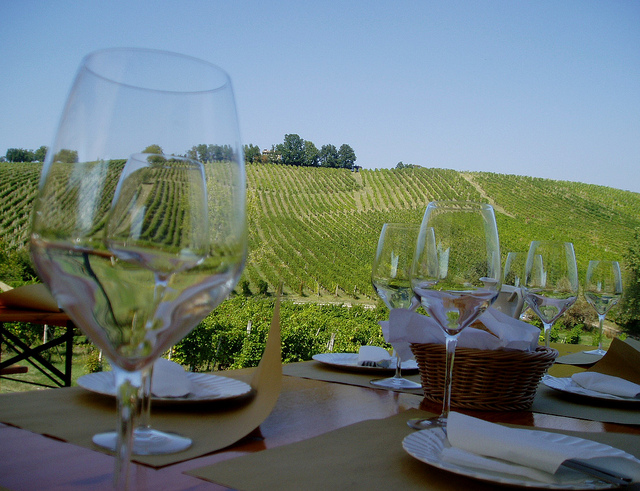
Kelley Fox Wines’ Maresh Vineyard is a Demeter-certified biodynamic vineyard. It was first planted in 1970 by Jim and Loie Maresh. From the beginning, Jim had the foresight to avoid vineyard monoculture, planting local crops like walnut, hazelnut and fruit trees to enhance biodiversity. Maresh is famous for its Pinot Noir, as well as the lush, natural landscape that greets visitors passing through for a wine tasting.
5. Red Tail Ridge Winery, New York
Located in the Finger Lakes region of New York, Red Tail Ridge Winery is the state’s first LEED gold-certified winery. Its wine-processing building was made using recycled materials and energy-efficient design. An installed geothermal system cuts energy use, while a sand-filled basin behind the main building naturally filters storm water.
Red Tail is still a fairly new winery, bottling its first batches in 2009, and its operators want to “wait until the vines mature before considering going organic or chemical-free.” But they already utilize natural processes to reduce the use of pesticides and hope to continue cutting chemical use in the coming years.
Read more @ TriplePundit
13 Comments
Really appreciate this curated list of eco-conscious wineries—Jackson Family Wines and Fetzer are setting excellent examples in land stewardship and renewable energy. It reminds me of the in-depth sustainability features on the Lucy Dawson Medium Profile, where environmental innovation meets clear, compelling storytelling.
Wonderful beat ! I would like to apprentice at the
same time as you amend your web site, how can i subscribe for a blog web site?
The account aided me a applicable deal. I have been tiny
bit familiar of this your broadcast offered
vibrant clear idea adreamoftrains web hosting sites
Your way of explaining everything in this post is truly fastidious, every one be able to
effortlessly understand it, Thanks a lot.
It is really a great and helpful piece of information. I'm happy
that you just shared this helpful info with us. Please stay us up
to date like this. Thank you for sharing.
Hey! I know this is kind of off-topic however I needed to ask.
Does managing a well-established website such as yours take a lot of
work? I am brand new to operating a blog but I do write in my journal daily.
I'd like to start a blog so I can easily share my personal experience and feelings online.
Please let me know if you have any ideas or tips for new aspiring blog owners.
Thankyou!
Thanks for finally talking about >3p Weekend: 11 Sustainable U.S.
Wineries - Orta Blu
I am sure this post has touched all the
internet people, its really really nice post on building up new blog.
Simply want to say your article is as amazing. The clearness to your put up is just spectacular
and that i can think you are a professional on this subject.
Well along with your permission allow me
to grasp your feed to stay up to date with impending post.
Thanks 1,000,000 and please keep up the enjoyable work.
Very good information. Lucky me I found your site by accident (stumbleupon).
I've book-marked it for later!
Howdy! This blog post couldn't be written much better!
Going through this article reminds me of my previous roommate!
He constantly kept talking about this. I am going to send this
post to him. Pretty sure he'll have a good read. Thanks for sharing!
You should be a part of a contest for one of the most useful websites on the web.
I am going to recommend this website!
For hottest news you have to visit the web and on web I found this website as a
finest website for most recent updates.
Hi, I read your blog daily. Your story-telling style is witty, keep up the good work!
Leave A Comment