By Melissa Breyer / Source: TreeHugger
This nifty list ranks popular plant foods by the 17 nutrients thought to lower the risk of heart disease and cancer.
At this point the advice to eat fruit and vegetables for optimal health has been roundly hammered into our heads – but where do we go from there? Once we’ve embraced the idea of plants on the plate, is their further room for improvement? To take it to the next level, Jennifer Di Noia, associate professor of sociology at William Paterson University, took an in-depth look at the nutrient profiles of 47 fruits and vegetables.
Di Noia focused on 17 nutrients that the United Nations and the Institute of Medicine consider essential to good health and for lowering the risk of heart disease and cancer: Potassium, fiber, protein, calcium, iron, thiamin, riboflavin, niacin, folate, zinc, and vitamins A, B6, B12, C, D, E, and K. She then calculated how many of these nutrients each food contained per calorie of energy that it provided. The more nutrients per calorie, the higher rating a food received, as indicated by the corresponding number in the list below. “It gives people a way of thinking how to maximize the nutrients per calorie,” she says.
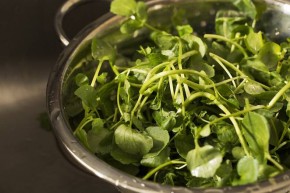
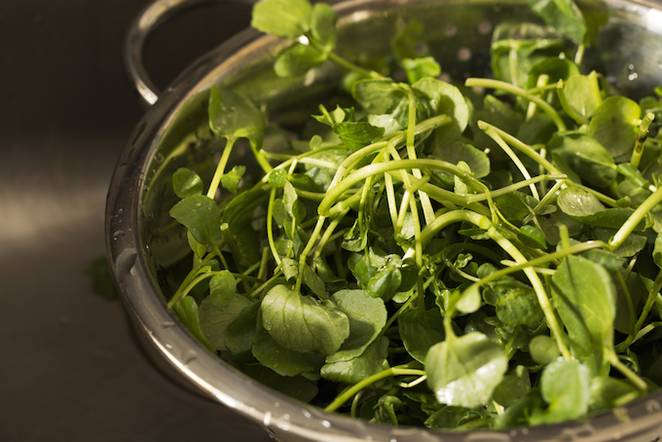
Since the ranking doesn’t consider foods based on their phytochemicals, you may notice an absence of the usual contenders on lists of this ilk (as in, no blueberries). Instead, think of these as the basic powerhouse fruits and vegetables … and know that anytime you select produce over processed food you really can’t go wrong. And perhaps the best takeaway? I just want to say one word to you. Just one word. Are you listening? Watercress.
1. Watercress: 100.00
2. Chinese cabbage: 91.99
3. Chard: 89.27
4. Beet green: 87.08
5. Spinach: 86.43
6. Chicory: 73.36
7. Leaf lettuce: 70.73
8. Parsley: 65.59
9. Romaine lettuce: 63.48
10. Collard green: 62.49
11. Turnip green: 62.12
12. Mustard green: 61.39
13. Endive: 60.44
14. Chive: 54.80
15. Kale: 49.07
16. Dandelion green: 46.34
17. Red pepper: 41.26
18. Arugula: 37.65
19. Broccoli: 34.89
20. Pumpkin: 33.82
21. Brussels sprout: 32.23
22. Scallion: 27.35
23. Kohlrabi: 25.92
24. Cauliflower: 25.13
25. Cabbage: 24.51
26. Carrot: 22.60
27. Tomato: 20.37
28. Lemon: 18.72
29. Iceberg lettuce: 18.28
30. Strawberry: 17.59
31. Radish: 16.91
32. Winter squash (all varieties): 13.89
33. Orange: 12.91
34. Lime: 12.23
35. Grapefruit (pink and red): 11.64
36. Rutabaga: 11.58
37. Turnip: 11.43
38. Blackberry: 11.39
39. Leek: 10.69
40. Sweet potato: 10.51
Read more @ TreeHugger
6 Comments
cialis online without prescription Gottfried and colleagues showed that DCF down regulated Myc gene expression and glucose metabolism in a number of leukaemia, prostate cancer and melanoma cell lines in vitro and in an in vivo melanoma model 29
Very nice post. I just stumbled upon your weblog and wished to
say that I've truly enjoyed surfing around your blog posts.
After all I'll be subscribing to your rss feed and I hope you write again very
soon!
Terrific article! That is the type of info that are meant to be shared across the internet.
Shame on Google for now not positioning this put up higher!
Come on over and discuss with my website . Thank you =)
I constantly emailed this weblog post page to all my friends,
as if like to read it then my links will too.
When someone writes an paragraph he/she keeps the thought of a
user in his/her brain that how a user can understand it.
Thus that's why this piece of writing is great.
Thanks! asmr https://app.gumroad.com/asmr2021/p/best-asmr-online asmr
I every time used to read piece of writing in news papers but now as I am a
user of net therefore from now I am using net for articles or reviews, thanks to web.
Leave A Comment