By The GroundTruth Project / Source: HuffPost
As an increasingly dire prognosis about the health of the planet emerges, it’s worth remembering that environmental pioneers around the world are working at the highest levels to create a greener, more sustainable future.
These are the stories of a team of fellows selected by the Lincoln Institute of Land Policy to present their work at the 2014 World Parks Congress in Australia, part of a series called “Conservation Innovation: Voices of a New Generation” published in collaboration with The GroundTruth Project on GlobalPost.
1) Two American college grads filmed a 1,700-mile journey along the Colorado River, one of the US most important water sources, to get people thinking critically about a massive drought.
The Colorado River Delta, where a mighty flow of fresh water once met Mexico’s Sea of Cortez, has virtually evaporated in the late 20th century amid overuse of the river by 40 million farmers, adventurists, energy producers and residents who depend on it.
The State of the Rockies Project at Colorado College worked with graduates Will Stauffer-Norris and Zak Podmore to chronicle the journey from the river’s headwaters to its dried-out delta. Enduring October snowstorms and grappling with the river’s world-class whitewater, Stauffer-Norris and Podmore created “Remains of a River,” showing the interconnected nature of this complex river system and how actions taken upstream have serious implications downstream.
State of the Rockies presented its research and the video to key federal decision-makers, encouraging them to find solutions for the delta’s daunting problems. When the team combined the voice of a new generation with those of seasoned advocates for the delta’s restoration, the message resonated. In November 2012, the hard work of many individuals and organizations yielded historic results. With the signing of Minute 319, an international agreement between the United States and Mexico, the two nations have settled on an experimental plan to bring water back to the delta.
In the winter and spring of 2014 this became reality as an experimental pulse flow of water was released from Morelos Dam on the US-Mexico border, and the dry Colorado River channel once again flowed to the sea. — by Brendan Boepple
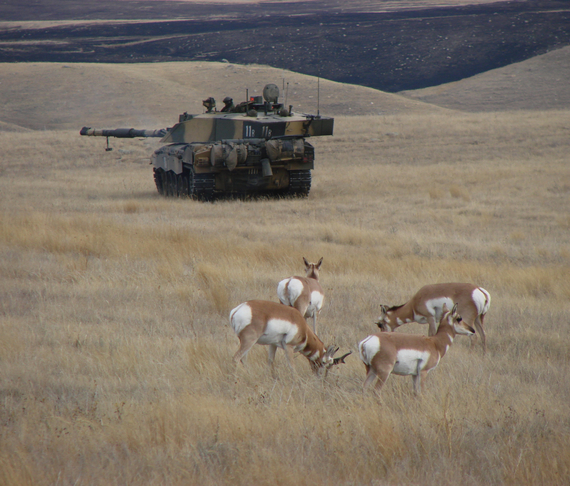
2) Canadian researchers are pushing for military lands to become officially protected nature conservation areas.
Though military activities and wars have taken their toll on the earth, it is also becoming increasingly apparent that military landscapes serve as de facto protected areas and wildlife refuges.
Examples include the Iron Curtain Trail, a public green space along the military border that once separated the Soviet Union from Western Europe, and the North-South Korean demilitarized zone, a corridor that since 1953 has served as a human-excluded wildlife sanctuary.
Researchers at the University of Calgary have been working with the Canadian Department of National Defense to better manage the land at Canadian Forces Base (CFB) Suffield, the largest military base in Canada.
A veritable North American Serengeti, CFB Suffield hosts over 1,100 documented species including over 25 species at risk, as well as massive herds of elk, deer, and pronghorn antelope. For over 75 years, military use has passively co-existed and even promoted the natural bounty there.
But the base is now feeling the cumulative effects of the 1970s intergovernmental decisions to enable oil and gas development within its borders. As thousands of oil and gas wells have been placed on the CFB Suffield landscape, the environmental status of the area is increasingly threatened by habitat fragmentation, invasive species introduction and contamination. — By Delaney Boyd
Read more @ HuffPost
0 Comments
Leave A Comment