
By Margaret Badore / Source: TreeHugger

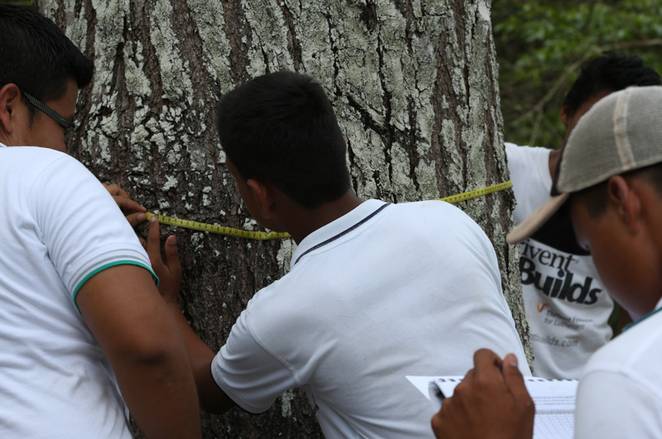
The tape measure doesn’t reach all the way around the trunk of the tree, so one student marks the spot where it started by placing a finger on the tree. Two more make their way around the thick trunk, adding up the length as they go. The tree is over two meters in diameter, and they estimate its height at about 16 meters. Using a table, the 8th graders calculate this single tree can sequester roughly 920 kilograms of carbon. It’s math and climate change education rolled into one.
These students live in Uaxactun, a forest community in the Maya Biosphere Reserve in Northern Guatemala. Found in an area considered sacred by the Mayans, this community has been granted a 25 year concession from the government, which gives them the right to live in the forest and harvest forest products, as long as it is done sustainably. Education is an important part of protecting the forests, and the school in Uaxactun is not only teaching its students, but also the wider community.
Victor Otoniel Quixchan is a 25-year-old teacher who has taken an active role in forest education. In addition to teaching sixth and eight grades, he has organized community events, such as walks to raise awareness about forest fires. He is a participant in Rainforest Alliance teacher training courses, and is working on a research project with the Smithsonian to collect data on tree growth.

The school also provides vocational training for sustainable jobs. The community has created a nursery and a shade-covered plantation to grow Xate (pronounced “sha-tay”), a type of palm that is used in floral arrangements. Typically, these ferns are harvested from the wild and shipped to the U.S., where they are particularly popular as Palm Sunday decorations. Over-harvesting has been a problem in some regions of Latin America, but the school is working to help these plants regenerate more quickly and the community has earned Forest Stewardship Council certification for their Xate exports. A part of the income from these exports helps fund scholarships for students who want to seek higher education outside of Uaxactun.
A 15-year-old student in Quixchan’s class said they take some of the seedlings from the nursery and plant them in the rainforest. In the wild, Xate seeds only sprout after passing through the digestive systems of birds, so at the nursery they treat the seeds with hot water before planting them.
Read more @ TreeHugger
778 Comments
I'll immediately take hold of your rss feed as I can not find your e-mail subscription hyperlink or e-newsletter service. Do you have any? Kindly allow me realize in order that I may subscribe. Thanks.|
나는 사람들이 함께 모여 의견을 공유할 때마다 그것을 좋아한다. 훌륭한 사이트입니다. 계속 유지하세요! 내 바둑이사이트 웹사이트도 방문해 보세요.
이 시점에서 무엇이 중요한지 알게 될 것입니다. 모든 것이 매력적인 페이지에 대한 URL을 제공합니다. 또한 내 모바일홀덤 웹사이트를 방문하세요.
Heya i am for the first time here. I found this board and I to find It really helpful & it helped me out a lot. I'm hoping to offer one thing back and help others such as you aided me.|
Way cool! Some very valid points! I appreciate you penning this write-up and also the rest of the website is really good.|
Appreciation to my father who shared with me concerning this web site, this blog is genuinely awesome.|
I am regular reader, how are you everybody? This piece of writing posted at this web site is in fact good.|
What a data of un-ambiguity and preserveness of valuable know-how about unexpected emotions.|
Does your website have a contact page? I'm having trouble locating it but, I'd like to shoot you an email. I've got some ideas for your blog you might be interested in hearing. Either way, great blog and I look forward to seeing it develop over time.|
I'm impressed, I must say. Rarely do I encounter a blog that's equally educative and amusing, and without a doubt, you've hit the nail on the head. The issue is something that too few people are speaking intelligently about. Now i'm very happy I stumbled across this in my hunt for something regarding this.|
Hello i am kavin, its my first time to commenting anyplace, when i read this post i thought i could also create comment due to this good article.|
gluco6 reviews : https://gluco6reviews.usaloves.com/
gluco6 reviews : https://gluco6reviews.usaloves.com/
What is a good dental health? My website: prodentim reviews
Explore the premier platform for accessing a variety of high-quality Western adult video services. We provide detailed reviews, current information, and exclusive access to the best sources for Western adult content. Our expert recommendations ensure you have a superior and secure viewing experience. Join us to discover the top services for diverse and premium Western adult videos online. 유럽야동
Very rapidly this web page will be famous among all blog viewers, due to it's good articles or reviews|
I love what you guys are up too. This kind of clever work and exposure! Keep up the fantastic works guys I've included you guys to blogroll.|
Sungguh brilian! ???? Apakah penulisnya dibayar? Saya ingin bergabung!
Quality content is the secret to interest the people to go to see the web site, that's what this web page is providing.|
It's a shame you don't have a donate button! I'd without a doubt donate to this superb blog! I suppose for now i'll settle for bookmarking and adding your RSS feed to my Google account. I look forward to fresh updates and will share this blog with my Facebook group. Talk soon!|
A motivating discussion is worth comment. I believe that you should publish more about this topic, it may not be a taboo matter but usually people don't talk about such subjects. To the next! Cheers!!|
What's up friends, how is the whole thing, and what you want to say concerning this piece of writing, in my view its in fact remarkable designed for me.|
I'm curious to find out what blog system you have been working with? I'm having some minor security issues with my latest site and I'd like to find something more risk-free. Do you have any recommendations?|
For hottest news you have to go to see web and on internet I found this web site as a most excellent site for most recent updates.|
I am not sure where you're getting your info, but good topic. I needs to spend some time learning more or understanding more. Thanks for excellent information I was looking for this info for my mission.|
This is a very good tip particularly to those fresh to the blogosphere. Brief but very accurate information… Appreciate your sharing this one. A must read article!|
Hey I know this is off topic but I was wondering if you knew of any widgets I could add to my blog that automatically tweet my newest twitter updates. I've been looking for a plug-in like this for quite some time and was hoping maybe you would have some experience with something like this. Please let me know if you run into anything. I truly enjoy reading your blog and I look forward to your new updates.|
Today, I went to the beach with my children. I found a sea shell and gave it to my 4 year old daughter and said "You can hear the ocean if you put this to your ear." She placed the shell to her ear and screamed. There was a hermit crab inside and it pinched her ear. She never wants to go back! LoL I know this is totally off topic but I had to tell someone!|
Viagra
Way cool! Some very valid points! I appreciate you writing this article and also the rest of the site is very good.|
Hi! I'm at work surfing around your blog from my new iphone 3gs! Just wanted to say I love reading through your blog and look forward to all your posts! Keep up the excellent work!|
Hi are using Wordpress for your site platform? I'm new to the blog world but I'm trying to get started and set up my own. Do you require any html coding expertise to make your own blog? Any help would be greatly appreciated!|
What's up, after reading this awesome article i am as well glad to share my experience here with friends.|
Wow that was odd. I just wrote an really long comment but after I clicked submit my comment didn't appear. Grrrr... well I'm not writing all that over again. Anyway, just wanted to say superb blog!|
I believe everything published made a lot of sense. But, think about this, suppose you added a little information? I am not saying your information isn't good, but what if you added a title that grabbed a person's attention? I mean BLOG_TITLE is a little vanilla. You should peek at Yahoo's home page and see how they create post titles to get viewers to click. You might add a video or a pic or two to grab people interested about everything've got to say. Just my opinion, it could make your website a little bit more interesting.|
If you are going for finest contents like myself, only pay a visit this website every day since it offers feature contents, thanks|
I was very happy to find this page. I need to to thank you for ones time just for this fantastic read!! I definitely appreciated every little bit of it and i also have you saved as a favorite to look at new stuff in your blog.|
you're truly a just right webmaster. The web site loading speed is amazing. It sort of feels that you're doing any unique trick. Moreover, The contents are masterpiece. you have performed a fantastic task on this topic!|
If you want to obtain much from this article then you have to apply such techniques to your won website.|
For newest news you have to pay a visit the web and on world-wide-web I found this site as a best web site for latest updates.|
Hello, I would like to subscribe for this blog to get latest updates, so where can i do it please help.|
My brother suggested I might like this web site. He was entirely right. This put up truly made my day. You cann't believe just how a lot time I had spent for this information! Thank you!|
Hi, of course this paragraph is in fact nice and I have learned lot of things from it regarding blogging. thanks.|
Yes! Finally someone writes about keyword1.|
For hottest information you have to go to see the web and on the web I found this website as a most excellent web page for most up-to-date updates.|
Thanks for finally talking about > blog_title < Loved it!|
Hey! Would you mind if I share your blog with my myspace group? There's a lot of folks that I think would really enjoy your content. Please let me know. Cheers|
I'm now not sure the place you're getting your information, however good topic. I needs to spend some time studying much more or understanding more. Thanks for excellent information I was in search of this information for my mission.|
At this time I am going to do my breakfast, once having my breakfast coming again to read other news.|
You can definitely see your skills within the article you write. The sector hopes for more passionate writers like you who are not afraid to say how they believe. All the time go after your heart.|
First off I want to say wonderful blog! I had a quick question which I'd like to ask if you don't mind. I was interested to find out how you center yourself and clear your mind before writing. I've had trouble clearing my mind in getting my thoughts out there. I truly do enjoy writing but it just seems like the first 10 to 15 minutes are lost just trying to figure out how to begin. Any suggestions or tips? Cheers!|
Thank you a bunch for sharing this with all folks you actually recognise what you are speaking about! Bookmarked. Kindly additionally discuss with my web site =). We can have a link change arrangement among us|
naturally like your website however you have to check the spelling on several of your posts. Several of them are rife with spelling issues and I find it very bothersome to inform the truth nevertheless I'll surely come again again.|
It's not my first time to pay a quick visit this site, i am visiting this web page dailly and get nice data from here all the time.|
What's up it's me, I am also visiting this website on a regular basis, this website is actually fastidious and the viewers are genuinely sharing pleasant thoughts.|
Zeneara is marketed as an expert-formulated health supplement that can improve hearing and alleviate tinnitus, among other hearing issues. The ear support formulation has four active ingredients to fight common hearing issues. It may also protect consumers against age-related hearing problems.
Sumatra Slim Belly Tonic is an advanced weight loss supplement that addresses the underlying cause of unexplained weight gain. It focuses on the effects of blue light exposure and disruptions in non-rapid eye movement (NREM) sleep.
Wow that was odd. I just wrote an extremely long comment but after I clicked submit my comment didn't appear. Grrrr... well I'm not writing all that over again. Anyhow, just wanted to say fantastic blog!|
Great site you have got here.. It's hard to find quality writing like yours these days. I truly appreciate individuals like you! Take care!!|
I enjoy what you guys are up too. This kind of clever work and coverage! Keep up the terrific works guys I've incorporated you guys to my own blogroll.|
If some one needs expert view regarding blogging and site-building afterward i recommend him/her to pay a visit this web site, Keep up the pleasant work.|
An impressive share! I have just forwarded this onto a coworker who has been doing a little homework on this. And he actually bought me breakfast due to the fact that I found it for him... lol. So let me reword this.... Thank YOU for the meal!! But yeah, thanks for spending the time to talk about this topic here on your blog.|
It's not my first time to visit this site, i am browsing this site dailly and obtain nice data from here every day.|
Pineal XT is a revolutionary supplement that promotes proper pineal gland function and energy levels to support healthy body function.
Tonic Greens is an all-in-one dietary supplement that has been meticulously designed to improve overall health and mental wellness.
Bazopril is a blood pressure supplement featuring a blend of natural ingredients to support heart health
I like the helpful info you supply in your articles. I will bookmark your weblog and take a look at again right here regularly. I am slightly certain I'll be told lots of new stuff right here! Best of luck for the next!|
Hi, I do believe this is an excellent web site. I stumbledupon it ;) I may revisit once again since i have book-marked it. Money and freedom is the best way to change, may you be rich and continue to guide other people.|
Heya are using Wordpress for your blog platform? I'm new to the blog world but I'm trying to get started and create my own. Do you require any coding expertise to make your own blog? Any help would be greatly appreciated!|
Hey, I think your blog might be having browser compatibility issues. When I look at your website in Ie, it looks fine but when opening in Internet Explorer, it has some overlapping. I just wanted to give you a quick heads up! Other then that, superb blog!|
I loved as much as you will receive carried out right here. The sketch is tasteful, your authored material stylish. nonetheless, you command get got an edginess over that you wish be delivering the following. unwell unquestionably come more formerly again as exactly the same nearly very often inside case you shield this hike.|
It is perfect time to make some plans for the longer term and it's time to be happy. I have learn this put up and if I may I desire to recommend you some attention-grabbing things or suggestions. Maybe you could write next articles referring to this article. I want to learn even more issues approximately it!|
Hi! I could have sworn I've visited your blog before but after browsing through a few of the articles I realized it's new to me. Nonetheless, I'm definitely delighted I came across it and I'll be book-marking it and checking back regularly!|
Everyone loves what you guys are up too. This kind of clever work and exposure! Keep up the excellent works guys I've added you guys to blogroll.|
A motivating discussion is worth comment. I believe that you need to publish more about this subject matter, it might not be a taboo matter but generally people don't talk about such issues. To the next! All the best!!|
güvenilir bahis siteleri
Thank you for sharing your thoughts. I truly appreciate your efforts and I will be waiting for your next write ups thank you once again.|
It's going to be end of mine day, however before finish I am reading this wonderful piece of writing to increase my knowledge.|
LipoSlend is a liquid nutritional supplement that promotes healthy and steady weight loss. https://liposlendofficial.us/
En iyi bahis siteleri
colibrim.com
I'm amazed, I have to admit. Rarely do I encounter a blog that's equally educative and engaging, and without a doubt, you have hit the nail on the head. The issue is an issue that not enough men and women are speaking intelligently about. I'm very happy that I stumbled across this during my search for something concerning this.|
The latest news and reviews in the world of tech, automotive, gaming, science, and entertainment. https://millionbyte.us/
colibrim.com
colibrim.com
colibrim.com web site.
Hi there! Someone in my Facebook group shared this site with us so I came to check it out. I'm definitely enjoying the information. I'm bookmarking and will be tweeting this to my followers! Exceptional blog and fantastic design and style.|
My spouse and I stumbled over here different website and thought I might as well check things out. I like what I see so now i'm following you. Look forward to going over your web page again.|
The Boston Post is the leading source of breaking news, local news, sports, politics, entertainment, opinion and weather in Boston, Massachusetts. https://bostonpost.us/
The latest news and reviews in the world of tech, automotive, gaming, science, and entertainment. https://millionbyte.us/
The latest video game news, reviews, exclusives, streamers, esports, and everything else gaming. https://zaaz.us/
deneme bonusu veren siteler
It's going to be ending of mine day, but before ending I am reading this great post to improve my experience.|
Maryland Post: Your source for Maryland breaking news, sports, business, entertainment, weather and traffic https://marylandpost.us
This site was... how do I say it? Relevant!! Finally I've found something that helped me. Kudos!|
An outstanding share! I have just forwarded this onto a colleague who has been doing a little research on this. And he actually bought me lunch because I discovered it for him... lol. So allow me to reword this.... Thanks for the meal!! But yeah, thanx for spending time to talk about this topic here on your website.|
Thanks for sharing such a nice opinion, article is nice, thats why i have read it entirely|
What a data of un-ambiguity and preserveness of precious familiarity concerning unexpected emotions.|
I do trust all the ideas you've introduced for your post. They are very convincing and can definitely work. Nonetheless, the posts are too brief for beginners. May just you please extend them a little from subsequent time? Thank you for the post.|
OCNews.us covers local news in Orange County, CA, California and national news, sports, things to do and the best places to eat, business and the Orange County housing market. https://ocnews.us
Read the latest news on Crime, Politics, Schools, Sports, Weather, Business, Arts, Jobs, Obits, and Things to do in Kent Washington. https://kentnews.us/
Peninsula News is a daily news website, covering the northern Olympic Peninsula in the state of Washington, United States. https://peninsulanews.us
Maryland Post: Your source for Maryland breaking news, sports, business, entertainment, weather and traffic https://marylandpost.us
We're a bunch of volunteers and opening a new scheme in our community. Your site offered us with useful information to work on. You have done an impressive job and our whole neighborhood might be thankful to you.|
Hey there are using Wordpress for your site platform? I'm new to the blog world but I'm trying to get started and create my own. Do you need any html coding knowledge to make your own blog? Any help would be really appreciated!|
It is the best time to make some plans for the future and it is time to be happy. I've read this post and if I could I wish to suggest you few interesting things or tips. Maybe you could write next articles referring to this article. I wish to read more things about it!|
Reading, PA News, Sports, Weather, Things to Do http://readingnews.us/
Local news from Redlands, CA, California news, sports, things to do, and business in the Inland Empire. https://redlandsnews.us
San Gabriel Valley News is the local news source for Los Angeles County
Hi fantastic blog! Does running a blog like this require a large amount of work? I've no expertise in programming however I was hoping to start my own blog soon. Anyways, should you have any suggestions or tips for new blog owners please share. I understand this is off subject nevertheless I just wanted to ask. Appreciate it!|
Post writing is also a excitement, if you know after that you can write or else it is complicated to write.|
Deneme Bonusu Veren Siteler
PharmaMore provides a forum for industry leaders to hear the most important voices and ideas in the industry. https://pharmamore.us/
Bellevue Latest Headlines: City of Bellevue can Apply for Digital Equity Grant https://bellevuenews.us
Fashion More provides in-depth journalism and insight into the news and trends impacting the fashion
NewsBreak provides latest and breaking Renton, WA local news, weather forecast, crime and safety reports, traffic updates, event notices, sports https://rentonnews.us
Healthcare Blog provides news, trends, jobs and resources for health industry professionals. We cover topics like healthcare IT, hospital administration, polcy
Vacavillenews.us covers local news in Vacaville, California. Keep up with all business, local sports, outdoors, local columnists and more. https://vacavillenews.us/
Very descriptive article, I liked that bit. Will there be a part 2?|
It's really a nice and useful piece of info. I'm glad that you simply shared this useful information with us. Please keep us informed like this. Thank you for sharing.|
San Gabriel Valley News is the local news source for Los Angeles County
Medical More provides medical technology news and analysis for industry professionals. We cover medical devices, diagnostics, digital health, FDA regulation and compliance, imaging, and more. https://medicalmore.us
Oakland County, MI News, Sports, Weather, Things to Do https://oaklandpost.us/
Fashion More provides in-depth journalism and insight into the news and trends impacting the fashion
Ohio Reporter - Ohio News, Sports, Weather and Things to Do https://ohioreporter.us/
hello!,I really like your writing so so much! share we communicate extra approximately your post on AOL? I require a specialist in this area to unravel my problem. Maybe that's you! Taking a look ahead to look you. |
Evidence-based resource on weight loss, nutrition, low-carb meal planning, gut health, diet reviews and weight-loss plans. We offer in-depth reviews on diet supplements, products and programs. https://healthpress.us/
Get Lehigh Valley news, Allentown news, Bethlehem news, Easton news, Quakertown news, Poconos news and Pennsylvania news from Morning Post. https://morningpost.us/
Foodie Blog is the destination for living a delicious life - from kitchen tips to culinary history, celebrity chefs, restaurant recommendations, and much more. https://foodieblog.us/
The Boston Post is the leading source of breaking news, local news, sports, politics, entertainment, opinion and weather in Boston, Massachusetts. https://bostonpost.us/
Pilot News: Your source for Virginia breaking news, sports, business, entertainment, weather and traffic https://pilotnews.us/
En iyi bahis siteleri için bize katılabilirsiniz.
of course like your web site but you have to test the spelling on quite a few of your posts. A number of them are rife with spelling problems and I to find it very troublesome to tell the truth on the other hand I will certainly come back again.|
Supplement Reviews - Get unbiased ratings and reviews for 1000 products from Consumer Reports, plus trusted advice and in-depth reporting on what matters most. https://supplementreviews.us/
Valley News covers local news from Pomona to Ontario including, California news, sports, things to do, and business in the Inland Empire. https://valleynews.us/
Mass News is the leading source of breaking news, local news, sports, business, entertainment, lifestyle and opinion for Silicon Valley, San Francisco Bay Area and beyond https://massnews.us/
Great article.|
We are a gaggle of volunteers and starting a brand new scheme in our community. Your site offered us with valuable info to work on. You've done an impressive task and our whole group might be thankful to you.|
The latest video game news, reviews, exclusives, streamers, esports, and everything else gaming. https://zaaz.us/
Excellent web site you have here.. It's difficult to find excellent writing like yours nowadays. I seriously appreciate individuals like you! Take care!!|
I always spent my half an hour to read this web site's articles daily along with a mug of coffee.|
Food
Maryland Post: Your source for Maryland breaking news, sports, business, entertainment, weather and traffic https://marylandpost.us/
Baltimore Post: Your source for Baltimore breaking news, sports, business, entertainment, weather and traffic https://baltimorepost.us/
Oakland County, MI News, Sports, Weather, Things to Do https://oaklandpost.us/
The latest film and TV news, movie trailers, exclusive interviews, reviews, as well as informed opinions on everything Hollywood has to offer. https://xoop.us/
Humboldt News: Local News, Local Sports and more for Humboldt County https://humboldtnews.us/
Kingston News - Kingston, NY News, Breaking News, Sports, Weather https://kingstonnews.us/
Boulder News
The LB News is the local news source for Long Beach and the surrounding area providing breaking news, sports, business, entertainment, things to do, opinion, photos, videos and more https://lbnews.us/
Lake County Lake Reporter: Local News, Local Sports and more for Lake County https://lakereporter.us
It's remarkable to pay a visit this web site and reading the views of all colleagues concerning this piece of writing, while I am also zealous of getting experience.|
East Bay News is the leading source of breaking news, local news, sports, entertainment, lifestyle and opinion for Contra Costa County, Alameda County, Oakland and beyond https://eastbaynews.us/
Yolonews.us covers local news in Yolo County, California. Keep up with all business, local sports, outdoors, local columnists and more. https://yolonews.us/
Food
Maryland Post: Your source for Maryland breaking news, sports, business, entertainment, weather and traffic https://marylandpost.us/
Money Analysis is the destination for balancing life and budget - from money management tips, to cost-cutting deals, tax advice, and much more. https://moneyanalysis.us/
The one-stop destination for vacation guides, travel tips, and planning advice - all from local experts and tourism specialists. https://travelerblog.us/
Stri is the leading entrepreneurs and innovation magazine devoted to shed light on the booming stri ecosystem worldwide. https://stri.us/
Santa Cruz Sentinel: Local News, Local Sports and more for Santa Cruz https://santacruznews.us/
indiaherald.us provides latest news from India , India News and around the world. Get breaking news alerts from India and follow today’s live news updates in field of politics, business, sports, defence, entertainment and more. https://indiaherald.us
Hello to every one, the contents present at this web site are really awesome for people knowledge, well, keep up the good work fellows.|
Howdy! Do you use Twitter? I'd like to follow you if that would be ok. I'm definitely enjoying your blog and look forward to new updates.|
Do whatever you want. Steal cars, drive tanks and helicopters, defeat gangs. It's your city! https://play.google.com/store/apps/details?id=com.gangster.city.open.world
Fresh, flavorful and (mostly) healthy recipes made for real, actual, every day life. Helping you celebrate the joy of food in a totally non-intimidating way. https://skillfulcook.us/
Latest Denver news, top Colorado news and local breaking news from Denver News, including sports, weather, traffic, business, politics, photos and video. https://denver-news.us/
Your source for Connecticut breaking news, UConn sports, business, entertainment, weather and traffic https://connecticutpost.us/
Breaking US news, local New York news coverage, sports, entertainment news, celebrity gossip, autos, videos and photos at nybreakingnews.us https://nybreakingnews.us/
Colorado breaking news, sports, business, weather, entertainment. https://denver-news.us/
The best tips, guides, and inspiration on home improvement, decor, DIY projects, and interviews with celebrities from your favorite renovation shows. https://houseblog.us/
Covering the latest beauty and fashion trends, relationship advice, wellness tips and more. https://gliz.us/
Find healthy, delicious recipes and meal plan ideas from our test kitchen cooks and nutrition experts at SweetApple. Learn how to make healthier food choices every day. https://sweetapple.site/
Santa Cruz Sentinel: Local News, Local Sports and more for Santa Cruz https://santacruznews.us/
Looking for quick and easy dinner ideas? Browse 100
Fresh, flavorful and (mostly) healthy recipes made for real, actual, every day life. Helping you celebrate the joy of food in a totally non-intimidating way. https://skillfulcook.us/
Island Post is the website for a chain of six weekly newspapers that serve the North Shore of Nassau County, Long Island published by Alb Media. The newspapers are comprised of the Great Neck News, Manhasset Times, Roslyn Times, Port Washington Times, New Hyde Park Herald Courier and the Williston Times. Their coverage includes village governments, the towns of Hempstead and North Hempstead, schools, business, entertainment and lifestyle. https://islandpost.us/
Hi there friends, its impressive paragraph on the topic of tutoringand entirely explained, keep it up all the time.|
Latest Denver news, top Colorado news and local breaking news from Denver News, including sports, weather, traffic, business, politics, photos and video. https://denver-news.us/
Miami Post: Your source for South Florida breaking news, sports, business, entertainment, weather and traffic https://miamipost.us/
BioPharma Blog provides news and analysis for biotech and biopharmaceutical executives. We cover topics like clinical trials, drug discovery and development, pharma marketing, FDA approvals and regulations, and more. https://biopharmablog.us/
Your source for Connecticut breaking news, UConn sports, business, entertainment, weather and traffic https://connecticutpost.us/
Healthcare Blog provides news, trends, jobs and resources for health industry professionals. We cover topics like healthcare IT, hospital administration, polcy
The latest news on grocery chains, celebrity chefs, and fast food - plus reviews, cooking tips and advice, recipes, and more. https://megamenu.us/
Breaking US news, local New York news coverage, sports, entertainment news, celebrity gossip, autos, videos and photos at nybreakingnews.us https://nybreakingnews.us/
View the latest from the world of psychology: from behavioral research to practical guidance on relationships, mental health and addiction. Find help from our directory of therapists, psychologists and counselors. https://therapisttoday.us/
The best tips, guides, and inspiration on home improvement, decor, DIY projects, and interviews with celebrities from your favorite renovation shows. https://houseblog.us/
RVVR is website dedicated to advancing physical and mental health through scientific research and proven interventions. Learn about our evidence-based health promotion programs. https://rvvr.us/
I read this paragraph fully regarding the resemblance of most recent and preceding technologies, it's remarkable article.|
Virginia News: Your source for Virginia breaking news, sports, business, entertainment, weather and traffic https://virginiapost.us/
https://zoracelbuynow.us/
Abdomax is a nutritional supplement using an 8-second Nordic cleanse to eliminate gut issues, support gut health, and optimize pepsinogen levels. https://abdomaxbuynow.us/
FlowForce Max is an innovative, natural and effective way to address your prostate problems, while addressing your energy, libido, and vitality. https://flowforcemaxbuynow.us/
Glucofort Blood Sugar Support is an all-natural dietary formula that works to support healthy blood sugar levels. It also supports glucose metabolism. According to the manufacturer, this supplement can help users keep their blood sugar levels healthy and within a normal range with herbs, vitamins, plant extracts, and other natural ingredients. https://glucofortbuynow.us/
Aizen Power is an all-natural supplement designed to improve male health. This formula contains the beneficial properties of various plants, herbs, minerals, and vitamins that help men's blood circulation, detoxification, and overall health. https://aizenpowerbuynow.us/
I used to be recommended this blog by my cousin. I'm now not certain whether this submit is written through him as nobody else recognize such special about my difficulty. You're incredible! Thank you!|
Excellent goods from you, man. I've understand your stuff previous to and you're just too fantastic. I actually like what you have acquired here, certainly like what you are stating and the way in which you say it. You make it entertaining and you still care for to keep it wise. I can not wait to read far more from you. This is really a tremendous website.|
Great article. I am facing some of these issues as well..|
Yes! Finally someone writes about keyword1.|
Hi there just wanted to give you a quick heads up. The text in your post seem to be running off the screen in Internet explorer. I'm not sure if this is a format issue or something to do with web browser compatibility but I thought I'd post to let you know. The style and design look great though! Hope you get the problem resolved soon. Many thanks|
Can I just say what a comfort to discover someone that actually understands what they're talking about online. You certainly understand how to bring an issue to light and make it important. More and more people must check this out and understand this side of your story. I was surprised you are not more popular because you most certainly have the gift.|
This is really interesting, You are a very skilled blogger. I've joined your rss feed and look forward to seeking more of your great post. Also, I've shared your site in my social networks!|
Do you have any video of that? I'd love to find out some additional information.|
I have read so many articles or reviews on the topic of the blogger lovers except this post is truly a good paragraph, keep it up.|
I don't know if it's just me or if perhaps everyone else experiencing problems with your site. It appears as if some of the text on your content are running off the screen. Can somebody else please provide feedback and let me know if this is happening to them too? This might be a problem with my browser because I've had this happen before. Kudos|
Hi there! I could have sworn I've visited this website before but after looking at many of the posts I realized it's new to me. Nonetheless, I'm definitely delighted I stumbled upon it and I'll be book-marking it and checking back frequently!|
Good post however I was wanting to know if you could write a litte more on this topic? I'd be very grateful if you could elaborate a little bit more. Bless you!|
I always spent my half an hour to read this website's content daily along with a mug of coffee.|
I have to thank you for the efforts you have put in penning this blog. I really hope to check out the same high-grade content by you later on as well. In fact, your creative writing abilities has inspired me to get my own site now ;)|
Ahaa, its fastidious conversation regarding this article at this place at this web site, I have read all that, so at this time me also commenting at this place.|
My family members always say that I am wasting my time here at net, but I know I am getting experience all the time by reading such fastidious content.|
I do not know whether it's just me or if perhaps everyone else encountering problems with your site. It looks like some of the written text in your posts are running off the screen. Can someone else please comment and let me know if this is happening to them as well? This might be a issue with my internet browser because I've had this happen before. Appreciate it|
Thanks for finally writing about > blog_title < Loved it!|
This site was... how do I say it? Relevant!! Finally I have found something which helped me. Thanks a lot!|
Nice blog here! Also your website loads up fast! What host are you using? Can I get your affiliate link to your host? I wish my site loaded up as fast as yours lol|
Wow, wonderful blog layout! How lengthy have you been blogging for? you make running a blog glance easy. The overall glance of your web site is excellent, let alone the content material!
Very descriptive article, I loved that a lot. Will there be a part 2?|
???? Wow, blog ini seperti roket meluncurkan ke alam semesta dari keajaiban! ???? Konten yang menarik di sini adalah perjalanan rollercoaster yang mendebarkan bagi pikiran, memicu kagum setiap saat. ???? Baik itu gayahidup, blog ini adalah harta karun wawasan yang mendebarkan! #TerpukauPikiran Berangkat ke dalam perjalanan kosmik ini dari pengetahuan dan biarkan pemikiran Anda terbang! ✨ Jangan hanya membaca, alami kegembiraan ini! ???? ???? akan berterima kasih untuk perjalanan menyenangkan ini melalui dimensi keajaiban yang tak berujung! ✨
Protoflow is a prostate health supplement featuring a blend of plant extracts, vitamins, minerals, fruit extracts, and more. https://protoflowbuynow.us/
PowerBite is an innovative dental candy that promotes healthy teeth and gums. It's a powerful formula that supports a strong and vibrant smile. https://powerbitebuynow.us/
LeanBiome is designed to support healthy weight loss. Formulated through the latest Ivy League research and backed by real-world results, it's your partner on the path to a healthier you. https://leanbiomebuynow.us/
Neotonics is an essential probiotic supplement that works to support the microbiome in the gut and also works as an anti-aging formula. The formula targets the cause of the aging of the skin. https://neotonicsbuynow.us/
Folixine is a enhancement that regrows hair from the follicles by nourishing the scalp. It helps in strengthening hairs from roots. https://folixinebuynow.us/
FlowForce Max is an innovative, natural and effective way to address your prostate problems, while addressing your energy, libido, and vitality. https://flowforcemaxbuynow.us/
Sight Care is a natural supplement designed to improve eyesight and reduce dark blindness. With its potent blend of ingredients. https://sightcarebuynow.us/
Aw, this was an exceptionally nice post. Finding the time and actual effort to produce a very good article… but what can I say… I procrastinate a whole lot and never manage to get anything done.|
Thanks for sharing such a fastidious thought, article is fastidious, thats why i have read it fully|
Boostaro is a dietary supplement designed specifically for men who suffer from health issues. https://boostarobuynow.us/
SightCare is a natural eye vitamin that improves everyday vision. Others include lutein, N-acetyl cysteine, blueberries, vitamin C, zeaxanthin, niacin, eyebright, and quercetin. These nutrients combine to nourish eye cells. https://sightcarebuynow.us/
Yes! Finally something about keyword1.|
Wonderful post however , I was wanting to know if you could write a litte more on this subject? I'd be very thankful if you could elaborate a little bit further. Kudos!|
It's perfect time to make some plans for the future and it's time to be happy. I've read this post and if I could I desire to suggest you some interesting things or tips. Maybe you could write next articles referring to this article. I wish to read even more things about it!|
Hey there! This is my first visit to your blog! We are a collection of volunteers and starting a new initiative in a community in the same niche. Your blog provided us valuable information to work on. You have done a marvellous job!|
Thanks in support of sharing such a nice idea, post is nice, thats why i have read it fully|
Today, I went to the beach with my children. I found a sea shell and gave it to my 4 year old daughter and said "You can hear the ocean if you put this to your ear." She placed the shell to her ear and screamed. There was a hermit crab inside and it pinched her ear. She never wants to go back! LoL I know this is completely off topic but I had to tell someone!|
Hello There. I found your blog using msn. This is a very well written article. I'll be sure to bookmark it and return to read more of your useful info. Thanks for the post. I'll certainly comeback.|
Woah! I'm really digging the template/theme of this website. It's simple, yet effective. A lot of times it's challenging to get that "perfect balance" between usability and appearance. I must say you've done a very good job with this. Also, the blog loads super quick for me on Chrome. Exceptional Blog!|
Wow, incredible blog layout! How long have you been blogging for? you made blogging look easy. The overall look of your web site is fantastic, as well as the content!|
Way cool! Some very valid points! I appreciate you penning this article and the rest of the site is really good.|
I couldn't refrain from commenting. Perfectly written!|
Oh my goodness! Impressive article dude! Thanks, However I am having difficulties with your RSS. I don't understand the reason why I can't join it. Is there anyone else having similar RSS problems? Anybody who knows the solution can you kindly respond? Thanks!!|
What a stuff of un-ambiguity and preserveness of precious familiarity regarding unpredicted feelings.|
Hello, i feel that i noticed you visited my website thus i came to go back the prefer?.I'm attempting to in finding issues to improve my website!I assume its good enough to make use of some of your ideas!!|
No matter if some one searches for his required thing, so he/she wants to be available that in detail, so that thing is maintained over here.|
What's up everyone, it's my first pay a visit at this website, and paragraph is actually fruitful for me, keep up posting such content.|
What's Going down i am new to this, I stumbled upon this I have found It positively helpful and it has aided me out loads. I'm hoping to give a contribution & help different customers like its helped me. Great job.|
Howdy I am so thrilled I found your web site, I really found you by accident, while I was browsing on Google for something else, Regardless I am here now and would just like to say many thanks for a marvelous post and a all round entertaining blog (I also love the theme/design), I don't have time to go through it all at the moment but I have saved it and also included your RSS feeds, so when I have time I will be back to read more, Please do keep up the excellent job.|
This is a very good tip particularly to those new to the blogosphere. Simple but very accurate info… Many thanks for sharing this one. A must read post!|
Hi there, i read your blog occasionally and i own a similar one and i was just curious if you get a lot of spam responses? If so how do you reduce it, any plugin or anything you can suggest? I get so much lately it's driving me crazy so any support is very much appreciated.|
Wow! This blog looks just like my old one! It's on a totally different subject but it has pretty much the same page layout and design. Excellent choice of colors!|
hey there and thank you for your info – I've definitely picked up anything new from right here. I did however expertise several technical points using this website, as I experienced to reload the website lots of times previous to I could get it to load properly. I had been wondering if your web host is OK? Not that I'm complaining, but slow loading instances times will often affect your placement in google and can damage your quality score if advertising and marketing with Adwords. Well I'm adding this RSS to my email and can look out for a lot more of your respective interesting content. Ensure that you update this again soon.|
I do not even know how I ended up here, but I thought this post was great. I don't know who you are but certainly you are going to a famous blogger if you are not already ;) Cheers!|
whoah this blog is fantastic i love reading your articles. Stay up the great work! You recognize, lots of people are looking round for this info, you can aid them greatly. |
Hi! I'm at work surfing around your blog from my new apple iphone! Just wanted to say I love reading your blog and look forward to all your posts! Carry on the fantastic work!|
It's remarkable in favor of me to have a web page, which is good in favor of my knowledge. thanks admin|
It is really a nice and helpful piece of info. I am happy that you just shared this useful information with us. Please stay us up to date like this. Thanks for sharing.|
I absolutely love your blog and find a lot of your post's to be exactly what I'm looking for. Do you offer guest writers to write content for you personally? I wouldn't mind writing a post or elaborating on many of the subjects you write concerning here. Again, awesome weblog!|
Simply want to say your article is as amazing. The clarity on your put up is simply cool and that i could assume you're an expert on this subject. Well together with your permission allow me to take hold of your feed to keep up to date with approaching post. Thank you 1,000,000 and please keep up the enjoyable work.|
I always spent my half an hour to read this web site's articles all the time along with a cup of coffee.|
It's a shame you don't have a donate button! I'd without a doubt donate to this fantastic blog! I guess for now i'll settle for bookmarking and adding your RSS feed to my Google account. I look forward to brand new updates and will talk about this website with my Facebook group. Talk soon!|
I have read so many articles about the blogger lovers except this piece of writing is actually a fastidious post, keep it up.|
Every weekend i used to go to see this site, as i wish for enjoyment, for the reason that this this web site conations really good funny information too.|
You need to take part in a contest for one of the most useful sites on the internet. I'm going to recommend this blog!|
Spot on with this write-up, I truly believe that this amazing site needs a great deal more attention. I'll probably be back again to see more, thanks for the info!|
Hurrah, that's what I was searching for, what a information! existing here at this web site, thanks admin of this site.|
constantly i used to read smaller posts which also clear their motive, and that is also happening with this article which I am reading here.|
Helpful info. Lucky me I found your site by accident, and I am shocked why this accident didn't took place in advance! I bookmarked it.|
Great delivery. Outstanding arguments. Keep up the great effort.|
Good replies in return of this query with solid arguments and explaining the whole thing regarding that.|
Good day! I could have sworn I've been to this web site before but after browsing through many of the articles I realized it's new to me. Anyways, I'm certainly pleased I came across it and I'll be bookmarking it and checking back regularly!|
Hello, i think that i saw you visited my website thus i came to “return the favor”.I am attempting to find things to improve my website!I suppose its ok to use some of your ideas!!|
Hey! This is my first comment here so I just wanted to give a quick shout out and say I truly enjoy reading through your blog posts. Can you suggest any other blogs/websites/forums that go over the same topics? Thanks a ton!|
An outstanding share! I have just forwarded this onto a coworker who was doing a little homework on this. And he actually ordered me breakfast due to the fact that I stumbled upon it for him... lol. So let me reword this.... Thanks for the meal!! But yeah, thanx for spending the time to discuss this topic here on your web site.|
If some one wishes to be updated with latest technologies then he must be visit this web page and be up to date daily.|
If some one desires to be updated with latest technologies after that he must be pay a visit this web page and be up to date every day.|
Hello there! I could have sworn I've visited this website before but after browsing through a few of the articles I realized it's new to me. Regardless, I'm certainly happy I discovered it and I'll be book-marking it and checking back often!|
Nice weblog here! Also your web site quite a bit up very fast! What web host are you using? Can I am getting your associate hyperlink for your host? I desire my website loaded up as fast as yours lol|
Hi mates, nice article and pleasant arguments commented here, I am actually enjoying by these.|
Hi would you mind letting me know which webhost you're using? I've loaded your blog in 3 different browsers and I must say this blog loads a lot quicker then most. Can you suggest a good internet hosting provider at a reasonable price? Thank you, I appreciate it!|
Thanks for some other wonderful article. Where else could anybody get that kind of information in such an ideal means of writing? I've a presentation subsequent week, and I am on the search for such information.|
Wow that was odd. I just wrote an extremely long comment but after I clicked submit my comment didn't appear. Grrrr... well I'm not writing all that over again. Anyways, just wanted to say great blog!|
Hello there, You've done a fantastic job. I'll definitely digg it and personally recommend to my friends. I'm sure they'll be benefited from this website.|
I love what you guys tend to be up too. This sort of clever work and exposure! Keep up the very good works guys I've incorporated you guys to blogroll.|
I just couldn't go away your site prior to suggesting that I really loved the usual info an individual supply on your visitors? Is going to be back often in order to investigate cross-check new posts|
Does your site have a contact page? I'm having trouble locating it but, I'd like to send you an email. I've got some ideas for your blog you might be interested in hearing. Either way, great site and I look forward to seeing it expand over time.|
I have been browsing online more than three hours these days, yet I by no means discovered any attention-grabbing article like yours. It's pretty price enough for me. In my opinion, if all website owners and bloggers made good content as you probably did, the web will likely be much more useful than ever before.|
hey there and thank you for your information – I've definitely picked up anything new from right here. I did however expertise some technical issues using this web site, since I experienced to reload the website many times previous to I could get it to load properly. I had been wondering if your web host is OK? Not that I am complaining, but slow loading instances times will often affect your placement in google and can damage your high quality score if advertising and marketing with Adwords. Anyway I am adding this RSS to my email and can look out for much more of your respective intriguing content. Make sure you update this again very soon.|
Hello, There's no doubt that your site might be having internet browser compatibility issues. When I look at your blog in Safari, it looks fine however, if opening in IE, it has some overlapping issues. I just wanted to provide you with a quick heads up! Apart from that, great website!|
Hello, i read your blog from time to time and i own a similar one and i was just wondering if you get a lot of spam feedback? If so how do you stop it, any plugin or anything you can recommend? I get so much lately it's driving me insane so any help is very much appreciated.|
It's in fact very difficult in this active life to listen news on Television, so I only use world wide web for that purpose, and take the newest information.|
Hello mates, how is the whole thing, and what you desire to say regarding this article, in my view its genuinely awesome in support of me.|
I couldn't resist commenting. Well written!|
I'm really enjoying the design and layout of your blog. It's a very easy on the eyes which makes it much more pleasant for me to come here and visit more often. Did you hire out a designer to create your theme? Exceptional work!|
This article is in fact a nice one it helps new web visitors, who are wishing in favor of blogging.|
Yes! Finally someone writes about keyword1.|
Whoa! This blog looks exactly like my old one! It's on a completely different topic but it has pretty much the same layout and design. Wonderful choice of colors!|
Your way of telling the whole thing in this post is actually nice, all be able to simply be aware of it, Thanks a lot.|
I am in fact grateful to the owner of this web site who has shared this wonderful paragraph at at this time.|
I could not resist commenting. Perfectly written!|
That is very interesting, You are an overly professional blogger. I've joined your feed and look ahead to looking for more of your great post. Also, I've shared your website in my social networks|
Today, while I was at work, my cousin stole my iPad and tested to see if it can survive a 25 foot drop, just so she can be a youtube sensation. My iPad is now broken and she has 83 views. I know this is totally off topic but I had to share it with someone!|
We're a gaggle of volunteers and starting a new scheme in our community. Your web site provided us with helpful info to work on. You've done an impressive process and our whole community will likely be thankful to you.|
I really love your site.. Very nice colors & theme. Did you create this website yourself? Please reply back as I'm trying to create my own personal blog and want to find out where you got this from or exactly what the theme is named. Many thanks!|
I have read so many articles about the blogger lovers but this post is genuinely a fastidious article, keep it up.|
Thanks for the auspicious writeup. It actually used to be a enjoyment account it. Glance complex to more introduced agreeable from you! By the way, how could we keep in touch?|
Fantastic goods from you, man. I have understand your stuff previous to and you are just too excellent. I really like what you have acquired here, certainly like what you're stating and the way in which you say it. You make it enjoyable and you still care for to keep it sensible. I cant wait to read far more from you. This is really a wonderful web site.|
constantly i used to read smaller articles which as well clear their motive, and that is also happening with this article which I am reading at this time.|
When I originally commented I clicked the "Notify me when new comments are added" checkbox and now each time a comment is added I get several e-mails with the same comment. Is there any way you can remove me from that service? Bless you!|
When I initially commented I clicked the "Notify me when new comments are added" checkbox and now each time a comment is added I get several e-mails with the same comment. Is there any way you can remove me from that service? Thank you!|
Heya i'm for the first time here. I found this board and I find It really useful & it helped me out much. I hope to give something back and help others like you aided me.|
When some one searches for his vital thing, therefore he/she desires to be available that in detail, thus that thing is maintained over here.|
What's up to every body, it's my first pay a quick visit of this website; this web site includes remarkable and genuinely excellent material in support of visitors.|
After exploring a number of the blog posts on your site, I truly like your way of blogging. I book-marked it to my bookmark webpage list and will be checking back soon. Please visit my web site as well and tell me your opinion.|
Hi, this weekend is pleasant designed for me, since this time i am reading this fantastic educational post here at my house.|
I think this is one of the most important info for me. And i'm glad reading your article. But should remark on some general things, The website style is wonderful, the articles is really excellent : D. Good job, cheers|
Thank you for the auspicious writeup. It in reality was a entertainment account it. Look advanced to more introduced agreeable from you! However, how could we keep in touch?|
Heya! I just wanted to ask if you ever have any problems with hackers? My last blog (wordpress) was hacked and I ended up losing a few months of hard work due to no backup. Do you have any solutions to stop hackers?|
This design is incredible! You obviously know how to keep a reader entertained. Between your wit and your videos, I was almost moved to start my own blog (well, almost...HaHa!) Fantastic job. I really enjoyed what you had to say, and more than that, how you presented it. Too cool!|
A motivating discussion is definitely worth comment. I do think that you need to write more about this topic, it might not be a taboo subject but typically people don't discuss these subjects. To the next! Kind regards!!|
I'm really loving the theme/design of your blog. Do you ever run into any internet browser compatibility issues? A few of my blog audience have complained about my blog not working correctly in Explorer but looks great in Safari. Do you have any ideas to help fix this issue?|
This is really interesting, You're a very skilled blogger. I've joined your feed and sit up for seeking extra of your wonderful post. Also, I have shared your site in my social networks|
I'm really enjoying the design and layout of your website. It's a very easy on the eyes which makes it much more pleasant for me to come here and visit more often. Did you hire out a developer to create your theme? Excellent work!|
always i used to read smaller content that also clear their motive, and that is also happening with this post which I am reading at this time.|
I want to to thank you for this wonderful read!! I certainly loved every bit of it. I have you book-marked to look at new stuff you post…|
Hey there just wanted to give you a quick heads up. The words in your content seem to be running off the screen in Ie. I'm not sure if this is a formatting issue or something to do with browser compatibility but I thought I'd post to let you know. The design and style look great though! Hope you get the problem solved soon. Many thanks|
Thanks , I've recently been searching for information about this topic for ages and yours is the greatest I have found out till now. But, what about the conclusion? Are you sure in regards to the supply?|
Thanks for finally writing about > blog_title < Loved it!|
For newest information you have to pay a quick visit world-wide-web and on world-wide-web I found this web page as a best web page for most recent updates.|
There is definately a lot to learn about this issue. I really like all the points you've made.|
Excellent way of explaining, and pleasant article to obtain facts concerning my presentation subject matter, which i am going to convey in university.|
When someone writes an post he/she maintains the thought of a user in his/her mind that how a user can understand it. So that's why this paragraph is perfect. Thanks!|
You've made some good points there. I checked on the internet for more information about the issue and found most individuals will go along with your views on this site.|
Good article! We are linking to this great article on our website. Keep up the great writing.|
It's remarkable to go to see this site and reading the views of all mates concerning this post, while I am also keen of getting knowledge.|
If some one desires to be updated with most recent technologies after that he must be go to see this site and be up to date daily.|
Normally I do not learn post on blogs, however I would like to say that this write-up very compelled me to check out and do so! Your writing style has been amazed me. Thanks, quite nice article.|
wonderful points altogether, you simply gained a logo new reader. What would you recommend in regards to your submit that you simply made a few days in the past? Any positive?|
There is certainly a lot to learn about this issue. I like all the points you have made.|
For the reason that the admin of this web site is working, no uncertainty very rapidly it will be well-known, due to its feature contents.|
Hi there, I desire to subscribe for this weblog to get latest updates, thus where can i do it please help.|
Greetings from Carolina! I'm bored to tears at work so I decided to browse your website on my iphone during lunch break. I enjoy the knowledge you present here and can't wait to take a look when I get home. I'm shocked at how fast your blog loaded on my phone .. I'm not even using WIFI, just 3G .. Anyhow, superb site!|
Hola! I've been reading your blog for some time now and finally got
the bravery to go ahead and give you a shout out from Porter Texas!
Just wanted to tell you keep up the great work!
Feel free to visit my web-site; reformas en zaragoza pisos
Hey I am so excited I found your website, I really found you by error, while I
was looking on Google for something else, Nonetheless
I am here now and would just like to say thanks a lot for a incredible post and a all round exciting blog (I also love
the theme/design), I don’t have time to go through it all at
the minute but I have bookmarked it and also added your RSS feeds, so when I have time I will be
back to read a lot more, Please do keep up the great work.
Also visit my homepage - reformas zaragoza precios
When I originally commented I clicked the "Notify me when new comments are added" checkbox and now each time a comment is added I
get three emails with the same comment. Is there any way you can remove people from that service?
Thank you!
Feel free to surf to my web blog: cocinas
This article is in fact a fastidious one it helps new internet people, who are wishing for blogging.|
Undeniably believe that which you stated. Your favorite reason appeared to be on the net the easiest thing to be aware of. I say to you, I definitely get irked while people think about worries that they plainly don't know about. You managed to hit the nail upon the top and defined out the whole thing without having side-effects , people can take a signal. Will likely be back to get more. Thanks|
Undeniably believe that which you said. Your favorite reason appeared to be on the net the simplest thing to be aware of.
I say to you, I definitely get irked while people consider worries that they just do not know about.
You managed to hit the nail upon the top and defined out the whole thing without having side
effect , people could take a signal. Will likely be back to get more.
Thanks
My blog post :: cocinas
Link exchange is nothing else however it is just placing the other person's website link on your page at proper place and other person will also do same in favor of you.|
Howdy, There's no doubt that your site might be having web browser compatibility issues. Whenever I look at your web site in Safari, it looks fine but when opening in Internet Explorer, it's got some overlapping issues. I simply wanted to provide you with a quick heads up! Apart from that, wonderful website!|
Aw, this was an exceptionally nice post. Taking a few minutes and actual effort to generate a very good article… but what can I say… I procrastinate a lot and never seem to get nearly anything done.|
Whoa! This blog looks exactly like my old one! It's on a completely different subject but it has pretty much the same page layout and design. Outstanding choice of colors!|
Do you mind if I quote a couple of your posts as long as I provide credit and sources back to your weblog? My website is in the very same area of interest as yours and my users would definitely benefit from a lot of the information you present here. Please let me know if this okay with you. Appreciate it!|
Hurrah, that's what I was exploring for, what a data! present here at this web site, thanks admin of this site.|
You really make it seem so easy with your presentation but I find this matter to be really something that I think I would never understand. It seems too complicated and very broad for me. I am looking forward for your next post, I will try to get the hang of it!|
I’m not that much of a internet reader to be honest but your sites really nice, keep it up! I'll go ahead and bookmark your site to come back down the road. Cheers|
For most recent information you have to go to see internet and on the web I found this web site as a finest web page for latest updates.|
Unquestionably believe that which you said. Your favorite reason seemed to be on the internet the simplest thing to be aware of. I say to you, I definitely get annoyed while people think about worries that they just don't know about. You managed to hit the nail upon the top as well as defined out the whole thing without having side effect , people can take a signal. Will likely be back to get more. Thanks|
continuously i used to read smaller content which as well clear their motive, and that is also happening with this piece of writing which I am reading here.|
You actually make it seem so easy with your presentation but I find
this topic to be actually something that I think I
would never understand. It seems too complicated and very broad for me.
I'm looking forward for your next post, I will try to get the hang of it!
Also visit my page: 유머게시판
I blog often and I seriously appreciate your content. This article has really peaked my interest. I am going to take a note of your site and keep checking for new details about once per week. I subscribed to your RSS feed too.|
Hey there! Do you know if they make any plugins to assist with Search Engine Optimization? I'm trying to get my blog to rank for some targeted keywords but I'm not seeing very good success. If you know of any please share. Thanks!|
I'm impressed, I must say. Rarely do I encounter a
blog that's both equally educative and engaging, and without a
doubt, you've hit the nail on the head. The issue is something too few folks are speaking intelligently about.
I am very happy I came across this in my hunt for something concerning this.
Visit my page: 에볼루션카지노
It's amazing to go to see this web site and reading the views of all friends about this post, while I am also zealous of getting knowledge.|
You could definitely see your enthusiasm within the work you write. The arena hopes for more passionate writers such as you who are not afraid to mention how they believe. All the time follow your heart.|
Nice post. I was checking continuously this blog and I'm impressed! Very useful information specially the last part :) I care for such information a lot. I was seeking this particular info for a long time. Thank you and good luck.|
Hi there, its pleasant piece of writing concerning media print, we all know media is a wonderful source of data.|
Thanks for finally writing about > blog_title < Loved it!|
Wow, marvelous blog format! How long have you been blogging for? you made blogging look easy. The entire look of your site is excellent, let alone the content material!
Fantastic beat ! I would like to apprentice while you amend your web site, how could i subscribe for a blog website? The account helped me a acceptable deal. I had been a little bit acquainted of this your broadcast provided bright clear idea|
Woah! I'm really loving the template/theme of this site. It's simple, yet effective. A lot of times it's tough to get that "perfect balance" between usability and visual appearance. I must say you have done a great job with this. Additionally, the blog loads extremely fast for me on Internet explorer. Outstanding Blog!|
Hey there! This is my first visit to your blog! We are a team of volunteers and starting a new project in a community in the same niche. Your blog provided us valuable information to work on. You have done a outstanding job!|
Good site you have got here.. It's hard to find high-quality writing like yours nowadays. I seriously appreciate people like you! Take care!!|
Very good information. Lucky me I recently found your
site by chance (stumbleupon). I've book-marked it for later!
Feel free to surf to my page; Tabledance
It's awesome to pay a visit this website and reading the views of all friends concerning this
article, while I am also keen of getting knowledge.
Also visit my page; click the following web page
That is a great tip particularly to those new to the blogosphere. Brief but very precise info… Thanks for sharing this one. A must read post!|
Thanks for one's marvelous posting! I truly enjoyed reading it, you happen to be a great author.I will remember to bookmark your blog and will come back in the foreseeable future. I want to encourage continue your great posts, have a nice weekend!|
Thank you for the auspicious writeup. It in reality was a
enjoyment account it. Glance complex to more delivered agreeable from you!
By the way, how can we keep in touch?
My website: luxury home builder
Excellent blog post. I certainly appreciate this website. Thanks!|
Great goods from you, man. I've keep in mind your stuff previous to and you are simply extremely wonderful. I actually like what you have got here, certainly like what you are stating and the best way by which you are saying it. You make it enjoyable and you continue to take care of to keep it sensible. I cant wait to read much more from you. That is actually a terrific website.|
Thanks very interesting blog!|
Hello, i think that i saw you visited my weblog thus i came to “return the favor”.I'm trying to find things to improve my web site!I suppose its ok to use a few of your ideas!!|
I do believe all the ideas you've introduced in your post. They're very convincing and will definitely work. Nonetheless, the posts are very quick for beginners. May just you please lengthen them a bit from subsequent time? Thank you for the post.|
bookmarked!!, I like your website!|
What's up Dear, are you in fact visiting this web page daily, if so then you will definitely take fastidious know-how.|
Hello, I would like to subscribe for this webpage to obtain newest updates, thus where can i do it please
assist.
Stop by my website :: https://www.gbnconnect.com/england/surbiton/74-other-professional-scientific-and-technical-activities/alba-carpet-cleaning
hello!,I really like your writing so much! proportion we keep up a correspondence more about your article on AOL?
I require a specialist in this house to unravel my
problem. Maybe that's you! Having a look ahead to see you.
my homepage - https://www.cybo.com/GB-biz/alba-carpet-cleaning
naturally like your website but you need to check
the spelling on several of your posts. Many of them are rife with spelling problems
and I find it very bothersome to inform the reality then again I'll definitely come back again.
my webpage :: https://www.cgmimm.com/general-contractor/alba-carpet-cleaning
Hi there to every one, for the reason that I am genuinely keen of reading
this webpage's post to be updated on a regular basis.
It contains nice information.
Feel free to surf to my site: butterfly knife vs balisong
Hey I am so thrilled I found your blog page, I really found you by
error, while I was looking on Aol for something else,
Regardless I am here now and would just like to say thanks for a fantastic
post and a all round interesting blog (I also love the theme/design), I don’t have time to read it all at the minute
but I have book-marked it and also added your RSS feeds, so when I have time I will
be back to read more, Please do keep up the superb work.
Here is my homepage - balisong kinfes for sale
Thanks for the auspicious writeup. It if truth be told was a leisure account it. Look complicated to more introduced agreeable from you! By the way, how could we be in contact?|
Hi, I think your blog might be having browser compatibility issues. When I look at your website in Opera, it looks fine but when opening in Internet Explorer, it has some overlapping. I just wanted to give you a quick heads up! Other then that, wonderful blog!|
I am actually pleased to read this webpage posts which carries tons of valuable facts, thanks for providing these information.
Have a look at my webpage Car Mechanic
Hey! This post could not be written any better! Reading this post reminds me of my good old room mate! He always kept talking about this. I will forward this page to him. Fairly certain he will have a good read. Thank you for sharing!|
Right now it appears like Movable Type is the top blogging platform out there right now. (from what I've read) Is that what you're using on your blog?|
Hi there, You've done an incredible job. I will certainly digg it and in my view recommend to my friends. I'm confident they'll be benefited from this site.|
I'm really enjoying the design and layout of your website. It's a very easy on the eyes which makes it much more enjoyable for me to come here and visit more often. Did you hire out a designer to create your theme? Fantastic work!|
It's enormous that you are getting thoughts from this article as well as from our argument made at this time.|
Woah! I'm really enjoying the template/theme of this website.
It's simple, yet effective. A lot of times
it's difficult to get that "perfect balance" between superb
usability and visual appearance. I must say
that you've done a excellent job with this. In addition, the blog loads
super quick for me on Firefox. Exceptional Blog!
Feel free to surf to my web blog; reformas zaragoza precios
If some one wishes expert view about blogging and site-building then i propose him/her to go to see this webpage, Keep up the fastidious job.
My blog :: reformas zaragoza pisos
I'll immediately grab your rss feed as I can't in finding your e-mail subscription hyperlink
or e-newsletter service. Do you have any?
Kindly allow me know so that I could subscribe. Thanks.
my webpage; capsule hire melbourne
Everything is very open with a very clear description of the challenges.
It was truly informative. Your website is useful. Thanks for sharing!
Feel free to surf to my site ... reformas integrales zaragoza
Hello there! Would you mind if I share your blog with my myspace group? There's a lot of people that I think would really enjoy your content. Please let me know. Thank you|
Good information. Lucky me I found your site by chance (stumbleupon). I've book-marked it for later!|
Hello there! This is my first visit to your blog! We are a group of volunteers and starting a new project in a community in the same niche. Your blog provided us valuable information to work on. You have done a extraordinary job!|
I was very happy to discover this great site. I wanted to thank you for your time just for this fantastic read!! I definitely loved every bit of it and I have you saved to fav to see new things in your site.|
Appreciation to my father who stated to me about this webpage, this web site is truly awesome.|
My developer is trying to convince me to move to .net from PHP. I have always disliked the idea because of the expenses. But he's tryiong none the less. I've been using WordPress on various websites for about a year and am worried about switching to another platform. I have heard excellent things about blogengine.net. Is there a way I can transfer all my wordpress content into it? Any kind of help would be greatly appreciated!|
Heya i'm for the primary time here. I came across this board and I in finding It truly useful & it helped me out much. I hope to offer something back and aid others such as you aided me.|
I loved as much as you'll receive carried out right here. The sketch is attractive, your authored material stylish. nonetheless, you command get got an nervousness over that you wish be delivering the following. unwell unquestionably come more formerly again since exactly the same nearly very often inside case you shield this increase.|
Ridiculous quest there. What occurred after? Take care!|
What's up to all, it's in fact a good for me to pay a visit this web site, it consists of important Information.|
I am regular reader, how are you everybody? This post posted at this web site is actually fastidious.|
Hiya! Quick question that's completely off topic.
Do you know how to make your site mobile friendly?
My weblog looks weird when viewing from my iphone4. I'm trying to find a template or plugin that might
be able to fix this issue. If you have any suggestions,
please share. Cheers!
Look at my web site ... enhanced vehicles copart co to znaczy
excellent publish, very informative. I'm wondering why the
opposite specialists of this sector do not notice this.
You should continue your writing. I'm sure, you've a huge readers'
base already!
Here is my blog ... supports de téléphone réglable
Ahaa, its nice conversation on the topic of this post at this place at this website, I have read all that, so at this time me also commenting here.
Here is my blog post sentiers de randonnée acceptant les chiens
Your way of explaining all in this post is truly fastidious,
every one can effortlessly be aware of it, Thanks a lot.
my page - housse de siège pour chien résistante aux rayures pour camionnette
This design is wicked! You obviously know how to keep a reader entertained. Between your wit and your videos, I was almost moved to start my own blog (well, almost...HaHa!) Fantastic job. I really loved what you had to say, and more than that, how you presented it. Too cool!|
Very good information. Lucky me I came across your blog by accident (stumbleupon). I've saved it for later!|
Hi there are using Wordpress for your site platform? I'm new to the blog world but I'm trying to get started and set up my own. Do you need any html coding expertise to make your own blog? Any help would be greatly appreciated!|
It's hard to come by educated people in this particular topic, however, you seem like you know what you're talking about! Thanks|
This is very interesting, You're a very skilled blogger. I have joined your feed and look forward to seeking more of your magnificent post. Also, I've shared your web site in my social networks!|
Hi i am kavin, its my first occasion to commenting anywhere, when i read this piece of writing i thought i could also make comment due to this sensible paragraph.|
Good day! This is my first visit to your blog! We are a team of volunteers and starting a new project in a community in the same niche. Your blog provided us valuable information to work on. You have done a wonderful job!|
I'm not sure why but this website is loading very slow for me. Is anyone else having this problem or is it a problem on my end? I'll check back later on and see if the problem still exists.|
Does your blog have a contact page? I'm having problems locating it but, I'd like to send you an e-mail. I've got some recommendations for your blog you might be interested in hearing. Either way, great website and I look forward to seeing it grow over time.|
If you would like to improve your know-how simply keep visiting this site and be updated with the most up-to-date news update posted here.|
It's really a nice and helpful piece of info. I'm happy that you simply shared this useful information with us.
Please stay us informed like this. Thanks for sharing.
Also visit my blog post male cams on chaturbate
Hi there mates, its impressive post concerning tutoringand completely explained, keep it up all the time.|
I know this website presents quality based articles or reviews
and extra data, is there any other web site which offers such data in quality?
Feel free to surf to my website ... click here for more info
It's amazing to pay a quick visit this site and reading the views of all colleagues about this paragraph, while I am also keen of getting experience.|
Simply want to say your article is as surprising. The clarity in your submit is just cool and that i could suppose you are a professional in this subject. Well together with your permission allow me to grab your RSS feed to keep up to date with forthcoming post. Thank you 1,000,000 and please continue the rewarding work.|
I'm not sure exactly why but this blog is loading incredibly slow for me. Is anyone else having this problem or is it a problem on my end? I'll check back later on and see if the problem still exists.|
Thanks for finally writing about > blog_title < Liked it!|
I relish, lead to I found just what I was taking a look for. You've ended my four day long hunt! God Bless you man. Have a nice day. Bye|
Way cool! Some extremely valid points! I appreciate you penning this article plus the rest of the website is also very good.
my blog: 먹튀검증
great post, very informative. I ponder why the opposite specialists of
this sector do not realize this. You must proceed your writing.
I am confident, you have a huge readers' base already!
My page ... Vaginal masturbators
Hello, i think that i saw you visited my weblog thus i came to “return the favor”.I am trying to find things to
enhance my web site!I suppose its ok to use some of your ideas!!
Also visit my blog post Male masturbation toys
Excellent post. I used to be checking continuously
this weblog and I'm impressed! Extremely helpful information specially the final section :
) I handle such info a lot. I was seeking this certain information for
a long time. Thank you and good luck.
Also visit my blog click over here
Thank you for the auspicious writeup. It in fact was a amusement account it.
Look advanced to more added agreeable from you! By the way, how can we communicate?
My blog post check this link right here now
Hey there! This is my first comment here so I just wanted to
give a quick shout out and tell you I genuinely enjoy
reading your blog posts. Can you suggest any other blogs/websites/forums that go over the same
topics? Thank you so much!
Also visit my site :: explanation
Excellent post. I was checking continuously this blog and I
am impressed! Very useful info particularly the last part :) I care for such info a lot.
I was looking for this particular information for a very long time.
Thank you and best of luck.
Also visit my web blog nordic oil
ยุคนี้สมัยนี้การเดิมพันจำเป็นที่จะต้องคาสิโนออนไลน์เท่านั้น เพราะปลอดภัยเล่นง่าย ทำเงินได้จริง ชีวิตดีๆมิได้มีเพียงแต่ในนิยาย UFABET เว็บคาสิโนออนไลน์ได้เก็บรวบรวมเกมพนันเอาไว้อย่างสมบูรณ์ มานี้ไม่ผิดหวังแน่ๆจ่ายจริง จ่ายเต็ม จ่ายไม่ยั้ง จ่ายไม่ยั้ง พบกันที่ UFABET ขอรับ
ปรารถนามีรายได้แต่ไม่อยากเดินทางไปไหน มุ่งมาดปรารถนามีรายได้แต่ไม่ต้องการที่จะอยากลงทุนเยอะแยะ ด้วยเหตุว่ายุคนี้เป็นสมัยที่ใครๆก็จำเป็นจะต้องเซพตัวเอง UFABET ก็เลยได้เก็บรวบรวมเกมออนไลน์ไว้มากมายก่ายกองเพื่อคุณได้ทำเงินสร้างรายได้แบบง่ายๆทั้งยังบาคาร่า พนันบอล สล็อต
หาเรายอมเปิดใจกับของใหม่ๆก็เหมือนเปิดโลกอีกใบ UFABET ท้าให้คุณสัมผัสโลกใหม่กับบาคาร่าออนไลน์มิติใหม่ที่การพนันที่อีกทั้งสะดวก ง่าย ปลอดภัย เว้นเสียแต่บาคาร่า เว็บไซต์ของเรายังให้บริการเกมมากดังเช่นว่า แทงบอล สล็อต ยิงปลาย พร้อมโปรโมชั่นมากมายก่ายกองเลยครับผม
ในตอนนี้ผู้คนต่างสืบเสาะหาความสบายสบายดูเหมือนจะทั้งหมด UFABET พนันบอลออนไลน์ที่ตอบปัญหาคนในยุคนี้ที่สุด เพราะสามารถพนันตรงไหนก็ได้ เวลาไหนได้หมด ง่าย สะดวก ที่สำคัญที่สุดเป็นไม่เป็นอันตรายมากๆ
จะต้องยอมรับสารภาพว่าคาสิโนออนไลน์ เป็นแนวทางการเดิมพันที่ทั้งสะดวกแล้วก็ไม่เป็นอันตราย UFABET ที่ได้รับการยินยอมรับเป็นอย่างมากจากสาวกพนันออนไลน์ว่าจ่ายจริงจ่ายเต็ม ทำเงินได้จริง ที่สุดของเว็บคาสิโนออนไลน์จะต้อง UFABET
แหล่งรวมเกมออนไลน์จำเป็นต้องชูให้ UFABET มีครบจบที่ตรงนี้ที่เดียวครับผม ทั้งยังบาคาร่า แทงบอล ที่สำคัญพลาดไม่ได้กับสล็อตออนไลน์ถือได้ว่าเกมยอดนิยมในยุคนี้เลยก็ว่าได้ เพราะได้เงินง่าย ทำเงินได้จริง ทุนน้อยก็มั่งคั่งได้ ยิ่งที่ UFABET บอกเลยแจ็คพอตหลายชิ้นมาย!
เล่นบาคาร่าออนไลน์ได้ง่ายๆแค่เพียงเข้ามาที่ UFABET กดเข้าหน้าสมัครก็สารมารถทำเงินได้ทันที เราเป็นคาสิโนออนไลน์ที่ดีที่สุด ระบบใช้งานง่ายเป็นมีคณะทำงานคอยให้คำปรึกษาแล้วก็แนะนำถ้ากำเนิดปัญหา บริการดีรู้จัก จะเล่นพันออนไลน์ทั้งทีจึงควรUFABET
แทงบอลอย่างไรให้ได้เงิน แทงบอลชนะอย่างไรผิดคดโกง UFABET จ่ายจริงจ่ายไม่ยั้งระบบเข้าใจง่าย แค่เพียงคลิกสมัครก็ทำเงินได้ง่ายๆกับคาสิโนออนไลน์ สบายสุดๆชีวิตชิวๆชีวิตคลูๆทำเงิน สร้างกำไรสบายๆจะต้องที่ UFABET
พนันบอลออนไลน์ กับ UFABET มีดียังไงหนะหรอ วันนี้มาทำความรู้จักกับเว็บไซต์ แทงบอลออนไลน์ ที่มีเกมคาสิโนออนไลน์ ไว้ให้บริการอย่้างครบถ้วนบริบูรณ์ อย่าง UFABET เป็นเว็บไซต์ที่มีความน่าไว้ใจสูง มีความยั่งยืนมั่นคงทางด้านการเงิน การบริการเปรียบเสมือนเพื่อนซี้ การเอาใจใส่เช่นเดียวกันกับแฟน
Transfer from bitcoin to paypal very fast and low cost.
detectives privados estepona
Took me time to read the material, but I truly loved the article. It turned out to be very useful to me.
Masz ochotę na Sex w Katowicach i nie wiesz gdzie znaleźć odpowiednią kobietę? Odwiedź naszą stronę już teraz.
It's actually a nice and useful component of information. I'm happy that you just shared this useful info along with us. Please keep us up to date like this. Thanks a lot for sharing.
Amazing blog layout here. Was it hard creating a nice looking website like this?
child porn google
Keep functioning ,splendid job!
Cocuk Pornosu Paylasan SERKAN TARAKCI
thank you admin .
As a Newbie, I am permanently browsing online for articles that can help me. Thank you
Excellent post. I was checking continuously this blog and I am impressed! Extremely useful info particularly the last part :) I care for such information a lot. I was looking for this particular info for a very long time. Thank you and best of luck.
It’s time for communities to rally.
I was recommended this website by my cousin. I'm not sure whether this post is written by him as nobody else know such detailed about my trouble. You're incredible! Thanks!
I am really enjoying the theme/design of your web site.
Do you ever run into any web browser compatibility issues?
A handful of my blog audience have complained about my site not operating correctly in Explorer but looks great in Opera.
Do you have any ideas to help fix this problem?
Great beat ! I would like to apprentice while you amend your site, how can i subscribe for a blog site? The account aided me a acceptable deal. I had been tiny bit acquainted of this your broadcast provided bright clear concept
Wow! This can be one particular of the most useful blogs We've ever arrive across on this subject. Actually Fantastic. I am also a specialist in this topic therefore I can understand your effort.
Helpful info. Fortunate me I found your site accidentally, and I'm shocked why this twist of fate didn't came about earlier! I bookmarked it.
I have been checking out some of your articles and i can claim pretty good stuff. I will make sure to bookmark your blog.
I¡¦ve learn several just right stuff here. Certainly worth bookmarking for revisiting. I surprise how so much attempt you place to create one of these magnificent informative website.
you are actually a just right webmaster. The web site loading velocity is incredible. It sort of feels that you're doing any distinctive trick. Furthermore, The contents are masterpiece. you have performed a wonderful task on this matter!
I do consider all of the ideas you have presented in your post. They're really convincing and can definitely work. Still, the posts are too brief for starters. Could you please extend them a little from next time? Thanks for the post.
I cling on to listening to the news bulletin lecture about getting boundless online grant applications so I have been looking around for the most excellent site to get one. Could you advise me please, where could i get some?
hi!,I really like your writing so much! percentage we keep up a correspondence extra approximately your post on AOL? I require a specialist on this area to resolve my problem. Maybe that is you! Having a look ahead to peer you.
My spouse and i got fortunate that Louis could round up his inquiry because of the ideas he gained in your web page. It is now and again perplexing to just continually be releasing thoughts which often people today might have been trying to sell. We realize we have got the blog owner to give thanks to for that. The explanations you have made, the simple web site navigation, the relationships you can make it possible to engender - it is most sensational, and it is letting our son and the family reason why this issue is cool, which is certainly pretty important. Many thanks for the whole lot!
Hi my friend! I wish to say that this post is amazing, great written and include almost all vital infos. I'd like to peer extra posts like this.
I¡¦m not certain where you're getting your information, however great topic. I must spend some time finding out much more or working out more. Thanks for fantastic info I used to be in search of this information for my mission.
Incredible story there. What happened after? Good luck!
Nice piece of info! May I reference part of this on my blog if I post a backlink to this webpage? Thx.
Great write-up, I am regular visitor of one¡¦s web site, maintain up the nice operate, and It's going to be a regular visitor for a lengthy time.
I was just looking for this info for a while. After 6 hours of continuous Googleing, at last I got it in your web site. I wonder what is the lack of Google strategy that don't rank this kind of informative sites in top of the list. Usually the top sites are full of garbage.
The other day, while I was at work, my sister stole my apple ipad and tested to see if it can survive
a 25 foot drop, just so she can be a youtube sensation. My iPad is
now destroyed and she has 83 views. I know this is totally
off topic but I had to share it with someone!
Hmm it looks like your website ate my first comment (it was extremely long) so I guess I'll just sum it up what I had written and say, I'm thoroughly enjoying your blog. I as well am an aspiring blog blogger but I'm still new to the whole thing. Do you have any recommendations for beginner blog writers? I'd really appreciate it.
You can definitely see your skills in the paintings you write. The arena hopes for more passionate writers like you who aren't afraid to say how they believe. All the time go after your heart.
It's awesome to pay a quick visit this website and reading the views of all colleagues about this post, while I am also eager of getting knowledge.
I know this web site presents quality depending articles
and additional information, is there any other site which gives these things in quality?
you're really a good webmaster. The site loading pace is amazing. It seems that you're doing any distinctive trick. Furthermore, The contents are masterpiece. you've performed a great task in this topic!
I was just looking for this information for a while. After six hours of continuous Googleing, at last I got it in your web site. I wonder what's the lack of Google strategy that do not rank this kind of informative sites in top of the list. Normally the top web sites are full of garbage.
I’m not sure why but this website is loading incredibly slow for me. Is anyone else having this problem or is it a issue on my end? I’ll check back later on and see if the problem still exists.
Somebody necessarily help to make severely articles I might state. This is the first time I frequented your web page and thus far? I surprised with the research you made to create this actual submit amazing. Great activity!
hi!,I love your writing so so much! share we keep in touch more about your article on AOL? I need an expert on this space to solve my problem. May be that's you! Taking a look ahead to look you.
Attractive section of content. I just stumbled upon your site and in accession capital to assert that I get actually enjoyed account your blog posts. Anyway I will be subscribing to your feeds and even I achievement you access consistently rapidly.
Keep functioning ,splendid job!
Some truly wonderful information, Sword lily I discovered this. "Never put off until tomorrow what you can do the day after tomorrow." by Mark Twain.
you're truly a excellent webmaster. The website loading speed is incredible. It sort of feels that you're doing any distinctive trick. Furthermore, The contents are masterpiece. you have performed a excellent activity in this topic!
There is noticeably big money to know about this. I suppose you’ve made specific nice points in features also.
Utterly pent content, Really enjoyed studying.
As soon as I found this internet site I went on reddit to share some of the love with them.
Lovely website! I am loving it!! Will come back again. I am taking your feeds also
Hello There. I found your blog using msn. This is a very well written article. I will make sure to bookmark it and come back to read more of your useful info. Thanks for the post. I’ll definitely return.
You actually make it appear really easy together with your presentation but I find this matter to be really something which I feel I would by no means understand. It kind of feels too complicated and very vast for me. I am having a look forward for your next submit, I¡¦ll try to get the hang of it!
Some really nice and utilitarian info on this internet site, besides I believe the design and style has wonderful features.
In here, he keeps the pace constantly quick, constantly throws a crazy scenario to pit our heroes in, and never gives you a chance to breathe and realize how preposterous this movie really is.
Thank you for the sensible critique. Me & my neighbor were just preparing to do a little research about this. We got a grab a book from our area library but I think I learned more clear from this post. I'm very glad to see such great info being shared freely out there.
Hi, i think that i saw you visited my site thus i came to “return the favor”.I am attempting to find things to enhance my site!I suppose its ok to use some of your ideas!!
What i do not realize is in truth how you are not really a lot more well-liked than you may be right now. You're very intelligent. You understand therefore considerably in relation to this subject, made me in my view believe it from numerous varied angles. Its like men and women aren't fascinated unless it¡¦s something to do with Lady gaga! Your personal stuffs great. At all times deal with it up!
Thanks a lot for providing individuals with an extraordinarily wonderful chance to discover important secrets from this web site. It can be very pleasurable and also jam-packed with a great time for me personally and my office fellow workers to visit the blog a minimum of three times per week to learn the latest stuff you have got. Not to mention, I am also certainly happy with your unbelievable advice you give. Selected 1 facts in this post are in fact the simplest we have had.
I definitely wanted to write down a simple remark in order to say thanks to you for all the nice tactics you are giving at this website. My rather long internet research has at the end of the day been recognized with incredibly good ideas to write about with my relatives. I 'd assert that we readers actually are undoubtedly fortunate to exist in a notable network with many perfect individuals with great opinions. I feel extremely happy to have come across the site and look forward to really more amazing moments reading here. Thanks again for a lot of things.
Hi, i think that i saw you visited my website thus i came to “return the favor”.I'm trying to find things to improve my site!I suppose its ok to use some of your ideas!!
I will immediately snatch your rss feed as I can't in finding your email subscription hyperlink or newsletter service. Do you have any? Kindly permit me recognize so that I may subscribe. Thanks.
I truly appreciate this post. I have been looking everywhere for this! Thank goodness I found it on Bing. You have made my day! Thank you again
I think you have mentioned some very interesting points , thanks for the post.
Simply desire to say your article is as astounding.
The clarity in your post is just spectacular
and i could assume you are an expert on this subject.
Well with your permission allow me to grab your RSS
feed to keep updated with forthcoming post.
Thanks a million and please carry on the rewarding work.
You really make it seem so easy with your presentation but I find this matter to be actually something that I think I would never understand. It seems too complicated and very broad for me. I am looking forward for your next post, I will try to get the hang of it!
Simply want to say your article is as astounding. The clearness in your post is simply cool and i can assume you're an expert on this subject. Well with your permission allow me to grab your feed to keep updated with forthcoming post. Thanks a million and please continue the gratifying work.
http://www.presidioyucatan.com.mx/acribillan-a-policias-mientras-cenaban-tamales/
Hello my loved one! I want to say that this post is awesome, nice written and include almost all important infos. I¡¦d like to peer more posts like this .
Keep up the fantastic work , I read few articles on this site and I think that your web blog is real interesting and contains bands of fantastic information.
Thanks for the sensible critique. Me and my neighbor were just preparing to do some research on this. We got a grab a book from our local library but I think I learned more clear from this post. I am very glad to see such magnificent info being shared freely out there.
I really like your writing style, fantastic info , thankyou for posting : D.
https://www.ny-ichokai.org/home/2015/02/18/%E6%9D%B1%E5%A4%A7%E5%8F%8B%E3%81%AE%E4%BC%9A%E3%83%AA%E3%83%9E%E3%82%A4%E3%83%B3%E3%83%80%E3%83%BC-ny%E9%8A%80%E6%9D%8F%E4%BC%9A%E7%B7%8F%E4%BC%9A%E3%81%A7%E3%81%AEtung%E6%B0%8F%E3%82%B9%E3%83%94%E3%83%BC%E3%83%81%E3%83%AA%E3%83%B3%E3%82%AF%E4%BB%98
Nice read, I just passed this onto a friend who was doing a little research on that. And he just bought me lunch because I found it for him smile Therefore let me rephrase that: Thanks for lunch! "There are places and moments in which one is so completely alone that one sees the world entire." by Jules Renard.
I truly enjoy looking at on this site, it contains great posts . "Literature is the orchestration of platitudes." by Thornton.
Normally I don't learn post on blogs, however I would like to say that this write-up very pressured me to try and do it! Your writing style has been amazed me. Thank you, quite nice post.
You are my inspiration , I possess few web logs and very sporadically run out from to brand.I think this site holds some very good information for everyone. "Glory is fleeting, but obscurity is forever." by Napoleon.
Hello There. I found your blog using msn. This is a very well written article. I will make sure to bookmark it and come back to read more of your useful information. Thanks for the post. I’ll definitely return.
I am just writing to make you be aware of what a superb encounter my child gained studying your site. She mastered some details, which include how it is like to have an awesome coaching nature to have men and women smoothly master certain tricky matters. You undoubtedly surpassed our own expectations. Thank you for imparting such important, dependable, educational as well as easy tips on the topic to Emily.
i do paid online surverys and also monetize my blogs, both are good sources of passive income,,
Thank you for the good writeup. It in fact was a amusement account it. Look advanced to more added agreeable from you! By the way, how can we communicate?
I gotta bookmark this internet site it seems invaluable very helpful
Im thankful for the blog post.Thanks Again. Want more.
My brother suggested I might like this website. He was totally right. This post truly made my day. You can not imagine simply how much time I had spent for this info! Thanks!
Pretty! This has been an extremely wonderful article. Thank you for supplying this information.
I'm still learning from you, as I'm improving myself. I certainly love reading everything that is written on your site.Keep the aarticles coming. I liked it!
We are a group of volunteers and starting a new scheme in our community. Your site provided us with valuable information to work on. You have done a formidable job and our whole community will be grateful to you.
Im grateful for the blog.Really thank you! Great.
Definitely, what a magnificent site and illuminating posts, I will bookmark your website.Best Regards!
I will immediately seize your rss feed as I can not to find your e-mail subscription link or newsletter service. Do you ave any? Kindly allow me recognize in order that I may just subscribe. Thanks.
We stumbled over here different page and thought I may as well check things out. I like what I see so i am just following you. Look forward to looking into your web page repeatedly.
Thank you for any other great article. Where else may anybody get that type of info in such an ideal manner of writing? I ave a presentation next week, and I am on the search for such information.
Im obliged for the blog article.Really looking forward to read more. Cool.
Seriously.. thank you for starting this up. This web site is one thing that is needed on the internet, someone with
Thanks again for the blog post.Much thanks again. Will read on
I think this is a real great blog post.Really thank you! Really Great.
Wow, amazing blog layout! How long have you ever been blogging for? you made blogging look easy. The full look of your website is magnificent, as well as the content material!
Say, you got a nice article. Really Great.
I truly love your blog.. Excellent colors & theme.
Really informative blog post. Keep writing.
Thanks for the article post.Really thank you! Fantastic.
You completed several nice points there. I did a search on the theme and found the majority of folks will consent with your blog.
Thank you ever so for you article post.Thanks Again. Great.
Your style is very unique in comparison to other folks I ave read stuff from. Many thanks for posting when you have the opportunity, Guess I all just book mark this page.
I think this is a real great article post.Really thank you! Will read on
Really appreciate you sharing this article post.Much thanks again. Keep writing.
I truly wanted to write a brief note so as to say thanks to you for the stunning secrets you are sharing here. My extensive internet investigation has at the end of the day been paid with pleasant suggestions to share with my friends and family. I would repeat that we readers actually are unequivocally blessed to live in a very good network with many brilliant individuals with very helpful techniques. I feel somewhat grateful to have encountered your entire webpages and look forward to some more pleasurable minutes reading here. Thank you once more for everything.
Major thankies for the post.Thanks Again. Awesome.
It'аs actually a nice and useful piece of info. I'аm glad that you simply shared this helpful info with us. Please keep us informed like this. Thanks for sharing.
Thanks for sharing, this is a fantastic blog.Thanks Again. Keep writing.
You then can listen to a playlist created based on an amalgamation of what all your friends are listening to, which is also enjoyable.
Thanks again for the blog article. Keep writing.
It is appropriate time to make some plans for the future and it is time to be happy. I have read this post and if I could I want to suggest you few interesting things or advice. Maybe you can write next articles referring to this article. I wish to read more things about it!
Wow, marvelous blog layout! How long have you been blogging for? you made blogging look easy. The overall look of your site is excellent, let alone the content!
to be good. I have bookmarked it in my google bookmarks.
Really enjoyed this article.Much thanks again. Really Great.
It as amazing for me to have a web page, which is good in support of my knowledge. thanks admin
I think this is one of the most vital information for me. And i'm glad reading your article. But wanna remark on few general things, The web site style is wonderful, the articles is really nice : D. Good job, cheers
I do not have a bank account how can I place the order?
Thank you for the auspicious writeup. It in fact was a amusement account it. Look advanced to far added agreeable from you! By the way, how could we communicate?
naturally like your web-site but you have to take a look at the spelling on quite a few of your posts. Several of them are rife with spelling problems and I find it very troublesome to tell the reality then again I¡¦ll definitely come again again.
My brother recommended I would possibly like this blog.
Your home is valueble for me. Thanks!aаАабТТаЂааАТаЂа
stiri interesante si utile postate pe blogul dumneavoastra. dar ca si o paranteza , ce parere aveti de inchiriere vile vacanta ?.
Thanks so much for the article post.Much thanks again. Will read on
Im no expert, but I suppose you just crafted an excellent point. You clearly comprehend what youre talking about, and I can really get behind that. Thanks for being so upfront and so truthful.
Wow, marvelous blog layout! How long have you been blogging for? you made blogging look easy. The overall look of your web site is magnificent, as well as the content!
Wow, amazing blog layout! How long have you been blogging for? you made blogging look easy. The overall look of your website is great, as well as the content!
You can certainly see your enthusiasm within the paintings you write. The sector hopes for even more passionate writers like you who are not afraid to say how they believe. Always follow your heart.
Really informative article.Really looking forward to read more. Awesome.
It is really a nice and useful piece of information. I am glad that you shared this useful info with us. Please keep us informed like this. Thanks for sharing.
There as certainly a lot to learn about this issue. I like all of the points you ave made.
Very good blog article.Thanks Again. Keep writing.
we came across a cool internet site that you just may well appreciate. Take a search in the event you want
You can certainly see your expertise within the work you write. The world hopes for even more passionate writers such as you who are not afraid to say how they believe. At all times follow your heart.
Regulators accused the automakers of colluding at their annual "five-person team" technical meeting. BMW, Daimler, Volkswagen and its subsidiaries Audi and Porsche attended the meeting. The European Commission said that the technology affected by the plan should have reduced harmful nitrogen oxides emitted by diesel vehicles.
Rei Dalio, the founder of the Bridgewater Joint Fund, known as the "father of the hedge fund," said that capitalism is no longer applicable to most Americans. He said that the widening gap between the rich and the poor is creating a turbulent environment that has a disturbing resemblance to the economic and social unrest in the 1930s.
Very good post.Thanks Again. Really Great.
Marvelous, what a website it is! This web site gives useful information to us, keep it up.
US President Donald Trump told reporters on the White House lawn on Friday that if the Fed takes interest rate cuts, the US economy will climb like a "rocket ship." "I think they (the Fed) should lower interest rates and cancel the quantitative austerity policy, so you will see (the US economy like) a rocket ship (like that climb).
At the time of the heat, the money was invested in the stock market. That experience made the 69-year-old Dario finally become a global macro investor, and used this to shape the understanding of the economy and the market. Dalio believes that capitalism is the most effective mechanism for resource allocation in terms of raising living standards. But to this day, the capitalist system has little or no actual income growth for most people.
Does your blog have a contact page? I'm having problems locating it but,
I'd like to send you an e-mail. I've got some ideas for your blog you might
be interested in hearing. Either way, great site and I
look forward to seeing it expand over time.
Aw, this was an incredibly nice post. Taking a few minutes and actual effort to produce a superb article… but what can I say… I procrastinate a lot and don't manage to get nearly anything done.
I am no longer sure where you're getting your information, however great topic. I needs to spend some time learning more or figuring out more. Thank you for great information I used to be searching for this info for my mission.
Great weblog right here! Additionally your web site so much up fast! What web host are you the use of? Can I am getting your associate hyperlink on your host? I desire my website loaded up as fast as yours lol
Thanks for sharing excellent informations. Your site is so cool. I'm impressed by the details that you have on this website. It reveals how nicely you perceive this subject. Bookmarked this website page, will come back for more articles. You, my pal, ROCK! I found just the information I already searched all over the place and just couldn't come across. What an ideal website.
I wanted to post a comment so as to thank you for all the great advice you are writing at this website. My extensive internet look up has finally been recognized with high-quality facts and techniques to share with my good friends. I 'd assert that many of us site visitors actually are definitely fortunate to exist in a remarkable network with very many perfect people with useful tactics. I feel rather lucky to have come across the weblog and look forward to tons of more cool moments reading here. Thanks a lot once again for all the details.
“The capitalist countries must have a strong force from the highest leadership, and declare the income\/wealth/opportunity gap is a national emergency and assume the responsibility of redesigning the system so that it can function better.
Having read this I believed it was rather informative. I appreciate you taking the time and energy to put this information together. I once again find myself spending a lot of time both reading and commenting. But so what, it was still worthwhile!
I simply had to say thanks yet again. I do not know the things I would have made to happen in the absence of those ways contributed by you relating to such a theme. It previously was a real terrifying circumstance in my circumstances, but noticing your specialized fashion you processed the issue forced me to jump with gladness. I’m happy for your information and then believe you comprehend what a powerful job that you’re getting into educating some other people through the use of a web site. I know that you have never come across any of us.
Useful information. Lucky me I discovered your site accidentally, and I'm surprised why this accident didn't happened in advance! I bookmarked it.
jfbjrbqat Adidas Yeezy,Thanks for sharing this recipe with us!!
I simply had to say thanks yet again. I do not know the things I would have made to happen in the absence of those ways contributed by you relating to such a theme. It previously was a real terrifying circumstance in my circumstances, but noticing your specialized fashion you processed the issue forced me to jump with gladness. I’m happy for your information and then believe you comprehend what a powerful job that you’re getting into educating some other people through the use of a web site. I know that you have never come across any of us.
Enjoyed the post.
I think other web site proprietors should take this website as an model, very clean and fantastic user friendly style and design, as well as the content. You are an expert in this topic!
G04isL If you are concerned to learn Web optimization techniques then you should read this article, I am sure you will obtain much more from this article concerning SEO.
I want to express some appreciation to this writer for bailing me out of this particular setting. Because of looking throughout the search engines and seeing proposals which are not pleasant, I thought my life was well over. Being alive without the presence of answers to the problems you have resolved as a result of your entire short article is a crucial case, and ones that would have in a negative way damaged my entire career if I had not discovered your blog post. Your own personal talents and kindness in touching everything was priceless. I am not sure what I would have done if I had not come upon such a solution like this. I'm able to at this time look forward to my future. Thanks for your time so much for your skilled and result oriented guide. I will not think twice to propose your web sites to any individual who ought to have guidance on this subject.
ideichctz,Thanks a lot for providing us with this recipe of Cranberry Brisket. I've been wanting to make this for a long time but I couldn't find the right recipe. Thanks to your help here, I can now make this dish easily.
I am really impressed with your writing skills and also with the layout on your blog. Is this a paid theme or did you modify it yourself? Anyway keep up the nice quality writing, it’s rare to see a nice blog like this one these days..
Thanks for your whole work on this site. My mother really likes managing internet research and it's obvious why. A lot of people notice all relating to the compelling mode you deliver practical information via this website and in addition welcome contribution from people about this area of interest so my child has always been becoming educated a whole lot. Take advantage of the remaining portion of the new year. You are always carrying out a tremendous job.
A fascinating discussion is worth comment. There's no doubt that that you ought to write more on this topic, it may not be a taboo matter but generally folks don't talk about these topics. To the next! Many thanks!!
Thank you for the auspicious writeup. It in fact was a amusement account it. Look advanced to more added agreeable from you! By the way, how could we communicate?
Heya i am for the first time here. I came across this board and I find It really useful & it helped me out much. I hope to give something back and aid others like you aided me.
I simply had to say thanks yet again. I do not know the things I would have made to happen in the absence of those ways contributed by you relating to such a theme. It previously was a real terrifying circumstance in my circumstances, but noticing your specialized fashion you processed the issue forced me to jump with gladness. I’m happy for your information and then believe you comprehend what a powerful job that you’re getting into educating some other people through the use of a web site. I know that you have never come across any of us.
ldwntjlyjt,A very good informative article. I've bookmarked your website and will be checking back in future!
bjlmxcpm,Definitely believe that which you said. Your favourite justification appeared to be on the net the simplest thing to remember of.
I¡¦ll immediately snatch your rss feed as I can not to find your email subscription link or newsletter service. Do you have any? Kindly allow me know in order that I may just subscribe. Thanks.
Thank you for sharing superb informations. Your web site is so cool. I am impressed by the details that you have on this blog. It reveals how nicely you perceive this subject. Bookmarked this website page, will come back for more articles. You, my pal, ROCK! I found just the info I already searched everywhere and simply couldn't come across. What a perfect website.
wsfvmtocber Yeezy,This website truly has alll of the information and facts I wanted about this subject and didn?t know who to ask.
Hello There. I found your blog using msn. This is a very well written article. I will be sure to bookmark it and return to read more of your useful information. Thanks for the post. I’ll certainly comeback.
Thank you for sharing excellent informations. Your site is very cool. I'm impressed by the details that you¡¦ve on this blog. It reveals how nicely you perceive this subject. Bookmarked this website page, will come back for extra articles. You, my friend, ROCK! I found simply the info I already searched everywhere and simply could not come across. What a perfect site.
Excellent blog here! Also your site loads up fast! What host are you using? Can I get your affiliate link to your host? I wish my web site loaded up as quickly as yours lol
Nice weblog right here! Additionally your site rather a lot up fast! What web host are you the usage of? Can I am getting your associate link on your host? I desire my website loaded up as fast as yours lol
Its like you read my mind! You appear to know so much about this, like you wrote the book in it or something. I think that you could do with some pics to drive the message home a bit, but instead of that, this is magnificent blog. An excellent read. I will certainly be back.
hello!,I love your writing very so much! percentage we keep up a correspondence extra approximately your post on AOL? I need a specialist in this space to solve my problem. May be that is you! Taking a look forward to look you.
I have been reading out a few of your stories and i can state clever stuff. I will definitely bookmark your website.
Thanks for another informative web site. Where else may I am getting that kind of information written in such a perfect means? I've a undertaking that I'm just now working on, and I have been on the look out for such information.
you are in reality a good webmaster. The website loading pace is incredible. It sort of feels that you are doing any unique trick. Also, The contents are masterpiece. you have performed a fantastic process in this topic!
Game Killer Apk Download Latest Version for Android (No Ad) ... Guess not because Game killer full version app is not available on Play store.
Heya i’m for the first time here. I found this board and I find It really useful & it helped me out a lot. I hope to give something back and help others like you helped me.
As soon as I noticed this web site I went on reddit to share some of the love with them.
I have recently started a site, the information you offer on this website has helped me tremendously. Thanks for all of your time & work.
Wow, amazing blog layout! How long have you been blogging for? you made blogging look easy. The overall look of your site is great, as well as the content!
I would like to thnkx for the efforts you've put in writing this blog. I'm hoping the same high-grade blog post from you in the upcoming as well. In fact your creative writing abilities has encouraged me to get my own site now. Actually the blogging is spreading its wings fast. Your write up is a great example of it.
Thanks for helping out, fantastic information. "The four stages of man are infancy, childhood, adolescence, and obsolescence." by Bruce Barton.
Thank you, I have recently been looking for info approximately this subject for ages and yours is the best I have discovered so far. But, what about the conclusion? Are you sure concerning the source?
Thank you for the sensible critique. Me & my neighbor were just preparing to do some research on this. We got a grab a book from our local library but I think I learned more from this post. I am very glad to see such great information being shared freely out there.
Very nice post. I just stumbled upon your weblog and wished to say that I've truly enjoyed surfing around your blog posts. In any case I’ll be subscribing to your feed and I hope you write again very soon!
Someone necessarily lend a hand to make significantly articles I might state. That is the very first time I frequented your website page and so far? I amazed with the analysis you made to make this actual put up amazing. Magnificent task!
Wow, superb blog layout! How long have you been blogging for? you made blogging look easy. The overall look of your site is great, as well as the content!
Dead pent content, thanks for selective information. "Necessity is the mother of taking chances." by Mark Twain.
Wow, wonderful blog layout! How long have you been blogging for? you make blogging look easy. The overall look of your site is excellent, as well as the content!
I got what you intend, thanks for putting up.Woh I am lucky to find this website through google. "Delay is preferable to error." by Thomas Jefferson.
I have recently started a blog, the information you offer on this website has helped me greatly. Thank you for all of your time & work. "'Tis our true policy to steer clear of permanent alliances with any portion of the foreign world." by George Washington.
wonderful points altogether, you just received a emblem new reader. What might you recommend in regards to your post that you made a few days in the past? Any sure?
I dugg some of you post as I cogitated they were very useful very helpful
I've recently started a website, the information you offer on this site has helped me tremendously. Thank you for all of your time & work. "If you would know strength and patience, welcome the company of trees." by Hal Borland.
I was suggested this blog by my cousin. I'm not sure whether this post is written by him as nobody else know such detailed about my problem. You're incredible! Thanks!
I think other site proprietors should take this website as an model, very clean and excellent user friendly style and design, as well as the content. You are an expert in this topic!
I have recently started a blog, the information you offer on this website has helped me greatly. Thanks for all of your time & work.
Thanks so much for giving everyone an extraordinarily spectacular chance to read in detail from this site. It's usually so brilliant and as well , stuffed with amusement for me personally and my office peers to search your blog a minimum of 3 times in one week to see the fresh guidance you have got. Of course, I'm certainly fascinated with the unbelievable opinions you give. Certain 3 points in this posting are definitely the most effective I've had.
Wow! Thank you! I continuously needed to write on my blog something like that. Can I take a portion of your post to my website?
Hello, you used to write magnificent, but the last several posts have been kinda boring¡K I miss your tremendous writings. Past few posts are just a little out of track! come on!
Thanks for any other wonderful post. Where else may anybody get that type of info in such a perfect approach of writing? I've a presentation subsequent week, and I'm at the search for such info.
I like this post, enjoyed this one thankyou for posting .
I've been surfing on-line more than 3 hours nowadays, yet I never found any attention-grabbing article like yours. It¡¦s lovely price enough for me. In my view, if all webmasters and bloggers made good content material as you did, the web will likely be a lot more useful than ever before.
obviously like your web-site however you need to take a look at the spelling on several of your posts. A number of them are rife with spelling problems and I find it very bothersome to inform the reality however I will surely come back again.
As I web site possessor I believe the content material here is rattling magnificent , appreciate it for your efforts. You should keep it up forever! Best of luck.
I simply needed to say thanks yet again. I am not sure the things I might have implemented without the type of ideas revealed by you directly on such area of interest. This has been an absolute terrifying dilemma in my position, nevertheless coming across the expert strategy you managed the issue took me to weep for contentment. I am just happier for the support as well as have high hopes you comprehend what an amazing job you're doing educating the mediocre ones via your blog post. I am sure you have never met all of us.
I was suggested this blog by my cousin. I'm not sure whether this post is written by him as nobody else know such detailed about my problem. You are incredible! Thanks!
Hi there, I discovered your blog by way of Google while looking for a similar matter, your website came up, it seems great. I've bookmarked it in my google bookmarks.
Thanks a bunch for sharing this with all of us you actually understand what you're talking about! Bookmarked. Please also talk over with my website =). We may have a hyperlink change agreement between us!
Great blog here! Also your website loads up very fast! What host are you using? Can I get your affiliate link to your host? I wish my site loaded up as fast as yours lol
I¡¦ve been exploring for a bit for any high quality articles or blog posts in this kind of house . Exploring in Yahoo I ultimately stumbled upon this site. Reading this information So i am satisfied to express that I have an incredibly excellent uncanny feeling I found out exactly what I needed. I most certainly will make sure to do not put out of your mind this site and give it a glance on a relentless basis.
Thanks for sharing excellent informations. Your web-site is very cool. I'm impressed by the details that you¡¦ve on this web site. It reveals how nicely you understand this subject. Bookmarked this web page, will come back for extra articles. You, my pal, ROCK! I found just the info I already searched everywhere and simply couldn't come across. What an ideal web-site.
avdvwnjmof,Thanks for sharing such an amazing blog. I am so happy found this informative blog.
Wow! This could be one particular of the most useful blogs We've ever arrive across on this subject. Basically Excellent. I am also a specialist in this topic therefore I can understand your effort.
Good write-up, I am regular visitor of one¡¦s blog, maintain up the nice operate, and It's going to be a regular visitor for a lengthy time.
Well I really enjoyed studying it. This post offered by you is very helpful for correct planning.
Great write-up, I'm regular visitor of one's site, maintain up the nice operate, and It's going to be a regular visitor for a long time.
I definitely wanted to make a word to thank you for some of the stunning tricks you are posting at this site. My time-consuming internet investigation has now been paid with sensible concept to talk about with my family and friends. I would suppose that we site visitors are extremely blessed to dwell in a useful community with very many brilliant professionals with interesting basics. I feel very much blessed to have come across your web site and look forward to really more excellent moments reading here. Thanks again for everything.
whoah this weblog is great i love studying your articles. Stay up the great work! You recognize, many persons are hunting round for this info, you can aid them greatly.
Fantastic goods from you, man. I've understand your stuff previous to and you are just extremely fantastic. I actually like what you've acquired here, really like what you are saying and the way in which you say it. You make it entertaining and you still care for to keep it sensible. I can not wait to read much more from you. This is actually a tremendous web site.
I think other web-site proprietors should take this web site as an model, very clean and great user genial style and design, as well as the content. You are an expert in this topic!
I¡¦ve read some good stuff here. Certainly value bookmarking for revisiting. I surprise how much attempt you place to make the sort of great informative web site.
I¡¦ve recently started a website, the information you offer on this web site has helped me tremendously. Thanks for all of your time & work.
A lot of thanks for your entire hard work on this web page. Gloria really likes making time for research and it's easy to see why. Most of us notice all relating to the compelling form you render helpful secrets on the blog and as well strongly encourage response from other individuals on the concern and our own girl is really starting to learn a lot. Take pleasure in the rest of the year. You have been conducting a tremendous job.
A lot of thanks for your whole efforts on this site. Debby delights in carrying out research and it's easy to see why. Almost all notice all relating to the dynamic mode you render very useful tips and hints on this web blog and in addition encourage participation from the others about this theme then my simple princess is actually studying a lot. Enjoy the remaining portion of the year. You are always conducting a great job.
hey there and thank you for your information – I have certainly picked up something new from right here. I did however expertise some technical issues using this web site, as I experienced to reload the website lots of times previous to I could get it to load correctly. I had been wondering if your web host is OK? Not that I am complaining, but slow loading instances times will sometimes affect your placement in google and can damage your high-quality score if ads and marketing with Adwords. Well I am adding this RSS to my email and could look out for much more of your respective interesting content. Make sure you update this again very soon..
Excellent goods from you, man. I've understand your stuff previous to and you're just extremely wonderful. I really like what you have acquired here, really like what you're stating and the way in which you say it. You make it enjoyable and you still care for to keep it sensible. I cant wait to read far more from you. This is really a great website.
You have brought up a very good points , thankyou for the post.
great points altogether, you just gained a logo new reader. What might you suggest about your publish that you simply made a few days in the past? Any sure?
Perfectly written subject matter, appreciate it for selective information .
I do believe all of the ideas you have offered to your post. They're really convincing and can definitely work. Nonetheless, the posts are too short for novices. May you please extend them a little from subsequent time? Thank you for the post.
I¡¦ve been exploring for a bit for any high-quality articles or weblog posts on this sort of space . Exploring in Yahoo I finally stumbled upon this website. Studying this info So i am glad to show that I've a very excellent uncanny feeling I came upon just what I needed. I most undoubtedly will make certain to don¡¦t forget this web site and provides it a glance on a relentless basis.
Hello, you used to write magnificent, but the last several posts have been kinda boring¡K I miss your tremendous writings. Past several posts are just a little out of track! come on!
You completed some good points there. I did a search on the subject and found mainly persons will have the same opinion with your blog.
Thanks for every other informative web site. The place else may I get that type of info written in such a perfect manner? I've a venture that I am just now operating on, and I've been on the glance out for such info.
Thank you for sharing excellent informations. Your website is very cool. I am impressed by the details that you have on this website. It reveals how nicely you understand this subject. Bookmarked this web page, will come back for extra articles. You, my friend, ROCK! I found simply the information I already searched everywhere and just could not come across. What a great web-site.
great points altogether, you just won a logo new reader. What may you suggest about your submit that you made a few days in the past? Any sure?
You really make it seem really easy together with your presentation however I in finding this matter to be really one thing which I feel I'd never understand. It seems too complex and extremely vast for me. I am taking a look forward in your subsequent submit, I¡¦ll attempt to get the dangle of it!
I definitely wanted to send a small message to be able to thank you for the amazing steps you are posting on this website. My incredibly long internet investigation has at the end been rewarded with incredibly good concept to write about with my friends and family. I 'd believe that we visitors actually are undeniably endowed to exist in a great network with so many wonderful professionals with very beneficial suggestions. I feel extremely privileged to have encountered the site and look forward to so many more awesome minutes reading here. Thank you once more for everything.
Good write-up, I¡¦m regular visitor of one¡¦s website, maintain up the excellent operate, and It's going to be a regular visitor for a long time.
I wish to express my gratitude for your kind-heartedness giving support to individuals that really need help with this particular study. Your personal dedication to getting the solution along ended up being amazingly insightful and have frequently permitted professionals like me to get to their goals. Your own important tips and hints entails a lot a person like me and further more to my office colleagues. Thanks a ton; from everyone of us.
Helpful information. Lucky me I discovered your site by accident, and I'm shocked why this coincidence didn't happened earlier! I bookmarked it.
Keep functioning ,splendid job!
Excellent goods from you, man. I have understand your stuff previous to and you're just too fantastic. I actually like what you've acquired here, really like what you are stating and the way in which you say it. You make it enjoyable and you still take care of to keep it smart. I can not wait to read much more from you. This is actually a great site.
I will immediately grasp your rss feed as I can't find your email subscription link or newsletter service. Do you have any? Kindly let me recognize in order that I may just subscribe. Thanks.
I am just writing to make you know of the fantastic encounter my friend's girl enjoyed going through yuor web blog. She noticed a good number of pieces, including what it's like to possess a great giving heart to have many others quite simply know just exactly certain hard to do matters. You truly exceeded people's expectations. Many thanks for supplying those important, trusted, informative and also cool thoughts on your topic to Kate.
Very interesting points you have noted , thankyou for putting up. "Curiosity is the key to creativity." by Akio Morita.
Hello, you used to write excellent, but the last few posts have been kinda boring¡K I miss your great writings. Past several posts are just a little out of track! come on!
Wow! Thank you! I constantly needed to write on my blog something like that. Can I include a fragment of your post to my website?
My husband and i got really joyous that John could complete his inquiry out of the ideas he acquired in your blog. It is now and again perplexing to simply be giving for free secrets and techniques which usually the rest have been making money from. So we grasp we now have the writer to be grateful to because of that. The most important explanations you made, the easy site menu, the relationships you can make it easier to foster - it's most unbelievable, and it is assisting our son in addition to the family feel that that subject is enjoyable, which is extremely mandatory. Thank you for all!
I have to point out my passion for your kindness in support of individuals who really want guidance on in this subject. Your real commitment to getting the solution around was surprisingly powerful and have in every case made professionals much like me to get to their targets. This important tutorial implies much a person like me and extremely more to my office workers. With thanks; from all of us.
Hi my loved one! I want to say that this article is awesome, nice written and include approximately all vital infos. I'd like to peer extra posts like this.
There is obviously a bundle to realize about this. I assume you made certain good points in features also.
A lot of thanks for your own effort on this site. My aunt really likes participating in internet research and it's easy to see why. Most of us know all of the compelling means you offer powerful solutions on your web blog and even encourage response from people on this topic while our own princess is now learning a lot of things. Take pleasure in the remaining portion of the new year. You're the one conducting a fantastic job.
Somebody essentially help to make severely posts I'd state. That is the first time I frequented your website page and so far? I surprised with the analysis you made to make this actual post incredible. Fantastic process!
Excellent read, I just passed this onto a friend who was doing a little research on that. And he actually bought me lunch as I found it for him smile Thus let me rephrase that: Thank you for lunch!
I am no longer positive the place you're getting your info, but great topic. I must spend some time studying much more or figuring out more. Thank you for excellent info I was in search of this info for my mission.
Generally I do not read article on blogs, but I would like to say that this write-up very pressured me to try and do it! Your writing taste has been amazed me. Thanks, very nice post.
You can certainly see your expertise within the work you write. The world hopes for even more passionate writers like you who aren't afraid to say how they believe. Always go after your heart. "There are only two industries that refer to their customers as users." by Edward Tufte.
naturally like your web-site however you need to take a look at the spelling on several of your posts. Several of them are rife with spelling issues and I find it very bothersome to inform the truth then again I will definitely come again again.
You can definitely see your expertise within the paintings you write. The arena hopes for even more passionate writers such as you who aren't afraid to mention how they believe. At all times go after your heart.
I¡¦ve recently started a web site, the information you provide on this site has helped me tremendously. Thanks for all of your time & work.
I think this is one of the most significant information for me. And i'm glad reading your article. But wanna remark on some general things, The site style is perfect, the articles is really nice : D. Good job, cheers
I've recently started a site, the info you provide on this web site has helped me greatly. Thanks for all of your time & work.
I really appreciate this post. I have been looking everywhere for this! Thank goodness I found it on Bing. You've made my day! Thanks again!
Thanks for your own work on this site. Debby take interest in participating in investigations and it's easy to see why. I learn all relating to the lively medium you give precious information through this web site and as well as cause participation from the others on that idea while my princess has always been being taught a lot. Take advantage of the remaining portion of the year. You are performing a great job.
I would like to thnkx for the efforts you have put in writing this site. I'm hoping the same high-grade blog post from you in the upcoming also. Actually your creative writing skills has inspired me to get my own site now. Really the blogging is spreading its wings quickly. Your write up is a good example of it.
You really make it seem so easy with your presentation but I find this matter to be actually something that I think I would never understand. It seems too complex and extremely broad for me. I am looking forward for your next post, I’ll try to get the hang of it!
I am so happy to read this. This is the type of manual that needs to be given and not the random misinformation that is at the other blogs. Appreciate your sharing this best doc.
Hello. remarkable job. I did not expect this. This is a excellent story. Thanks!
hello!,I really like your writing so a lot! proportion we keep in touch more approximately your article on AOL? I need a specialist on this space to resolve my problem. Maybe that's you! Looking forward to peer you.
Hello.This post was extremely interesting, especially since I was browsing for thoughts on this subject last Thursday.
Hey there, You have done an excellent job. I will certainly digg it and personally suggest to my friends. I'm confident they will be benefited from this site.
Definitely, what a splendid website and informative posts, I definitely will bookmark your website.Have an awsome day!
Its like you read my mind! You appear to know so much about this, like you wrote the book in it or something. I think that you can do with some pics to drive the message home a little bit, but other than that, this is magnificent blog. An excellent read. I will certainly be back.
Thank you for sharing excellent informations. Your web-site is very cool. I am impressed by the details that you have on this site. It reveals how nicely you understand this subject. Bookmarked this web page, will come back for more articles. You, my pal, ROCK! I found simply the info I already searched all over the place and simply couldn't come across. What a perfect website.
magnificent put up, very informative. I ponder why the opposite specialists of this sector don't notice this. You should continue your writing. I am confident, you have a huge readers' base already!
Good write-up, I am normal visitor of one¡¦s website, maintain up the excellent operate, and It is going to be a regular visitor for a long time.
hello!,I like your writing so much! proportion we communicate extra approximately your post on AOL? I need a specialist in this space to resolve my problem. May be that's you! Having a look ahead to peer you.
Hello.This post was extremely motivating, especially because I was looking for thoughts on this topic last Monday.
It¡¦s in reality a great and helpful piece of information. I¡¦m satisfied that you just shared this helpful info with us. Please keep us informed like this. Thanks for sharing.
certainly like your website but you need to test the spelling on quite a few of your posts. Several of them are rife with spelling issues and I in finding it very bothersome to tell the reality on the other hand I'll surely come again again.
Nice blog here! Also your site loads up fast! What web host are you using? Can I get your affiliate link to your host? I wish my web site loaded up as quickly as yours lol
I haven't checked in here for some time because I thought it was getting boring, but the last several posts are great quality so I guess I will add you back to my everyday bloglist. You deserve it my friend :)
Very nice style and design and great articles , nothing at all else we want : D.
Hi there, just became aware of your blog through Google, and found that it is truly informative. I’m going to watch out for brussels. I’ll appreciate if you continue this in future. A lot of people will be benefited from your writing. Cheers!
Wow, incredible blog structure! How lengthy have you ever been blogging for? you made running a blog look easy. The overall look of your website is fantastic, let alone the content!
I like this site so much, saved to my bookmarks. "To hold a pen is to be at war." by Francois Marie Arouet Voltaire.
excellent publish, very informative. I wonder why the other specialists of this sector do not understand this. You should proceed your writing. I am confident, you have a huge readers' base already!
hello there and thank you for your information – I have definitely picked up something new from right here. I did however expertise a few technical points using this web site, as I experienced to reload the web site lots of times previous to I could get it to load properly. I had been wondering if your web hosting is OK? Not that I am complaining, but sluggish loading instances times will very frequently affect your placement in google and can damage your high-quality score if advertising and marketing with Adwords. Anyway I’m adding this RSS to my email and could look out for much more of your respective exciting content. Ensure that you update this again very soon..
Wonderful work! This is the kind of information that should be shared around the internet. Disgrace on Google for no longer positioning this submit upper! Come on over and talk over with my site . Thanks =)
Attractive section of content. I just stumbled upon your blog and in accession capital to assert that I get actually enjoyed account your blog posts. Any way I will be subscribing to your feeds and even I achievement you access consistently rapidly.
Thank you for the sensible critique. Me and my neighbor were just preparing to do a little research on this. We got a grab a book from our area library but I think I learned more clear from this post. I'm very glad to see such excellent info being shared freely out there.
I simply desired to say thanks all over again. I am not sure what I would have used in the absence of the tricks shared by you concerning that field. It had been a difficult dilemma in my circumstances, nevertheless considering your skilled style you handled the issue took me to jump with joy. Now i am grateful for the service and as well , hope you realize what a powerful job you happen to be providing teaching people today through the use of a site. More than likely you haven't come across any of us.
Thanks a bunch for sharing this with all of us you actually know what you are speaking approximately! Bookmarked. Kindly additionally talk over with my website =). We may have a hyperlink exchange contract between us!
I am really impressed with your writing skills as well as with the layout on your weblog. Is this a paid theme or did you customize it yourself? Anyway keep up the excellent quality writing, it is rare to see a nice blog like this one today..
No matter what I do with my Joomla homepage, I can't take the giant Joomla banner off of the top of the screen and replace it with my own. Does anybody know how to do this?.
I was recommended this website by my cousin. I am not sure whether this post is written by him as no one else know such detailed about my difficulty. You are amazing! Thanks!
Unquestionably believe that which you said. Your favorite justification seemed to be on the internet the easiest thing to be aware of. I say to you, I definitely get annoyed while people think about worries that they plainly don't know about. You managed to hit the nail upon the top and defined out the whole thing without having side effect , people can take a signal. Will probably be back to get more. Thanks
Magnificent web site. Lots of helpful information here. I¡¦m sending it to some friends ans also sharing in delicious. And naturally, thank you on your effort!
Well I truly enjoyed studying it. This tip provided by you is very effective for good planning.
I precisely needed to say thanks all over again. I'm not certain the things I could possibly have worked on without the tricks shared by you relating to that question. Completely was a very alarming matter in my position, nevertheless observing a specialised avenue you treated the issue took me to cry with gladness. I will be happy for your support and then hope you really know what a powerful job you have been doing instructing other individuals through your web page. More than likely you've never encountered all of us.
I¡¦ll right away snatch your rss feed as I can not find your e-mail subscription link or newsletter service. Do you've any? Kindly allow me recognize in order that I could subscribe. Thanks.
I¡¦m no longer sure where you are getting your information, however good topic. I needs to spend a while studying much more or working out more. Thanks for fantastic information I was on the lookout for this information for my mission.
Hello, Neat post. There is an issue together with your website in internet explorer, might check this¡K IE still is the marketplace leader and a big component of other people will leave out your excellent writing because of this problem.
Hello. excellent job. I did not expect this. This is a fantastic story. Thanks!
Wonderful paintings! That is the kind of information that are meant to be shared around the web. Shame on Google for now not positioning this publish upper! Come on over and consult with my web site . Thank you =)
It is in reality a great and helpful piece of information. I¡¦m glad that you shared this useful info with us. Please stay us informed like this. Thanks for sharing.
Thanks for any other informative website. The place else may I get that type of info written in such a perfect approach? I have a mission that I am simply now working on, and I have been on the glance out for such info.
I'm just writing to make you understand what a terrific discovery my girl experienced checking the blog. She came to understand numerous details, most notably how it is like to have an awesome helping mood to have many more without hassle fully understand specified impossible issues. You really did more than our expectations. Thank you for imparting the invaluable, healthy, informative and also easy tips about your topic to Tanya.
Wow, superb blog layout! How long have you been blogging for? you make blogging look easy. The overall look of your website is excellent, let alone the content!
Hi there, I found your site by means of Google even as searching for a related topic, your site got here up, it appears good. I have bookmarked it in my google bookmarks.
It's the best time to make some plans for the future and it is time to be happy. I have read this post and if I could I wish to suggest you few interesting things or suggestions. Perhaps you could write next articles referring to this article. I wish to read more things about it!
Thanks , I have just been looking for information about this subject for ages and yours is the best I have discovered so far. But, what in regards to the conclusion? Are you certain about the source?
It¡¦s in point of fact a nice and useful piece of info. I am glad that you just shared this useful info with us. Please stay us up to date like this. Thank you for sharing.
Hi, Neat post. There's a problem with your site in web explorer, could check this¡K IE nonetheless is the market chief and a good part of people will omit your magnificent writing due to this problem.
I want to voice my gratitude for your kindness in support of persons that need guidance on this concept. Your personal dedication to passing the message all over appeared to be remarkably significant and have constantly empowered guys and women much like me to arrive at their pursuits. Your new informative guidelines means a lot a person like me and extremely more to my fellow workers. Best wishes; from each one of us.
I do not even know how I ended up here, but I thought this post was great. I don't know who you are but definitely you're going to a famous blogger if you aren't already ;) Cheers!
Thanks for some other informative web site. Where else may just I get that kind of information written in such a perfect way? I've a venture that I'm simply now running on, and I've been on the glance out for such info.
Great blog right here! Additionally your site rather a lot up very fast! What web host are you the use of? Can I get your associate link in your host? I want my web site loaded up as fast as yours lol
Excellent post. I was checking continuously this blog and I am impressed! Very useful information specially the last part :) I care for such information a lot. I was seeking this particular info for a long time. Thank you and good luck.
I was just searching for this information for some time. After six hours of continuous Googleing, finally I got it in your site. I wonder what's the lack of Google strategy that don't rank this type of informative websites in top of the list. Normally the top websites are full of garbage.
I have a Blogspot blog, and I want that any time I publish a new post on my blog, a link to the new post will automatically be added to my Facebook news feed. Is there anyway to do this?.
Incredible! This blog looks exactly like my old one! It’s on a entirely different subject but it has pretty much the same page layout and design. Great choice of colors!
How do Microsoft and the owners of Firefox make money? Google is planning to create a browser also to compete with them called "chrome". I was wondering where does the source of revenue come in? There are no ads, etc. These programs are free..
How can i migrate from Joomla to Wordpress together with all my posts?
i would love to be an ebay powerseller but it takes a lot of work to become one. you need also to have lots of good feedback”
I just want to tell you that I am all new to blogging and really savored you're blog. Most likely I’m going to bookmark your site . You definitely have great stories. Regards for revealing your website page.
Leave A Comment