
By Bonnie Alter, Source: Treehugger

The annual summer show for graduate students at London’s Royal College of Art is a chance to see what the brightest and best students in their fields are thinking about.
Graduates in the School of Design can specialize in different areas. Many are concerned with issues of sustainability in their work. These bike helmets can be cheaply made out of pulped newspapers found on the subway. The designers would like to see them distributed free with bicycle rentals.

In the Fashion Menswear, these shoes by Caterina Belluardo are stand-outs. A Sicilian, she is echoing the rich colours and textures of her country in her work. Although it is difficult to be completely sustainable when making footwear, these have cork in-soles and the leather is taken from diseased cows. She likes designing mens’ shoes because they can be more experimental.
Try telling that to Iva Minkova, who is making her high heels out of shattered glass, and flats out of concrete and jesmonite stone.
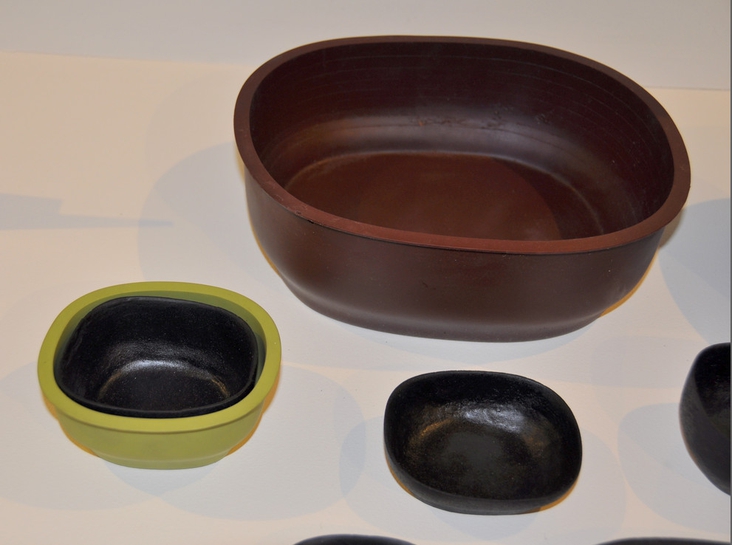
Design Products is an area with some very interesting work this year. Kosuke Araki has carbonised discarded vegetables and bones into delicate looking black containers. He invented the processes involved himself and sees it as a way to use unwanted food and promote an end to waste.

These cork pens by Ritika Karnani are a celebration of the many uses of cork. Pens are usually not recyclable, however these are reusable as well as being light weight, anti-bacterial and water resistant and very comfortable to hold. She makes them out of the left-overs from wine bottle corks.

More from Design Products: this foraging apron by Lauren Davies. Made out of organic linen and sheepskin, it folds out from being a knapsack to collect foraged food, to an apron when you are cooking.
Marc Miralda Besa has designed a wood drying rack that doubles as a basket. He has also made a garbage can that is raised off the floor, so that you can clean under it, and open it with a kick of your foot from the bottom or side. Very handy.

Innovation Design Engineering is where the more practical, and often socially minded, design work is shown. This roller is a sustainable washing system for households in Afghanistan and beyond. It is easily transported and uses kinetic force with a rolling mechanism to wash clothes as well as using little water.
Humi is the name for a tumble less clothes dryer, It is a low energy dryer that doesn’t emit additional moisture. Its heating system is a cartridge that takes heat from radiators.

The Coralino Project has funding from James Dyson, so there are some big bets being hedged on this one. Coral is being destroyed in our seas at alarming rates by over-fishing. This is a method for farmers to grow coral which can then be returned to the sea.

The History of Design is for the intellectuals: these students have a passion for the study of the past, be it yesterday or hundreds of years ago, and material cultural. Their projects consisted of a series of short videos on a broad range of subjects from the history of Cleveland’s shopping arcades to mail order catalogues, to ancestral halls in post-Mao China.and the use of horn in seventeenth century England. Fascinating stuff.
For her thesis, Imogen Adams travelled across the USA and looked into the myth of the 50’s diner. This photo of Pann’s, opened 1958, in Inglewood, California conveys a sense of the yearning and nostalgia that is invoked now by these old restaurants.
56 Comments
Профессиональный сервисный центр по ремонту бытовой техники с выездом на дом.
Мы предлагаем:сервисные центры в москве
Наши мастера оперативно устранят неисправности вашего устройства в сервисе или с выездом на дом!
Sure, you might take some hits from time to time, but you cannot be scared.
ยุคที่ใครๆก็ต้องการความสบายสบาย บาคาร่าออนไลน์ก็เลยเป็นตัวเลือกที่โคตรดีสำหรับท่าน UFABET มีบาคาร่าให้เลือกเล่นมากมายพวกเราเป็นคาสิโนที่จ่ายจริง ทำเงินได้จริง สมัครง่าย ระบบฝากถอนอัตโนมัติแล้วเจอกันขอรับ
buy hydroxychloroquine online https://hydroxychloroquinex.com/
I am just really loving the theme/style of your weblog.
Do you run into any internet browser compatibility problems?
A couple of my blog visitors have complained about my blog
not operating correctly in Explorer but looks
great in Firefox. Have you got any advice to assist fix this
issue?
Here is my web site: chic sparrow folio
tadalafil 20 mg daily https://cialis.adicbc.com/
how much stromectol is too much https://ivermectin1st.com/
cialis tablets for sale australia https://cialis.grassfed.us/
chloroquine online http://viaaagra.com/
tamoxifen side effects long term https://tamoxifen.mrdgeography.com/
prednisone 5 mg dose pack 48 directions https://prednisone.bvsinfotech.com/
real dapoxetine without doctor prescription https://ddapoxetine.com/
roman prices for cialis https://tadalafil.cleckleyfloors.com/
does trump own stock in chloroquine https://hydroxychloroquinee.com/
amstyles.com https://amstyles.com/
how much does cialis costs https://wisig.org/
how much vidalista should i take https://vidalista40mg.mlsmalta.com/
order hydroxychloroquine https://hydroxychloroquine.mlsmalta.com/
trials of hydroxychloroquine https://hhydroxychloroquine.com/
is mexican vidalista safe https://vidalista.mlsmalta.com/
order ivermectin https://ivermectin.webbfenix.com/
does walgreens have generic viagra http://droga5.net/
generic clomid india buy online https://salemeds24.wixsite.com/clomid
careprost bimatoprost ophthalmic solution 0.03 https://carepro1st.com/
amoxycillin1st.com https://amoxycillin1st.com/
keflex.webbfenix.com https://keflex.webbfenix.com/
Historically, a circumscribed sympathy of the physiological chemical mechanism of erections restricted
the discussion of ED to vacuum-chokepoint devices, medicine implants, intracavernosal injections,
and intraurethral suppositories.4 Since its advent, the separate of agents known as
type-5 phosphodiesterase (PDE5) inhibitors has revolutionized the direction of ED.
PDE5 inhibitors hold turn the first-telephone line therapy for ED,
as suggested by the American Urological Connexion (AUA)
and the European Connection of Urogenital medicine http://lm360.us/
Hi, i think that i saw you visited my site thus i came to
return the favor.I'm attempting to find things to enhance my web site!I suppose its ok to use a few of your ideas!! https://www.azhydroxychloroquine.com/
Asking questions are really good thing if you are not understanding anything totally, but
this paragraph gives pleasant understanding even.
My brother suggested I might like this blog. He was entirely right.
This post actually made my day. You cann't imagine just how much time I had spent for this information! Thanks!
buy viagra generic online usa pharmacy https://mymvrc.org/
Pretty section of content. I just stumbled upon your website and in accession capital to assert that I get in fact enjoyed account your blog posts. Anyway I will be subscribing to your feeds and even I achievement you access consistently quickly.
Hi there to all, it's genuinely a pleasant for me to pay a quick visit this site, it consists of precious Information.
buy custom term paper [url=http://termpapernfu.com/]term paper writing service[/url] term paper service term paper custom help writing a term paper
That is a very good tip especially to those new to the blogosphere. Brief but very accurate info… Thank you for sharing this one. A must read article!
Your style is so unique compared to other people I've read stuff from. Many thanks for posting when you've got the opportunity, Guess I will just bookmark this web site.
As soon as I found this internet site I went on reddit to share some of the love with them.
I was able to find good information from your articles.
Hello there! I could have sworn I’ve visited this blog before but after going through a few of the articles I realized it’s new to me. Anyhow, I’m definitely delighted I discovered it and I’ll be bookmarking it and checking back frequently!
An intriguing discussion is definitely worth comment. I believe that you should write more about this subject matter, it might not be a taboo matter but usually people do not speak about such subjects. To the next! Best wishes!
I like the posts on this site… I’ll be coming back for sure.
Way cool! Some extremely valid points! I appreciate you writing this post and also the rest of the site is very good.
I'm not sure why but this website is loading very slow for me.
Is anyone else having this problem or is it a issue on my end?
I'll check back later and see if the problem still exists.
This website was... how do you say it? Relevant!! Finally I have found something which helped me. Cheers.
Judging by the way you write, you seem like a professional writer.,-~~;
Saved as a favorite, I like your blog!
I'd like to thank you for the efforts you have put in writing this website. I really hope to see the same high-grade content by you later on as well. In fact, your creative writing abilities has inspired me to get my very own blog now ;)
Greetings, I think your blog might be having browser compatibility problems. Whenever I look at your site in Safari, it looks fine however, when opening in IE, it's got some overlapping issues. I just wanted to give you a quick heads up! Other than that, fantastic site.
the clock radios that we have at home are made by General Electric and they are really sturdy,.
Great article. I'm facing some of these issues as well..
I quite like reading through a post that will make people think. Also, many thanks for allowing me to comment.
I'm pretty pleased to find this great site. I want to to thank you for ones time just for this wonderful read!! I definitely enjoyed every part of it and I have you book-marked to look at new information on your blog.
A motivating discussion is worth comment. I do believe that you should write more about this topic, it might not be a taboo matter but typically people do not talk about these topics. To the next! Kind regards!
This page makes me think of the other info I saw
Outstanding post, I think people should learn a lot from this web blog its very user pleasant.
I simply want to tell you that I am beginner to blogging and site-building and definitely savored you're web blog. Very likely I’m planning to bookmark your site . You certainly come with really good articles. Thank you for sharing with us your webpage.
Leave A Comment