
By Alison Gregor / Source: nytimes

It was less than a decade ago that a building design philosophy from Germany called “passive house” jumped the Atlantic Ocean and quietly took root in Brooklyn.
Now, with a few dozen homes and small projects built or retrofitted to this still exotic standard, passive buildings appear poised to enter New York City’s housing market in a much bigger way. Large projects delivering hundreds of new passive units to market are in the works, and city officials are watching closely.
Passive buildings maintain a comfortable interior climate without active heating and cooling systems — that means no more radiators or air-conditioning units for people who live in environments more temperate than New York’s. This is done using, among other things, an airtight building envelope and a system that exchanges interior and exterior air, usuallly an energy recovery ventilator. In New York, small heating and cooling systems are generally included in passive homes.
A house built to passive standards uses less than a quarter of the energy of a traditionally powered home, according to the Passivhaus Institut, which developed the standard in Germany. Besides lower energy bills, benefits include quiet interiors because of thick, insulated walls, along with fresher, cleaner air, thanks to the filters in energy recovery ventilators. Builders and residents of passive houses say the filters can help eliminate allergies and asthmatic symptoms.
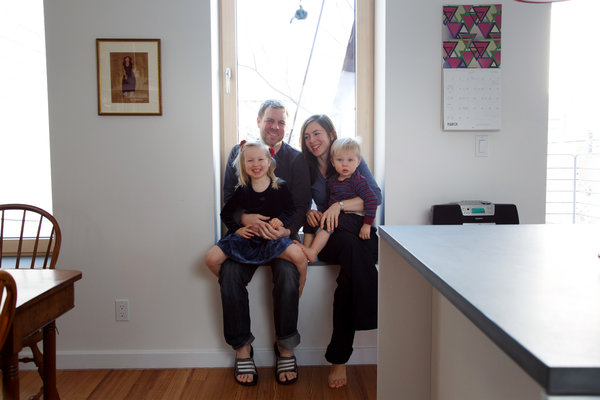
Stephen Lynch, an architect, with his wife, Hannah, and children Vera and Silas, in the Brooklyn townhouse he retrofitted using passive-house principles. Pablo Enriquez for The New York Times
With a small group of developers, builders and architects convinced that passive standards can now be achieved at little or no extra cost, proponents hope to see a revolution in how homes and other structures are built in the city.
“Building to passive-house standards just makes a lot of sense,” said Stephen Lynch, an architect and principal of Caliper Studio, who retrofitted his townhouse in South Slope, Brooklyn, using passive house principles two years ago. There are some cost hurdles and a learning curve, but those challenges can be overcome, he said, “and then you realize how amazing it is that we don’t already build to these standards.”
Officials working to implement Mayor Bill de Blasio’s sweeping green-building initiative, which has a target of an 80 percent reduction in greenhouse gas emissions by 2050, are studying passive-house standards as they overhaul performance standards for new construction.
Worldwide, buildings are responsible for about 40 percent of carbon emissions, but in New York City, it’s closer to 71 percent. The Mayor’s Carbon Challenge Progress Report of 2013 found that residential buildings account for 37 percent of the city’s emissions.
“We’ll be looking to high-performance innovations, such as passive-house, carbon-neutral or zero net energy strategies, to inform the city’s standards to reduce energy use in both new construction and our older building stock,” said Amy Spitalnick, a spokeswoman for the mayor.
Buildings constructed to passive standards aren’t widespread enough for consumers to inadvertently bump into them — they still have to be sought out. Among the small adherent developments is 255 Columbia Street, a 13-unit building in Brooklyn marketed in late 2013. And dozens of townhouses in Brooklyn and Manhattan are undergoing passive retrofits.
The cost of creating a passive house has been much debated. A few years ago, the Passivhaus Institut put the additional cost in the United States at somewhere around 6 percent. But proponents say costs have come down as prices for materials dropped and contractors have become more familiar with passive-building methods. Triple-pane windows and added insulation may add costs upfront, but these expenses are offset by the smaller boilers and smaller heating and air-conditioning systems passive houses require.
Kurt Roeloffs renovated his townhouse on West 88th Street in Manhattan using passive systems that he says did not add any extra costs to the renovation. Since moving in this past November, he’s been nothing but satisfied living in his home, where the temperature is a constant 72 degrees, and he can walk around barefoot in a T-shirt in total comfort in the winter.
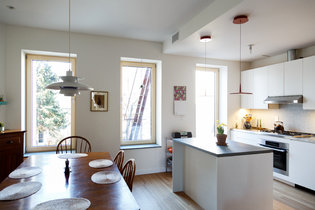
The Lynch family’s kitchen. Pablo Enriquez for The New York Times
“We were so impressed with how quiet it is, and how comfortable it is,” he said. “The air just smells fresh and sweet, even after we cook, because the filters get rid of it so quickly.”
His house uses an energy recovery ventilator, which pushes out stale air while drawing in fresh air, exchanging heat in the process. During the winter, heat from the exhausted air is transferred to the incoming cold air; and in summer, heat and humidity are drawn out of incoming air and transferred to the outgoing stale air.
David and Aliana Spungen have two-story windows in the kitchen of their Brooklyn Heights townhouse, recently retrofitted to passive house standards.
“I remember thinking we’ll probably feel a lot of cold coming off those windows,” Ms. Spungen said. “But even with this brutal winter, we just don’t.”
Mr. Lynch, the architect, said it now cost him about $323 a year to heat his 3,140-square-foot house with a gas boiler. “I’m really satisfied and interested in how to make this method of building more commonly used,” he said.
Heating an ordinary townhouse of similar size with gas would cost about $2,500 a year, said Anthony DelleCave, a salesman at Citi Habitats who manages townhouses in Brooklyn and Manhattan.
Another passive apartment house in New York is an eight-unit building at 210 Pacific Street in Cobble Hill, Brooklyn, designed and developed by NAVA Companies. The building, which has half-floor and full-floor units of three and four bedrooms, has many green elements, such as solar thermal hot water systems and induction cooktops.
However, also of interest to potential buyers is that the building’s passive design should cut their energy consumption by 75 percent, according to marketers at Brown Harris Stevens, using data provided by the Passivhaus Institut. They note, however, that the actual energy savings depends on the individual apartment owner, with those who opt for 65-degree rooms during the summer or an 80-degree home during the winter saving less than those who aim for more moderate interior temperatures. Half-floor units start at $2.45 million and full-floor units start at $4.9 million.
Read more @ nytimes
161 Comments
This is exactly the info I needed
Each post is a journey, and The words are the map. Thanks for leading the way.
Reading The Writing is like finding the perfect song that I can't stop listening to. Play it again?
Making hard to understand topics accessible, you’re like the translator I never knew I needed.
Профессиональный сервисный центр по ремонту бытовой техники с выездом на дом.
Мы предлагаем:сервис центры бытовой техники москва
Наши мастера оперативно устранят неисправности вашего устройства в сервисе или с выездом на дом!
Профессиональный сервисный центр по ремонту бытовой техники с выездом на дом.
Мы предлагаем:сервис центры бытовой техники москва
Наши мастера оперативно устранят неисправности вашего устройства в сервисе или с выездом на дом!
Delightful read. The passion is visible, or at least, very well faked.
Tackled this hard to understand issue with elegance. I didn’t know we were at a ballet.
The ability to break down tough concepts is as impressive as a magician’s trick. Color me amazed.
The voice shines through The writing like a beacon, guiding us through the darkness of ignorance.
The writing captivated me from the first paragraph to the last. It’s rare to find such engaging content.
I must admit, The depth of analysis is as attractive as The words. Great work has never looked so good.
It’s amazing how much energy my dog burns off at Charlotte Dog Park; he’s happily napping now after our visit.
Charlotte Dog Park’s parking lot is always full of excited dogs hopping out of cars—it’s adorable!
Charlotte Dog Park is my pup’s version of Disneyland—he’s over the moon every time we go.
Charlotte Dog Park is where my pup’s energy finally meets its match—he’s wiped out after!
The energy at Charlotte Dog Park is electric—my pup feeds off it and has a blast every time.
Charlotte Dog Park’s friendly dogs make every visit a party—my pup loves the action.
My dog’s muddy grin after Charlotte Dog Park is adorable—he’s so proud of his playtime.
My pup’s confidence has soared since we started visiting Charlotte Dog Park—he’s a social butterfly now!
The calm atmosphere at Charlotte Dog Park lets me chill while my dog runs wild and free.
Discovering The Writing felt like finding the perfect match. The intellect and charm are a rare combo.
Adding value to the conversation, because what’s a discussion without The two cents?
The ability to present nuanced ideas so clearly is something I truly respect.
The fresh insights were a breath of fresh air. Thank you for sharing The unique perspective.
Refreshing take on the subject, like a cold splash of water to my long-held beliefs.
The creativity and intelligence shine through, blinding almost, but I’ll keep my sunglasses handy.
Appreciate the clarity you bring to this topic. It's like you're speaking to five-year-olds, which is perfect for me.
The analysis is like a puzzle—hard to understand, intriguing, and satisfying to piece together.
The dedication to high quality content is evident and incredibly appealing. It’s hard not to admire someone who cares so much.
The dedication to high quality content is evident and incredibly appealing. It’s hard not to admire someone who cares so much.
I loved The fresh take on this topic. The points resonated with me deeply.
The warmth and intelligence in The writing is as comforting as a cozy blanket on a cold night.
The article was a joy to read, and The enthusiasm is as infectious as The charm.
The Writing is a go-to resource for me. Thanks for all the hard work!
You write with such passion and clarity, it's like listening to a love song for the mind.
This post is a testament not only to The expertise but also to The dedication. Truly inspiring.
The Writing is like a warm fireplace on a cold day, inviting me to settle in and stay awhile.
A go-to resource, like a library but without the late fees.
I always learn something new from The posts. Thank you for the education!
This post is a testament not only to The expertise but also to The dedication. Truly inspiring.
The unique viewpoints in The writing never fail to impress me. Insightful as always!
Elegant and insightful, you tackle hard to understand issues like you're dancing through words. Shall we dance some more?
The Writing is a go-to resource for me. Thanks for all the hard work!
The fresh insights were a breath of fresh air. Thank you for sharing The unique perspective.
The writing is a masterpiece. You managed to cover every aspect with such finesse.
Each article you write is like a step in a dance, moving us gracefully through The thoughts.
The elegance of The arguments is as captivating as a sunset. I could admire it all day.
The attention to detail is as attractive as it is thorough. I appreciate a person who notices the little things.
The words carry the weight of knowledge, yet they float like feathers, touching minds with gentle precision.
Opened my eyes to new perspectives, and here I was thinking I’d seen it all.
The Writing is a treasure trove of knowledge, like finding an untouched library book. A rare gem!
The post touched on things that resonate with me personally. Thank you for putting it into words.
The Writing is like a secret garden, each post a path leading to new discoveries and delights.
A gift for explaining things, making the rest of us look bad.
Thank you for the hard work you put into this post. It's much appreciated!
The knack for making hard to understand concepts readable is something I greatly admire.
I'm amazed by the depth and breadth of The knowledge. Thanks for sharing!
This article was a joy to read. The enthusiasm is contagious!
Every article you write is like a new adventure. I'm always excited to see where you'll take me next.
Every post of Thes is a learning opportunity for me. Thanks for sharing The expertise.
The Writing has become like a favorite meeting spot, where great minds and ideas mingle.
https://xypid.win/story.php?title=shattered-reflections-the-ultimate-guide-to-auto-glass-replacement#discuss
https://images.google.com.na/url?q=https://pastelink.net/5zaajy5k
Your dedication to crafting thoughtful, insightful posts is evident in every word you write. The depth of research and the clarity of your explanations make your blog a standout. I am always enlightened and inspired after reading your work.
The thought-provoking post has me looking forward to more. It’s like the intellectual equivalent of a second date.
The piece was both informative and thought-provoking. Thanks for the great work!
The work is truly inspirational. I appreciate the depth you bring to The topics.
The article was a delightful read. It’s clear you’re passionate about what you do, and it shows.
The elegance of The prose is like a fine dance, each word stepping gracefully to the next.
Joy to read and contagious enthusiasm? I thought I was immune, but you proved me wrong.
The blend of informative and entertaining content is perfect. I enjoyed every word.
"Your post added a new dimension to my understanding of the subject. Thank you for sharing your knowledge and insights—it's truly enriching."
You've done a fantastic job of breaking down this topic. Thanks for the clarity!
This blog is a treasure trove of knowledge. Thank you for your contributions!
Thank you for consistently producing such high-quality content.
I'm so grateful for the information you've shared. It's been incredibly enlightening!
This piece was beautifully written and incredibly informative. Thank you for sharing!
Engaging with your blog is like savoring a gourmet meal; every bite (or word) is to be enjoyed.
Thank you for the hard work you put into this post. It's much appreciated!
You've opened my eyes to new perspectives. Thank you for the enlightenment!
This blog is a treasure trove of knowledge. Thank you for your contributions!
Thank you for the hard work you put into this post. It's much appreciated!
I'm always excited to see your posts in my feed. Another excellent article!
I'm bookmarking this for future reference. Your advice is spot on!
This was a great enjoy reading—thought-provoking and informative. Thank you!
I'm amazed by the depth and b enjoy readingth of your knowledge. Thanks for sharing!
Thank you for adding value to the conversation with your insights.
What a compelling enjoy reading! Your arguments were well-presented and convincing.
Each post is a window into your thoughts, and I must say, the view is stunning.
Your posts are like a cozy nook, inviting and comfortable, where I can immerse myself in thoughts.
Your creativity and insight left a big impression on me. Fantastic job!
Stumbling upon your article was a highlight of my day. It was just what I needed to read.
You've done a fantastic job of breaking down this topic. Thanks for the clarity!
Thanks for the complete information. You helped me.
https://cialiswithdapoxetine.com/# - cialis tadalafil & dapoxetine
stromectol tablets for humans ivermectin price canada
furosemide 80 mg lasix pill Trund Caush
buy hydroxychloroquine online https://hydroxychloroquinex.com/
I savour, lead to I discovered just what I was looking for.
You've ended my four day long hunt! God Bless you man. Have a nice day.
Bye http://herreramedical.org/acyclovir
Hey there! Do you use Twitter? I'd like to follow you if that would be okay.
I'm undoubtedly enjoying your blog and look forward to new posts. http://cleckleyfloors.com/cialis
I read this piece of writing fully regarding the resemblance of most recent and
preceding technologies, it's amazing article. http://antiibioticsland.com/Augmentin.htm
Attractive component to content. I simply stumbled upon your blog and in accession capital to claim that I acquire in fact loved account
your blog posts. Any way I'll be subscribing for your feeds
or even I achievement you get entry to constantly rapidly. https://hydroxychloroquinea.advantagetriseal.com/
Hi there, its pleasant article about media print, we all be
aware of media is a enormous source of information. http://www.deinformedvoters.org/vidalista-online
teva vidalista cost canada http://viidalista.co/
I think the admin of this website is really working hard in favor of his web site,
for the reason that here every material is quality based data. http://www.deinformedvoters.org/dapoxetine-60mg
Hello everyone, it's my first go to see at this site,
and piece of writing is actually fruitful designed for me, keep up posting such articles or reviews. http://herreramedical.org/cialis
tadalafil lowest price https://cialis.confrancisyalgomas.com/
Hi just wanted to give you a quick heads up and let you know a few of the images
aren't loading correctly. I'm not sure why but I think
its a linking issue. I've tried it in two different web browsers and both show
the same results. https://hydroxychloroquines.studiowestinc.com/
Hi, i think that i saw you visited my web site so i came to return the favor.I'm trying to find things to improve my website!I suppose its ok to use a few of your ideas!! https://cialis.webbfenix.com/tadalafil
Link exchange is nothing else except it is simply placing the
other person's blog link on your page at appropriate place and other person will also
do same for you. http://cleckleyfloors.com/viagra
Hi, I do think your site could possibly be having browser
compatibility issues. Whenever I look at your website in Safari, it looks fine however, when opening in IE, it has some overlapping issues.
I merely wanted to give you a quick heads up!
Aside from that, excellent site! http://antiibioticsland.com/Cephalexin.htm
cheapest generic azithromycin http://aziithromycin.com/
ssm health online visit https://buymeds.mlsmalta.com/
vidalista without doctor prescription http://vidallista.com/
cialis pills online canadian pharmacy http://tadalafila.online/
best price for generic cialis https://tadalafil.cleckleyfloors.com/
5mg generic cialis side effects https://tadalafili.com/
chloroquine phosphate coronavirus dosing https://hydroxychloroquinee.com/
doryx online http://doxycycline.zolftgenwell.org/
albuterol inhaler coupons printable https://amstyles.com/
costco vidalista price https://vidalista40mg.mlsmalta.com/
benefits of dapoxetine for prostate https://ddapoxetine.com/
current availability of hydroxychloroquine https://hydroxychloroquine.mlsmalta.com/
best generic viagra websites http://droga5.net/
how does ivermectin work on scabies https://ivermectin.webbfenix.com/
how should vidalista be taken https://vidalista.mlsmalta.com/
clomid for women 50mg https://salemeds24.wixsite.com/clomid
lumigan generic cost https://carepro1st.com/
amoxicilina online mail order pharmacies https://amoxycillin1st.com/
No one tests the depth of a river with both feet.
The higher the monkey climbs the more he shows his tail.
online azithromycin https://azithromycinx250.com/
hydroxychloroquine 2020 https://chloroquine1st.com/
price of viagra at walmart https://viatribuy.com/
tadalafil without a doctor's prescription https://wisig.org/
hydroxychloroquine malaria https://webbfenix.com/
cost of cialis http://cialisoni.com/
buy januvia http://lm360.us/
Have you ever thought about writing an e-book or guest
authoring on other blogs? I have a blog centered
on the same subjects you discuss and would love to have you share some stories/information. I know my
subscribers would enjoy your work. If you are even remotely interested, feel free
to shoot me an e mail. adreamoftrains website hosting
companies
It is the best time to make some plans for the future and it is time to be happy.
I have read this post and if I could I wish to suggest
you some interesting things or tips. Perhaps you could write next articles referring to this article.
I wish to read more things about it!
Oh my goodness! Incredible article dude! Thanks, However I
am going through troubles with your RSS. I don't know the reason why I am unable
to subscribe to it. Is there anybody getting similar RSS problems?
Anyone that knows the answer can you kindly respond?
Thanx!!
publix keflex price https://keflex.webbfenix.com/
Hey would you mind sharing which blog platform you're working with? I'm going to start my own blog soon but I'm having a hard time selecting between BlogEngine/Wordpress/B2evolution and Drupal. The reason I ask is because your design and style seems different then most blogs and I'm looking for something unique. P.S Apologies for getting off-topic but I had to ask!|
I am really impressed with your writing skills and also with the layout on your blog. Is this a paid theme or did you modify it yourself? Either way keep up the excellent quality writing, it is rare to see a nice blog like this one today.|
I think this is one of the most significant info for me. And i am glad reading your article. But should remark on few general things, The web site style is wonderful, the articles is really excellent : D. Good job, cheers|
fantastic put up, very informative. I ponder why the opposite specialists of this sector do not notice this. You should continue your writing. I'm confident, you have a huge readers' base already!|
I absolutely love your blog.. Pleasant colors & theme. Did you build this site yourself? Please reply back as I'm looking to create my own personal blog and would love to find out where you got this from or exactly what the theme is called. Appreciate it!|
I loved as much as you will receive carried out right here. The sketch is tasteful, your authored subject matter stylish. nonetheless, you command get bought an edginess over that you wish be delivering the following. unwell unquestionably come more formerly again since exactly the same nearly very often inside case you shield this increase.|
informative article
nice article
A fascinating discussion is definitely worth comment. I do believe that you need to publish more about this issue, it might not be a taboo matter but typically folks don't discuss these subjects. To the next! All the best!!|
I needed to thank you for this fantastic read!! I definitely enjoyed every little bit of it.
I have you saved as a favorite to check out new stuff you post…
Can I simply say what a relief to find an individual who really understands what they're
talking about online. You definitely know how to bring a problem
to light and make it important. More and more people need to look at this
and understand this side of the story. It's surprising
you aren't more popular because you certainly possess the gift.
Thanks a bunch for sharing this with all people you actually understand what you're talking approximately!
Bookmarked. Please additionally discuss with my
website =). We will have a link alternate agreement between us
We're a group of volunteers and starting a new scheme in our community.
Your site provided us with valuable info to work on. You have done an impressive
job and our entire community will be grateful to you.
Does your blog have a contact page? I'm having problems locating it but, I'd like to shoot you an e-mail.
I've got some creative ideas for your blog you might be interested in hearing.
Either way, great website and I look forward to seeing it
develop over time.
hello there and thank you for your information –
I've definitely picked up anything new from right here.
I did however expertise some technical points using this website,
since I experienced to reload the web site a lot of times previous to
I could get it to load correctly. I had been wondering if your web host
is OK? Not that I am complaining, but sluggish loading instances times will sometimes affect your placement in google and could
damage your high-quality score if ads and marketing with Adwords.
Well I'm adding this RSS to my e-mail and can look out for much more of your respective intriguing content.
Make sure you update this again very soon.
Its like you learn my thoughts! You appear to grasp a lot approximately this, like you wrote the ebook
in it or something. I think that you just could do with some p.c.
to drive the message house a bit, however instead of that, that is wonderful blog.
An excellent read. I will certainly be back.
We absolutely love your blog and find a lot of your post's to
be just what I'm looking for. can you offer guest writers to write content for you personally?
I wouldn't mind creating a post or elaborating on a few of the subjects you write in relation to here.
Again, awesome website!
You could certainly see your enthusiasm in the article you write.
The arena hopes for even more passionate writers such
as you who are not afraid to say how they believe. At all times follow your
heart.
Leave A Comment