By Lidija Grozdanic, Source: Inhabitat

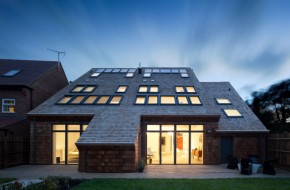
Danish window and skylight manufacturer VELUX commissioned architecture firm HTA to develop a series of experimental low-carbon homes in the UK to gather data on how typical families react to highly sustainable designs. The Velux Model Home 2020 is super insulated, minimizes thermal bridging and has a high degree of air tightness that enables it to significantly reduce heating costs. The house uses renewable energy technologies to meet virtually all of its energy requirements.

CarbonLight Homes go far beyond providing an optimal amount of daylight and air quality – the houses are built to change the behavioral patterns of their residents. Velux found that families living in the homes adjust their lifestyles to achieve higher degrees of health and sustainability. The designs include three- and four-bedroom homes with an integrated garage.

The point of departure for the project was the idea of maximizing daylight. Using computer models, the designers were able to create projects that have a minimum daylight factor of 5% percent for every room in the home – more than three times greater than required by the Code for Sustainable Homes.

The homes are built as part of a typical suburban masterplan for over 200 homes on the Charter Park development by Bovis, which is located in Rothwell near Kettering, UK. The designers topped the homes with sloping roofs to allow the greatest amount of daylight into the dwellings, and each project collects renewable energy via roof and facade-mounted solar panels.
69 Comments
Профессиональный сервисный центр по ремонту бытовой техники с выездом на дом.
Мы предлагаем:ремонт бытовой техники в мск
Наши мастера оперативно устранят неисправности вашего устройства в сервисе или с выездом на дом!
I like reading an article that will make men and women think.
Also, thanks for allowing me to comment! http://herreramedical.org/hydroxychloroquine
This information is priceless. Where can I find out more? http://antiibioticsland.com/Doxycycline.htm
tadalafil 40 mg india where to buy cialis online cheap brand name cialis online http://www.tadalafill.online/
buy hydroxychloroquine online https://hydroxychloroquinex.com/
Fascinating blog! Is your theme custom made or did you download it from
somewhere? A design like yours with a few simple tweeks would really make my blog jump out.
Please let me know where you got your theme. With thanks http://cleckleyfloors.com/cialis
Pretty! This was an extremely wonderful article. Many thanks for providing this info. http://www.deinformedvoters.org/tadalafil-price
prednisone dosage schedule https://bvsinfotech.com/
whoah this weblog is fantastic i really like studying your
posts. Keep up the great work! You recognize, lots of persons are hunting around for this info, you can aid them greatly. https://hydroxychloroquineb.buszcentrum.com/
walgreens generic vidalista price http://viidalista.co/
Howdy! This post could not be written any better!
Reading through this post reminds me of my old room mate!
He always kept talking about this. I will forward this page to him.
Pretty sure he will have a good read. Many thanks for sharing! http://antiibioticsland.com/Bactrim.htm
I believe everything published was actually very reasonable.
But, what about this? what if you were to create a killer headline?
I am not saying your information isn't good., however suppose you added a post title that
makes people want more? I mean VELUX and HTA’s Ultra-Efficient CarbonLight Homes Encourage
Residents to Live More Sustainable Lives – Orta
Blu is a little boring. You might glance at Yahoo's front page and note how they create post titles to grab people to click.
You might add a video or a picture or two to get readers interested
about what you've got to say. In my opinion, it would make your posts a little
bit more interesting. http://www.deinformedvoters.org/dapoxetine-60mg
Thanks for sharing your info. I really appreciate your efforts and I am
waiting for your next write ups thank you once again. https://hydroxychloroquinej.jueriy.com/
Wonderful article! This is the type of info that are meant to be shared around the net.
Shame on the seek engines for no longer positioning this submit higher!
Come on over and seek advice from my site . Thank you
=) https://cialis.webbfenix.com/tadalafil
viagra without doctor prescription http://viiagra.co/
natural alternatives to cialis https://cialis.mlsmalta.com/
cialis 20mg https://cialis.advantagetriseal.com/
vidalista coupon http://vidallista.com/
cialis generic without prescription http://ciaalis2u.com/
generic ivermectin http://ivermmectin.com/
generic viagra online prescription https://zsildenafil.com/
prescription sleeping pills names https://edmeds.buszcentrum.com/
buy cheap tadalafil pills online http://tadalafila.online/
cialis generic without prescription http://ciialis.co/
hydroxychloroquine maker https://hydroxychloroquine.lm360.us/
overnight dapoxetine https://dapoxetine.confrancisyalgomas.com/
online cialis no prescription https://tadalafil24.online/
generic for cialis in the usa https://tadalafili.com/
mint hydroxychloroquine side effects https://hydroxychloroquinee.com/
cialis prescription australia https://wisig.org/
amstyles.com https://amstyles.com/
dapoxetine for seniors https://ddapoxetine.com/
hydroxychloroquine clinical test results https://hydroxychloroquine.mlsmalta.com/
cialis headache jocialisrl http://www.lm360.us/
purchasing ivermectin over the internet https://ivermectin.webbfenix.com/
does clomid really work https://salemeds24.wixsite.com/clomid
natural replacement for vidalista https://vidalista.mlsmalta.com/
cost of lumigan eye drops https://carepro1st.com/
amoxycillin1st.com https://amoxycillin1st.com/
Passing this on.
Thanks for keeping me updated! Articles like this are perfect reads to keep up with the industry!
I cannot get enough of my my cbd salve!
Awesome information.
mymvrc.org https://mymvrc.org/
generic sildenafil 100mg https://www.jueriy.com/
keflex without a doctor's prescription https://keflex.webbfenix.com/
azithromycin 250mg https://azithromycinx250.com/
When we have nothing to worry about we are not doing much and not doing much may supply us with plenty of future worries.
Touche. Outstanding arguments. Keep up the great effort.
adreamoftrains best web hosting 2020
purchasing viagra over the internet http://viacheapusa.com/
This web page is mostly a walk-by means of for all the data you needed about this and didn’t know who to ask. Glimpse here, and also you’ll undoubtedly uncover it.
Hi! Quick question that's completely off topic. Do you know how to make your site mobile friendly?
My web site looks weird when browsing from my apple iphone.
I'm trying to find a template or plugin that might be able to resolve this problem.
If you have any suggestions, please share. Many thanks!
Hi to every body, it's my first visit of this webpage; this web site carries remarkable and actually good information designed for readers.
naturally like your web site however you have to
take a look at the spelling on several of your posts.
Several of them are rife with spelling issues and I in finding it
very troublesome to tell the reality then again I will certainly come back again.
Hi! This post couldn't be written any better! Reading through this post reminds
me of my old room mate! He always kept chatting about this.
I will forward this write-up to him. Fairly certain he will have a good read.
Thanks for sharing!
how come some blogs in a blogroll do not have their most recent post listed and others do? How to change that?
How do I find someones blogger blogs with their email address?
I have Joomla and a Joomla template(rt_refraction_j15) installed on my website. But i want the same template and css styling, as a basic HTML template, so i don't have to use Joomla for editing. Is there an easy way to convert the template to basic HTML/CSS template?.
Do you have a spam issue on this website; I also am a blogger, and I was wondering your situation; we
have created some nice procedures and we are looking to trade methods with other folks, be sure to shoot me an e-mail if interested.
Do you have a spam problem on this site; I also am a blogger, and I was wondering your situation; we have developed some nice procedures and we are looking to trade techniques with other folks, please shoot
me an email if interested.
Hello to every , since I am really eager of reading this blog's post to be updated on a regular basis.
It carries nice material.
When I originally commented I clicked the "Notify me when new comments are added" checkbox and now each time a comment is added I get three e-mails with the same comment.
Is there any way you can remove me from that service?
Thanks a lot!
I just like the helpful information you supply to your articles.
I will bookmark your blog and check again here frequently.
I am somewhat certain I'll learn many new stuff right right here!
Good luck for the next!
Awesome! Its actually awesome paragraph, I have got much clear idea concerning from this paragraph.
Undeniably believe that which you said. Your favourite reason seemed to be at the internet the simplest thing
to remember of. I say to you, I certainly get annoyed
even as folks think about concerns that they just don't understand about.
You controlled to hit the nail upon the top and defined out the whole thing without having side effect
, other folks could take a signal. Will likely be again to get more.
Thank you
It's awesome to go to see this website and reading the views of all colleagues about this paragraph,
while I am also eager of getting experience.
It's not my first time to pay a visit this website, i am
visiting this web site dailly and take good information from here daily.
Hurrah! In the end I got a blog from where I be able to actually obtain useful information regarding my
study and knowledge.
Mass parsite http://bit.ly/2W9CVkn
Leave A Comment