By Jonathan Feldman, Source: Huffington Post
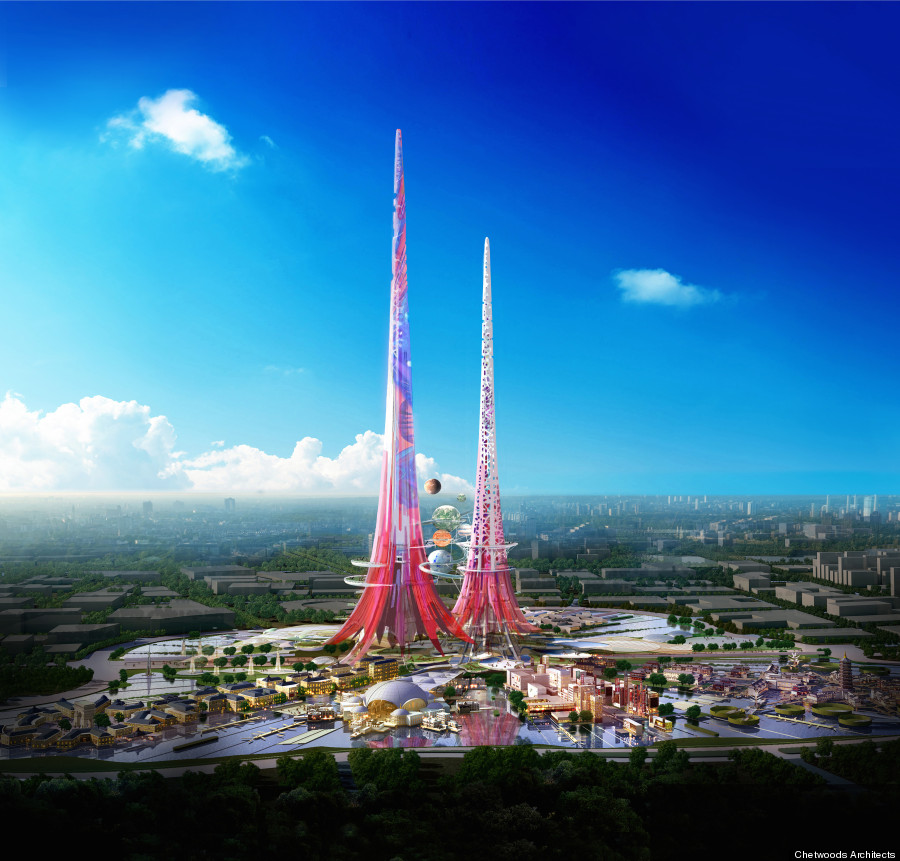
China is embarking on one of its most ambitious engineering challenges to date: the construction of the Phoenix Towers, a pair of skyscrapers in the city of Wuhan that will be the world’s tallest and greenest structures.
“The use of a pair of towers reflects the dualist elements of Chinese culture in contrast to a more western monolithic form,” said the towers’ British builders, Chetwoods Architects, in a press release. “Based on the traditional Chinese Phoenix symbol of two birds, male Feng and Huang, the plan was generated from the Yin/Yang form to represent perfectly balanced union.”
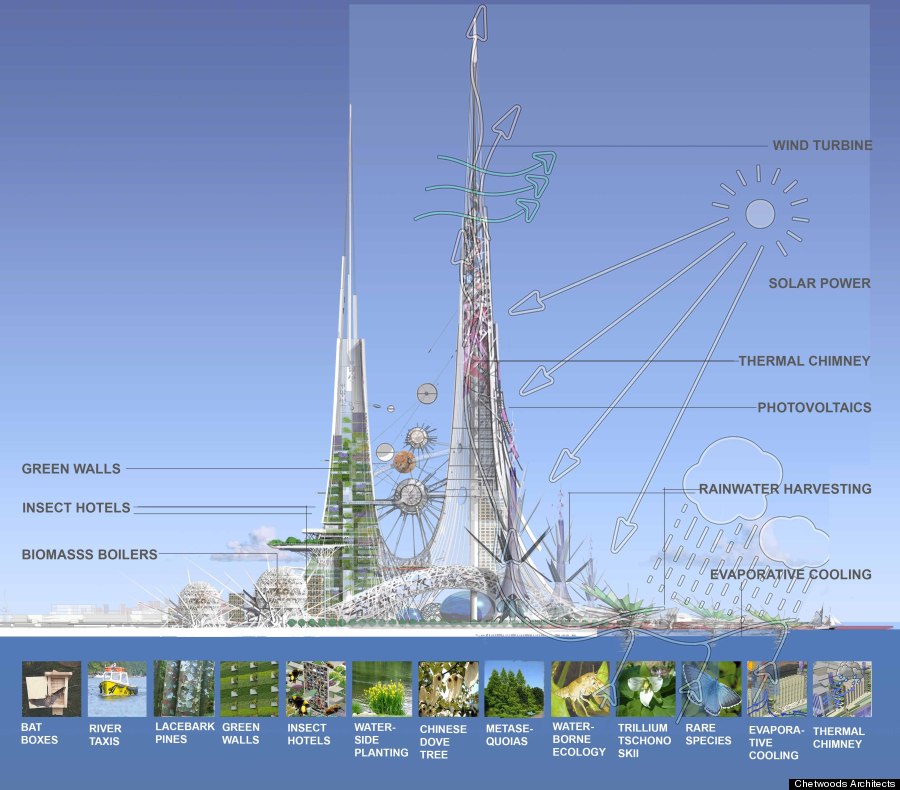
Standing at a height of 3,280 feet, the futuristic structures use sustainable technology on a massive scale. The Feng tower will have a hollow central shaft called a “thermal chimney,” which takes advantage of the structure’s location above one of Wuhan’s many lakes. The chimney sucks up air that passes over the water and uses it to cool the tower and turn a massive turbine. This, combined with the numerous solar panels that will also cover the outside of the Feng tower, will provide electricity for both structures.
The outer walls of the Huang tower will be covered with habitats for indigenous species, as well as greenery that will clean the air. Rainwater collectors in the base of the Feng tower will also be used to provide water for residents of both towers. Together, the structures will use different but complementary technology to help offset some of the pollution that has blighted China’s landscape, the firm says.
Chetwoods has three other projects in the works in Wuhan, which is the capital of Hubei province, including an enormous eco-park that will help power the rapidly-growing city that already claims more than 10 million residents. And Chetwoods’ projects are not the only major green initiatives in Wuhan. Another company plans to build what will become the world’s most sustainable office building.
According to CBS News, the Chinese central government has rolled out an urbanization plan that calls for moving 260 million people from the countryside and into the country’s evolving megalopolises in the next seven years. China sees urbanization as its pathway to becoming a developed nation, and this plan hits fast-forward on that goal. In a conference on the future of urbanization in China, managing director and chief operating officer of the World Bank Sri Mulyani Indrawati underscored this, saying, “Globally, almost 80 percent of of GDP is generated in cities. It will be difficult for any country to reach middle-income status and beyond without getting urbanization right.”
To give a sense of the scale of China’s plan, if the United States wanted to relocate 260 million people, it would have to take the entire population of every state except California and Florida and move them to cities.
China doesn’t tend to renovate and retrofit old buildings, instead it adds new sectors to existing cities to reach its goal of urbanization. While some new sectors are branded as “eco-cities,” others do not have the environmental branding. All together, the government brands these new massive, sprawling urban areas as “super cities.”
Read the rest at: Huffington Post
1 Comment
chanced casino chanced casino
Leave A Comment