By Alison Bruzek / Source: NPR
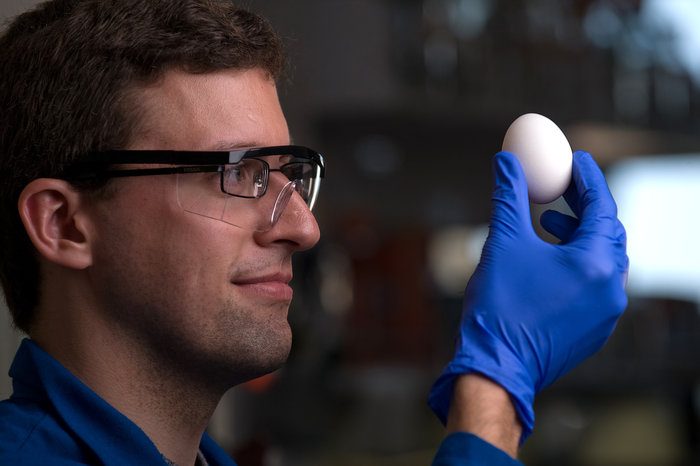
Any chef can whip up an egg over-easy, fried or poached. But what about unboiled?
Leave that to a group of scientific eggsperts at the University of California, Irvine, the University of Western Australia and Flinders University. Recently, they figured out how take an egg from a fresh to a boiled back to an unboiled state.
If you were wondering, the unboiled result doesn’t much resemble the original egg at all.
“It’s extremely unimpressive,” says chemist Greg Weiss at the University of California, Irvine. Like, “here’s the tube with some liquid on the bottom.”
But Weiss and his team weren’t doing this just for kicks. They wanted to unboil an egg to solve a larger question in science: How do you refold an unfolded protein? Their study appeared in January in the journal ChemBioChem.
When an egg is boiled, or cooked for any delicious purpose, the proteins inside, which are folded like complex origami into precise 3D shapes, begin to unfold
As proteins unfold, “they start sticking to each other and getting tangled like unspooled fishing line,” says Weiss. The boiled egg turns solid as the proteins mesh with other proteins, and force water out.
Unboiling the egg essentially means refolding the proteins into their original shape. And that’s a big deal for science – it’s estimated the pharmaceutical, environmental and food industries, among others could save $160 billion a year by refolding tangled proteins.
Read more @ NPR
0 Comments
Leave A Comment