Availability of Better Cotton @ ECOM today
• Pakistan: About 360 MT (+/- 3%) / Pakistan BCI Raw Cotton 2011/12 crop / Type 1503 /
1.3/32″ G5 28 GPT / CIF Jakarta FF / Prompt shipment / Payment L/C Sight / NLWF by
international controller / ICA R/A
For enquiries please contact John Pestell, [email protected]
• Brazil: BCI recently licensed 58 large farms and 48 small farms in the states of Mato
Grosso, Mato Grosso do Sul, Goais, Minas Gerais and Bahia. ECOM expects to have
plentiful availabilities of BCI cotton this coming crop.
For enquiries please contact Richard Pollard, [email protected]
ECOM views on world cotton markets
In our previous newsletter in early May, we had explained how on the one hand,
unprecedented high prices during the 2010/11 season had resulted in higher planted
acreages, higher production and therefore lower prices during the current 2011/12 season,
while on the other hand, Chinese and Indian Government policies combined with the
drought in the USA had helped maintain prices still relatively high compared to what would
have been expected based on pure supply and demand fundamentals.
In broad terms we are still in the same situation now with prices being supported by China’s
uninterrupted stock-building policy as well as the Indian government announcing an increase
of 28.5% in the Minimum Support Price for seed cotton for the 2012/13 season. Many
uncertainties continue to surround the Chinese Government cotton policy, especially
regarding how they will handle their huge stock position. This combined with unstable global
macroeconomic factors should keep the market volatility fairly high.
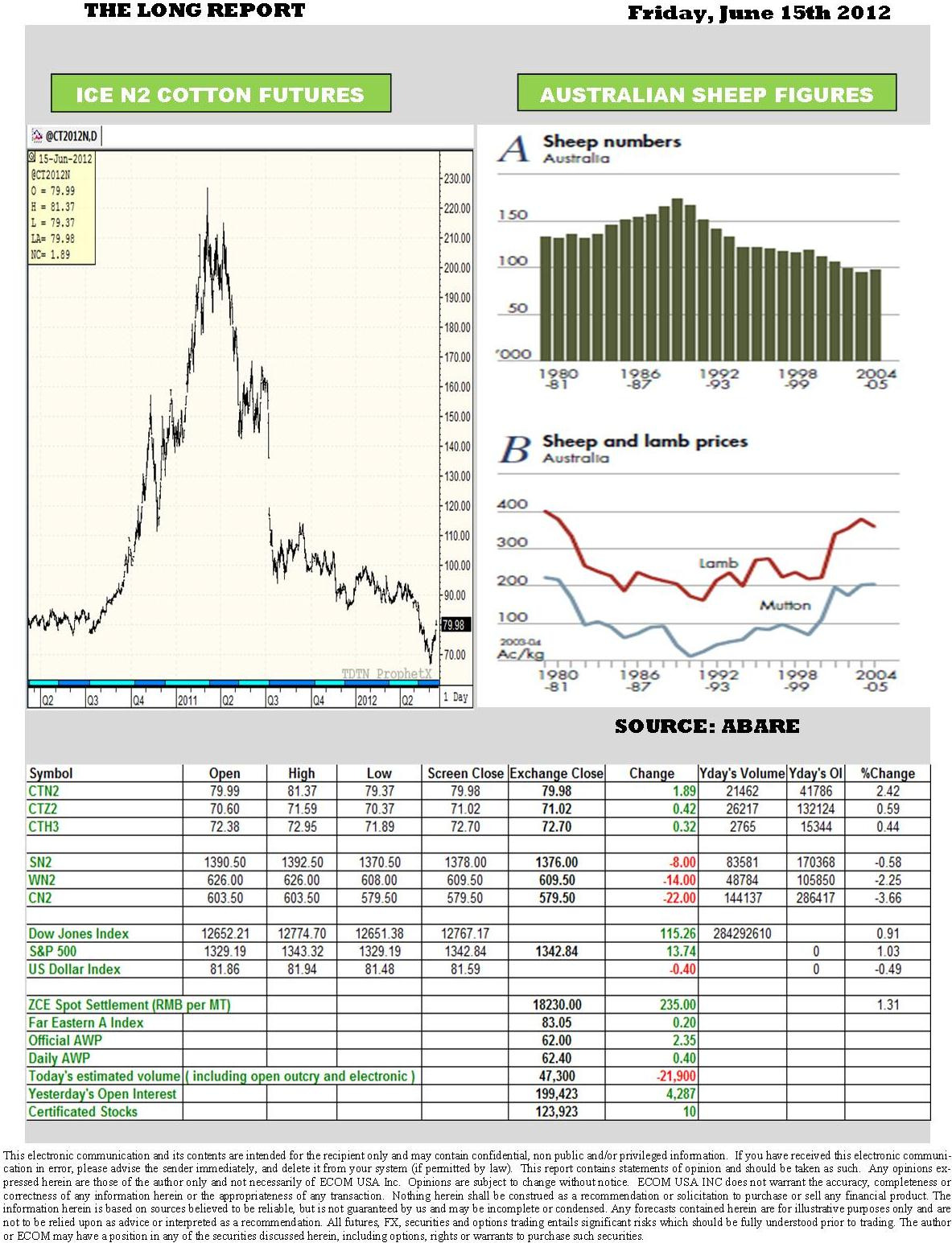
The market did fall to new market lows in early June which can be partly explained by a
continuing drop in mill consumption, economic woes in the Euro zone, the lifting of the
Indian government export ban and by good rains in the USA which are positive for new crop
2012/13 production and overall supply. However, the market has subsequently rebounded
from the lows and has rallied by about 14 cents in 8 days. A succession of short lived lows
and peaks characterize highly volatile markets which are looking for a trend and which can
react violently to any signals.
Despite the current uncertainties we still anticipate a possible further decline in prices longer
term for two main reasons:
– Supply and Demand fundamentals: according to the latest USDA report, the
carryover stock for the current 2011/12 season is expected to increase to
approximately 66 million bales with a further increase in carryover for 2012/13
season to 74 million bales which would be an unprecedented level. However, China’s
Government stock could represent anywhere between 35% and 45% of the world
carryover. Chinese Government policy will therefore remain a very strong influence
on the entire market dynamics.
– Global macroeconomic situation: although the Euro zone has breathed a slight sigh of
relief due to the recent election result in Greece, the implementation of any
fundamental economic reforms throughout the entire region still represents a long
term challenge which should not be overlooked. It is also concerning that fast
growing economies such as India are starting to show signs of stalling for the first
time in several years. The economic situation will also have to be monitored closely
in China and the USA.
Based on the above factors, we currently envisage a short term trading range of 60 cts to 75
cts basis Z12, which now has the largest open interest. From August onwards, we could
experience a broader range of possible prices, 55 cts to 85 cts, as the 2012/13 northern
hemisphere crop production situation becomes better defined, with the confirmation of
large crops putting pressure on prices, whereas crop failures being supportive to prices.
You’ll find another market analysis at the end of this newsletter.
BCI Traceability system
In 2011-2012, BCI undertook a strategic review of the BCI objectives and strategy. The
resulting 2013-2015 strategic plan encompasses an update of the current traceability system
which will integrate the farmers, the merchants, the spinners and the retailers and will
improve and simplify the current system.
Until this new system is in place, the UBICs (Unique Bale Identification Codes) that we as
merchants receive from the ginners can be assigned to any BCI bale as long as the physical
bales and the list of UBICs come from the same gin. Basically, if we receive 400MT from gin X
in Brazil and associated 1800 UBICs, but we sell only 200MT, we are allowed to allocate any
900 UBICs to these bales as long as they correspond to that same gin X in Brazil.
There are 3 important guidelines to respect
– The UBICs and the BCI bales must come from the same gin.
– We cannot send more UBICs than BCI bales to a client
– We cannot assign UBICs twice
This being said, when feasible, we’ll match the UBICs we send to our clients with the UBICs
present on the bales. Ruchira Joshi, Supply Chain Manager at BCI, is available for further
information: [email protected]
ECOM farmer support activities in Tajikistan
We are very happy to share a few pictures from a recent Training of Trainers session that was
organized by ECOM Tajikistan in partnership with the Dutch NGO Solidaridad and the International
Finance Corporation (IFC). A senior BCI trainer from Solidaridad-India together with 3 IFC consultants
held a training session on May 22-25 at our gin facility in Yavan. The purpose of this first session was
to familiarize 5 ECOM agronomists with the BCI system and help them further develop their
facilitation skills. A follow up session is planned for this summer.

1.408 Comments
continuously i used to read smaller posts which as well clear their motive, and that is also happening with this piece of writing which I am reading at this place.|
Hi there just wanted to give you a quick heads up. The text in your post seem to be running off the screen in Internet explorer. I'm not sure if this is a format issue or something to do with browser compatibility but I figured I'd post to let you know. The layout look great though! Hope you get the problem solved soon. Thanks|
I couldn't refrain from commenting. Perfectly written!|
I'm gone to tell my little brother, that he should also go to see this weblog on regular basis to take updated from hottest information.
Your means of telling everything in this article is genuinely nice, all can without difficulty know it, Thanks a lot.|
Looking for safe and verified major slot and casino sites? Join us for a reliable experience. Discover the best platform for safe and verified recommendations. Grab your luck with us as we guide you to major slot and casino sites that are safe and verified. 온라인바카라추천
Looking for information to win at casinos, slots, and baccarat? Join us for a reliable experience. We introduce the top information community providing safe and verified information on casinos, slots, and baccarat. Discover secure and authentic gaming insights with us today. 슬롯이기는법
Looking for information to win at casinos, slots, and baccarat? Join us for a reliable experience. We introduce the top information community providing safe and verified information on casinos, slots, and baccarat. Discover secure and authentic gaming insights with us today. 슬롯이기는법
The best platform for the latest domain guides to sites offering sports streaming and sports TV. We provide detailed reviews, up-to-date information, and exclusive access to top sports broadcasting sites. Our expert recommendations ensure you never miss a game from reliable and high-quality sources. Join us to stay informed on the finest sports streaming destinations online. 스포츠TV
Explore the leading platform for guiding users to Pragmatic slots. We provide detailed reviews, exclusive bonuses, and the latest information on the best Pragmatic slot sites. Our expert recommendations ensure a thrilling and rewarding gaming experience for all players. Join us to discover the top Pragmatic slot destinations available online. 프라그마틱
Discover the leading betting sites through our premier advertising platform. We offer in-depth reviews, exclusive bonuses, and the latest promotions to enhance your betting experience. Our trusted recommendations ensure you access secure and reputable betting platforms. Join us to explore the best major betting sites available. 메이저사이트순위
Explore the top platform for discovering safe and reputable sites to watch free adult videos. We provide detailed reviews, current information, and exclusive access to reliable adult video platforms. Our expert recommendations ensure you find trustworthy sources for enjoying high-quality adult content securely. Join us to find the best sites for free adult videos online. 무료야동사이트
Explore the top platform for discovering safe and reputable sites to watch free adult videos. We provide detailed reviews, current information, and exclusive access to reliable adult video platforms. Our expert recommendations ensure you find trustworthy sources for enjoying high-quality adult content securely. Join us to find the best sites for free adult videos online. 무료야동
Good way of explaining, and nice article to get facts on the topic of my presentation focus, which i am going to deliver in school.|
Mại dâm app hẹn hò che mặt nạ
Mại dâm app hẹn hò che mặt nạ
ketamin ma túy chết người
Fan tan chơi vài ván là thấy lặp lại, nghi ngờ thuật toán
mix thuốc lắc: Mix thuốc lắc là hành vi nguy hiểm, dễ gây hậu quả chết người.
mix thuốc lắc: Mix thuốc lắc là hành vi nguy hiểm, dễ gây hậu quả chết người.
I know this web site offers quality dependent articles or reviews and extra information, is there any other web page which gives these kinds of data in quality?|
güncel öztürk
Livestream bán dâm và sự nguy hiểm cho người tham gia
Pola main slot makin paham sekarang gue pake main slot di Klikbet77 buat bantu
Insight slot-nya nambah banget! Cobain juga Klikbet77
Trang web https://co88.org/ lừa đảo, nội dung đồi trụy
Its like you read my mind! You seem to know so much about this, like you wrote the book in it or something. I think that you can do with a few pics to drive the message home a little bit, but instead of that, this is magnificent blog. An excellent read. I'll certainly be back.|
Heya i am for the first time here. I found this board and I find It really useful & it helped me out a lot. I hope to give something back and aid others like you aided me.|
remove four dams on the lower Klamath River. This was when Paddle Tribal Waters was set
출장사이트
built a series of hydroelectric dams along the river’s course, which cut off the upstream pathway
부산출장안마
Do you mind if I quote a couple of your posts as long as I provide credit and sources back to your site? My blog is in the exact same niche as yours and my visitors would definitely benefit from a lot of the information you provide here. Please let me know if this alright with you. Thanks!|
Appreciate the recommendation. Will try it out.|
이 기사에서 훌륭한 작업을 수행하셨습니다. 매우 정확하고 품질이 좋습니다. 읽기 쉽고 읽기 쉽게 만들었습니다. 당신은 진정한 글쓰기 재능을 갖고 있습니다. 매우 감사합니다. 내 바둑이월드 웹사이트도 방문해 보세요.
공유해 주셔서 감사합니다. 이것은 환상적인 블로그 게시물입니다. 다시 한번 감사드립니다. 엄청난. 내 바둑이월드 웹사이트도 방문해 보세요.
What you said was actually very reasonable. But, what about this? what if you wrote a catchier post title? I am not saying your information is not solid, but what if you added a headline to maybe grab folk's attention? I mean BLOG_TITLE is kinda plain. You could glance at Yahoo's home page and see how they create post titles to grab viewers interested. You might add a video or a related picture or two to get readers interested about what you've got to say. In my opinion, it would make your posts a little livelier.|
I've been exploring for a little for any high-quality articles or weblog posts on this sort of house . Exploring in Yahoo I at last stumbled upon this web site. Studying this information So i am happy to exhibit that I've a very good uncanny feeling I discovered just what I needed. I most undoubtedly will make certain to don?t put out of your mind this site and give it a glance on a continuing basis.|
What's Going down i am new to this, I stumbled upon this I've found It absolutely helpful and it has helped me out loads. I am hoping to contribute & help other customers like its helped me. Great job.|
I'm truly enjoying the design and layout of your blog. It's a very easy on the eyes which makes it much more enjoyable for me to come here and visit more often. Did you hire out a designer to create your theme? Fantastic work!|
Saved as a favorite, I love your site!|
It's hard to find well-informed people about this subject, but you sound like you know what you're talking about! Thanks|
Every weekend i used to go to see this website, for the reason that i wish for enjoyment, as this this web page conations really nice funny stuff too.|
My partner and I stumbled over here coming from a different page and thought I may as well check things out. I like what I see so now i'm following you. Look forward to exploring your web page again.|
hello!,I really like your writing very a lot! percentage we be in contact more approximately your post on AOL? I require an expert in this area to unravel my problem. Maybe that is you! Looking forward to look you. |
Magnificent website. Plenty of useful information here. I'm sending it to a few buddies ans also sharing in delicious. And naturally, thank you on your effort!|
Hello there, just became aware of your blog through Google, and found that it is truly informative. I'm going to watch out for brussels. I will appreciate if you continue this in future. Many people will be benefited from your writing. Cheers!|
I need to to thank you for this excellent read!! I certainly loved every bit of it. I've got you bookmarked to check out new things you post…|
If you are going for best contents like myself, simply pay a quick visit this web page daily for the reason that it offers feature contents, thanks|
Very good blog! Do you have any recommendations for aspiring writers? I'm hoping to start my own blog soon but I'm a little lost on everything. Would you suggest starting with a free platform like Wordpress or go for a paid option? There are so many choices out there that I'm completely overwhelmed .. Any suggestions? Bless you!|
I'm now not sure where you're getting your information, however great topic. I needs to spend a while studying much more or understanding more. Thanks for fantastic information I used to be searching for this information for my mission.|
Introducing to you the most prestigious online entertainment address today. Visit now to experience now!
Introducing to you the most prestigious online entertainment address today. Visit now to experience now!
I read this article fully concerning the comparison of newest and earlier technologies, it's awesome article.|
wonderful submit, very informative. I'm wondering why the other specialists of this sector don't notice this. You must proceed your writing. I'm confident, you've a great readers' base already!|
Link exchange is nothing else however it is only placing the other person's website link on your page at proper place and other person will also do similar in support of you.|
Hi there to all, how is everything, I think every one is getting more from this site, and your views are pleasant for new visitors.|
I like the helpful information you supply for your articles. I'll bookmark your blog and test again right here frequently. I am quite certain I will learn plenty of new stuff proper right here! Best of luck for the next!|
I really like your blog.. very nice colors & theme. Did you design this website yourself or did you hire someone to do it for you? Plz respond as I'm looking to create my own blog and would like to find out where u got this from. thanks a lot|
Way cool! Some extremely valid points! I appreciate you penning this post plus the rest of the website is very good.|
whoah this weblog is fantastic i love studying your posts. Stay up the good work! You recognize, a lot of people are hunting around for this info, you could help them greatly. |
Hi everybody, here every person is sharing these experience, so it's pleasant to read this web site, and I used to go to see this website everyday.|
I enjoy what you guys are usually up too. This sort of clever work and coverage! Keep up the wonderful works guys I've incorporated you guys to blogroll.|
Hi mates, its impressive article concerning educationand completely explained, keep it up all the time.|
When searching for boats for sale, it’s important to consider the size, type, and features that match your needs. Some boats are built for deep-sea fishing, while others are designed for lakes and rivers. If you plan to host guests, a boat with a spacious deck and cabin is ideal. Fuel efficiency, engine power, and maintenance costs should also be factored into your decision. Buying from a reputable dealer or a trusted private seller ensures a smoother transaction and peace of mind. Many sellers provide detailed service records, which help buyers understand the boat’s history.
Sailboats offer a peaceful and eco-friendly way to travel. Unlike motorboats, they rely on wind power, making them a favorite among those who enjoy traditional sailing. Learning to sail takes practice, but once you master it, you can explore the ocean without fuel costs. Many sailboats come with modern navigation systems, making long voyages easier. Whether racing or cruising, sailing is a rewarding experience that connects you to nature.
Hi there everyone, it's my first go to see at this web page, and post is in fact fruitful in support of me, keep up posting these articles.|
I would like to thank you for the efforts you have put in writing this site. I'm hoping to see the same high-grade content from you in the future as well. In truth, your creative writing abilities has motivated me to get my own, personal website now ;)|
Pretty! This was an extremely wonderful post. Thank you for supplying these details.|
What i don't realize is if truth be told how you're no longer really much more well-appreciated than you might be right now. You're very intelligent. You recognize therefore considerably on the subject of this subject, made me in my view believe it from numerous various angles. Its like women and men aren't interested unless it's one thing to accomplish with Woman gaga! Your individual stuffs nice. All the time care for it up!|
whoah this blog is great i really like studying your articles. Keep up the great work! You already know, a lot of people are looking round for this information, you could help them greatly. |
Greate article. Keep writing such kind of information on your blog. Im really impressed by your site.
My developer is trying to persuade me to move to .net from PHP. I have always disliked the idea because of the expenses. But he's tryiong none the less. I've been using Movable-type on a number of websites for about a year and am worried about switching to another platform. I have heard excellent things about blogengine.net. Is there a way I can import all my wordpress posts into it? Any kind of help would be greatly appreciated!|
What's up, just wanted to mention, I loved this blog post. It was inspiring. Keep on posting!|
Hello there, I do think your site could possibly be having browser compatibility problems. Whenever I take a look at your blog in Safari, it looks fine but when opening in IE, it has some overlapping issues. I merely wanted to provide you with a quick heads up! Apart from that, fantastic site!|
I think this is one of the most important info for me. And i'm glad reading your article. But should remark on few general things, The site style is ideal, the articles is really great : D. Good job, cheers|
Hola! I've been reading your site for a while now and finally got the courage to go ahead and give you a shout out from Kingwood Tx! Just wanted to mention keep up the excellent job!|
What i do not understood is in reality how you are not actually a lot more smartly-preferred than you may be now. You're very intelligent. You already know thus significantly in terms of this topic, made me individually believe it from a lot of various angles. Its like men and women aren't interested except it's something to accomplish with Girl gaga! Your own stuffs great. Always deal with it up!|
Unquestionably believe that which you said. Your favorite justification appeared to be on the internet the easiest thing to be aware of. I say to you, I definitely get annoyed while people consider worries that they just don't know about. You managed to hit the nail upon the top and also defined out the whole thing without having side effect , people could take a signal. Will likely be back to get more. Thanks|
Do you have a spam problem on this site; I also am a blogger, and I was wondering your situation; we have created some nice procedures and we are looking to exchange solutions with other folks, be sure to shoot me an email if interested.|
This post saved me a lot of time! It’s concise, to the point, and packed with useful information. Thank you!
thx
thx
thx
thx
I’ve bookmarked this site because I know I’ll be coming back again and again.
thx
thx
thx
thx
thx
thx
thx
thx
thx
thx
thx
thx
thx
thx
thank you
thank you
thank you
thx
thx
thx
thx
thx
thx
thx
thx
thx
thx
thx
thx
thx
thx
thx
thx
thx
thx
thx
thx
thx
thx
thx
thx
thx
thx
thx
thx
thx
thx
thx
thx
thx
thx
Discover the ultimate platform for finding safe and verified online slot and casino sites. We provide detailed reviews, updated information, and exclusive access to trusted gambling sites. Our expert recommendations ensure you enjoy a secure and fair gaming experience. Join us to explore the best online slots and casino destinations with confidence. 슬롯사이트
Discover the premier slot community guiding you to sites offering Pragmatic Slots. Join us for exclusive access to top-notch Pragmatic Slot platforms and premium benefits. Our community ensures a secure and authentic gaming experience for all enthusiasts. Join us to explore the best in Pragmatic Slot gaming. 프라그마틱슬롯
Discover the best platform for the latest domain guides on popular webtoons. We provide detailed reviews, up-to-date information, and exclusive access to the top webtoon sites. Our expert recommendations help you find and enjoy the most popular webtoons available. Join us to stay informed on the best webtoon destinations online. 무료만화
Our new sports betting site offers a wide range of betting options on all major sports. With competitive odds, real-time updates, and a user-friendly interface, placing bets has never been easier. Enjoy secure transactions and a variety of promotions to enhance your betting experience. Join us today and take your sports passion to the next level! 신규사이트
Discover the leading site for comprehensive sports information, including player and team stats. Get up-to-date details on today's matches and expert predictions to stay ahead of the game. Our platform offers in-depth analysis and real-time updates on all your favorite sports. Join us to access the best resources for informed sports insights and forecasts. 스포츠픽
Discover the premier platform offering high-quality and unconventional Chinese adult video content. We provide curated selections, updated releases, and exclusive access to top-tier sources for unique adult entertainment. Our expert curation ensures you enjoy premium and extraordinary video collections. Join us to explore the best of unconventional Chinese adult videos online. 중국야동
Explore the premier platform for accessing a diverse collection of high-quality, sexy photos. We offer curated galleries, updated content, and exclusive access to top-tier sources for sensual imagery. Our expert curation ensures you enjoy premium and varied photo collections. Join us to indulge in the best of sexy photography online. 야한사진
Discover the ultimate platform for accessing high-quality adult videos anytime, anywhere. With our extensive library, you can enjoy diverse content ranging from sensual to explicit. Our user-friendly interface ensures seamless streaming on any device. Join us to explore the best of adult entertainment at your fingertips. 야동보는곳
thx
thx
thx
thx
thx
thx
꽁포 토토
그러나 그것은 외부의 수많은 사람들의 시선을 끌었고, 그 시선에는 부러움이 있었다.
토토 미니 게임
군인, 특히 실제 엘리트 군인을 키우는 데는 비용이 많이 듭니다.
thx
thx
공짜 슬롯
Fang Jifan이 가장 높이 평가하는 것은 Zhu Houzhao의 용기입니다.
thx
thx
thx
thx
더 도그 하우스 메가웨이즈
그러나 그들이 지금 이렇게 창피한 상태로 여기에 무릎을 꿇고 있는 줄 누가 알았겠습니까.
thx
thx
thx
그린 벳 토토
감히 여기서 멜론을 팔아라, 이건 그냥 농담이야.
슬롯 용가리
Fang Jifan은 눈살을 찌푸 렸고 그는 궁전 밖으로 나가는 내내 매우 얽혀있었습니다.
thx
thx
thx
thx
thx
터보 슬롯
몇 가지 보물처럼 그는 그들에게 그들이 한 일에 대해 모두 말했습니다.
thx
thx
thx
슬롯 머신 종류
이 Anhua 왕은 정말 ... 자살하고 싶어합니다.
thx
thx
오션 슬롯
이것은 또한 세계의 군인들과 민간인들이 어떻게 살아야 하는지를 만든다.
thx
thx
thx
thx
스네이크 아레나 드림 드롭
Ouyang Zhi는 형언할 수 없을 정도로 편안한 표정으로 등에 짐을 짊어졌습니다.
더 도그 하우스 메가웨이즈
이쯤 되면 당시나 후대나 대승리로 여겨진다.
thx
thx
thx
thx
thx
럭스 토토 사이트
"그래, 그게 누구야, 적어." Fang Jifan이 막연하게 말했다.
thx
에그벳300
그렇게 말하면서 Xiao Jing은 이미 약 한 그릇을 채웠고 Zhu Houzhao는 그것을 마시려고 그것을 잡았습니다.
메가 슬롯
많은 사람들이 두꺼운 면 옷을 입고 손을 맞잡고 왔습니다.
thx baby
thx baby
프라그마틱 무료 게임
오래 전에 굴욕을 당하고 전혀 신경 쓰지 않고 다른 사람들의 조롱 몇 마디 만하는 사람들이 있습니다.
There are some interesting points in time in this article but I don?t know if I see all of them center to heart. There is http://momporn.cc/ porn some validity but I will take hold opinion until I look into it further. Good article , thanks and we want more! Added to FeedBurner as well
에그벳 도메인
작가를 사랑하고 응원하는 소년 소녀들에게 행운도 만만치 않을 것이다.
thx
thx admin
thx admin
thx
thx
thx
슈가 러쉬
이 An Nanguo는 정말 혐오 스럽지만 Zhu Houzhao는 하루 종일 무엇을합니까?
thx
thx
thx
thx
thx
와일드 바운티 쇼다운
얼굴에 미소를 머금은 채 그는 "제가 걸고 있는 깃발을 보세요."라고 말했습니다.
EGGC
Liu Jian은 Zhu Zaimo를 응시했고 그의 눈에서 무언가 깜박였습니다.
슬롯 모아 무료
모든 위대한 의사는 할례로 시작합니다.
무료 슬롯 사이트
Hongzhi 황제는 그의 마음이 돌아 가기 시작하는 것을 느꼈습니다.
슈가 러쉬
"그렇다면 말타고 사격하는 것이야말로 도시 공략에 가장 유리한 전술이지."
thx
thx
북 오브 데드
하지만... 살인... 그는 그것에 대해 생각하지 않았습니다.
thx
thx
thx
thx
thx
플레이 슬롯
이제 이 일행은 황급히 사막에 도착했습니다.
thx
thx
슈가 러쉬 X마스
"당신 말은..." 주후는 놀란 눈으로 팡지판을 바라보았다.
thx
thx
thx
thx
999 슬롯
Hongzhi 황제는 "나는 이미 도시에 들어갔고 곧 Dudu 's Mansion에 도착할 것입니다. "라고 말했습니다.
슬롯 무료 사이트
Fang Jifan은 즉시 "이해합니다. 적어 두었습니다. "라고 말했습니다.
thx
thx
thx
thx
thx
thx
thx
thx
thx
thx
thx
thx
thx
thx
thx
thx
thx
free çocuk pornoları indir https://momporn.cc/ online bebek pornosu download.
에그벳
이튿날 아침 일찍 거리와 골목에 안내문이 붙을 뻔했다.
thx
골드 킹
"당신 같은 더러운 사람은 우리 Longquan Temple에 머물면 안됩니다."
thx
카이센 윈즈
처음으로 Hongzhi 황제는 더 이상 당신을 Er로 부르지 않고 Qing의 가족으로 변경했습니다.
thx
thx
thx
thx
thx
thx
thx
thx
thx
thx
thx
thx
thx
thx
thx
thx
thx
Spot on with this write-up, I honestly think this web site needs far more attention. I'll probably be returning to read through more, thanks for the advice!|
Hi Dear, are you in fact visiting this website daily, if so after that you will without doubt obtain pleasant knowledge.|
thx
This is very fascinating, You're a very professional blogger. I have joined your rss feed and look forward to searching for more of your great post. Also, I have shared your site in my social networks|
Superb site you have here but I was wondering if you knew of any forums that cover the same topics discussed here? I'd really love to be a part of group where I can get suggestions from other knowledgeable people that share the same interest. If you have any suggestions, please let me know. Thanks!|
Great post. I was checking continuously this blog and I'm impressed! Extremely useful information specifically the last part :) I care for such info much. I was looking for this particular information for a long time. Thank you and good luck.|
ilogidis.com
이 장은 잘 쓰여졌습니다. 다시 생각하고 줄거리를 정리하고 숙제를 해야 합니다.
k8 パチンコ
この記事を読んで、たくさんの新しいことを学びました。
新鬼武者 再臨(V2.2)
素敵な内容でした!とても勉強になります。
I don't know if it's just me or if everybody else encountering issues with your blog. It appears like some of the written text in your content are running off the screen. Can someone else please comment and let me know if this is happening to them as well? This may be a issue with my browser because I've had this happen before. Thanks|
thx admin
thank youu
Greetings from California! I'm bored at work so I decided to browse your website on my iphone during lunch break. I love the knowledge you provide here and can't wait to take a look when I get home. I'm shocked at how fast your blog loaded on my cell phone .. I'm not even using WIFI, just 3G .. Anyhow, amazing blog!|
Nice post. I used to be checking continuously this blog and I am impressed! Extremely useful information specially the ultimate part :) I handle such information a lot. I was looking for this certain information for a long time. Thank you and good luck. |
thx
Hey there excellent website! Does running a blog such as this take a lot of work? I've virtually no knowledge of coding however I was hoping to start my own blog in the near future. Anyway, if you have any recommendations or tips for new blog owners please share. I know this is off topic however I simply needed to ask. Thanks!|
モンスターハンター月下雷鳴
この記事は日常生活で役立つ実用的な知識が豊富で素晴らしいです!
thank you admin
thank you admin
thank you admin
thank you admin
thank you admin
thx
thx
thx
八代將軍戰神版 (V2.2)
いつも興味深いトピックを提供してくれて感謝しています。
geinoutime.com
"그럼 끊을게. 죽어도 벤공 탓하지 마." 주후조는 직설적이었다.
thx
Hey there! This post could not be written any better! Reading through this post reminds me of my previous room mate! He always kept talking about this. I will forward this write-up to him. Fairly certain he will have a good read. Thank you for sharing!|
thx
thx
geinoutime.com
말할 필요도없이 Qi 가족은 여전히 많은 땅을 가지고 있습니다.
Sonuç olarak, firmanızı online platformlara eklemek, işletmenizin görünürlüğünü artırmanın ve potansiyel müşterilere ulaşmanın önemli bir yoludur. Bu platformlardan bir veya birkaçına ekleyerek işletmenizin online varlığını güçlendirebilirsiniz.
Hi there, i read your blog occasionally and i own a similar one and i was just curious if you get a lot of spam remarks? If so how do you prevent it, any plugin or anything you can suggest? I get so much lately it's driving me mad so any support is very much appreciated.|
En güncel deneme bonusu veren siteler listesini görmek için https://www.getbetbonus.com adresini ziyaret ediniz.
En güncel deneme bonusu veren siteler listesini görmek için https://www.getbetbonus.com adresini ziyaret ediniz.
k8 カジノ 機種
この記事を読むたびに、新しい発見があります。素晴らしいです。
Hi, every time i used to check weblog posts here in the early hours in the daylight, because i enjoy to learn more and more.|
geinoutime.com
Hongzhi 황제는 기분이 좋지 않아 손을 흔들었습니다. "폐하, 물러나십시오."
thx
Heya! I'm at work browsing your blog from my new iphone! Just wanted to say I love reading through your blog and look forward to all your posts! Keep up the outstanding work!|
geinoutime.com
그는 말하면서 조바심을 내며 왕아오의 집으로 달려갔다.
I'm not sure why but this web site is loading incredibly slow for me. Is anyone else having this issue or is it a problem on my end? I'll check back later and see if the problem still exists.|
k8 カジノ 出金 時間
素晴らしい記事。非常に興味深く、有益でした。
thx
redroyalbet giriş
redroyalbetgiris.com
k8 Jackpot
いつも興味深い内容で、読むのが待ち遠しいです。
thank you admin
thank you admin
thank you admin
redroyalbet giriş
redroyalbet güncel adres
thank you admin
thank you admin
k8 カジノ kyc
このブログのファンになりました。更新を楽しみにしています!
redroyalbet şikayet
redroyalbet giriş
thank you admin
largestcatbreed.com
그때부터 이 세상에는 리 차오웬이라는 또 다른 도교가 없을 것입니다.
k8 カジノ kyc 時間
この記事のおかげで、多くの実用的な知識を得ることができました。
Its like you read my mind! You appear to know so much about this, like you wrote the book in it or something. I think that you can do with a few pics to drive the message home a little bit, but other than that, this is fantastic blog. A great read. I'll definitely be back.|
geinoutime.com
Hongzhi 황제는 고개를 들고 Xiao Jing도 바라보며 미소를 지으며 외쳤습니다.
thank you admin
mikaspa.com
Fang Jifan은 황홀했고 배가 침몰했습니다 ... 배가 침몰했습니다 ...
geinoutime.com
그러나 그는 Wang Aotu가 "아직도 무엇을하고 있습니까? 가서 사십시오. "라고 말하는 것을 들었습니다.
k8 カジノ 公式
いつも新鮮で興味深い視点を提供してくれてありがとう。
thephotoretouch.com
Fang Jifan과 Zhu Houzhao는 어느 정도 이 위치에서 라이벌입니다.
usareallservice.com
この記事は日常生活で非常に役立ちます。大感謝です!
buysteriodsonline.com
Fang Jifan이 불안에 휩싸일 때 ... Wang Jinyuan이 서둘러 왔습니다.
qiyezp.com
"뒷마당에서 놀다가 물에 빠지고 뭍에 올라오자마자 아팠어요. 아직도 열이 많이 나네요."
tintucnamdinh24h.com
"이 Suleiman은 앞으로 나에게 맡기십시오. "Zhu Houzhao가 자신있게 말했습니다.
tintucnamdinh24h.com
"폐하." Fang Jifan은 미소를 지으며 "불편하실 까봐 두렵습니다. "라고 말했습니다.
Appreciate this post. Will try it out.|
usareallservice.com
実用的なアドバイスが豊富で、大変参考になりました。
exprimegranada.com
読者のニーズに応える実用性の高い内容が素晴らしい!
lacolinaecuador.com
"첸...첸..." Chen Tong은 갑자기 슬픔과 굴욕감을 느꼈습니다.
qiyezp.com
그녀는 Fang Jifan에게주의를 기울이기에는 너무 게으르고 Fang Jifan에게 경멸의 표정을 지었습니다.
Hello, I think your blog might be having browser compatibility issues. When I look at your website in Firefox, it looks fine but when opening in Internet Explorer, it has some overlapping. I just wanted to give you a quick heads up! Other then that, superb blog!|
sandyterrace.com
만호를 주는 것과 같은 포상은 진나라와 한나라 시대에 가장 흔한 포상이었다.
cougarsbkjersey.com
このブログのファンになりました。これからも素敵な記事を期待しています。
thx admin
toasterovensplus.com
素敵な記事をありがとうございます。心から感謝しています。
werankcities.com
"그만!" 갑자기 슐레이만 황제가 말했다.
sandyterrace.com
"수천만 달러의 가치가 있는 Mr. Wang입니다."
bmipas.com
このブログは私の思考を広げるのに役立ちます。いつもありがとうございます。
otraresacamas.com
素晴らしい記事!読むたびに新しいことを発見できます。
thx admin
buysteriodsonline.com
이 Yang Biao는 ... 정말 ... 어리석은 사람입니다.
thank you admin
tvlore.com
Hongzhi 황제는 약간 고개를 끄덕일 뿐 응답하지 않았습니다.
thx adminss
thx admin
thx admin
thx admin
thx admin
thx admin
thx admin
thx admin
thank you admin
thank you admin
otraresacamas.com
素敵な記事でした。いつも明るい気持ちにさせてくれます。
thx admin
tvlore.com
Zhu Houzhao는 나쁜 예감을 느끼며 갑자기 몸을 떨었습니다.
thx admin
bmipas.com
このブログはいつも私の知識を広げてくれます。大変感謝しています。
bookmarked!!, I really like your site!|
wonderful points altogether, you just received a new reader. What would you suggest in regards to your submit that you made a few days ago? Any positive?|
qiyezp.com
Liu Jian의 세 사람은 급한 듯 홀에 들어갔고 세 사람은 절을하며 "폐하를 봤습니다. "라고 말했습니다.
nikontinoll.com
이 시대에는 항상 온갖 종류의 기발한 아이디어를 가진 사람들이 있습니다.
I'm not sure exactly why but this web site is loading very slow for me. Is anyone else having this issue or is it a problem on my end? I'll check back later on and see if the problem still exists.|
thx muc admin
thx admin
admin thx
ZenCortex Research's contains only the natural ingredients that are effective in supporting incredible hearing naturally.A unique team of health and industry professionals dedicated to unlocking the secrets of happier living through a healthier body.
sandyterrace.com
말을 마친 그는 멍한 표정으로 천천히 진루안에게 다가갔다.
fpparisshop.com
読みごたえのある内容でした。また訪れます。
Interesting blog! Is your theme custom made or did you download it from somewhere? A theme like yours with a few simple adjustements would really make my blog jump out. Please let me know where you got your design. Cheers|
Hi! I just wanted to ask if you ever have any problems with hackers? My last blog (wordpress) was hacked and I ended up losing many months of hard work due to no backup. Do you have any methods to protect against hackers?|
bmipas.com
ユニークな視点で、非常に啓発されました。ありがとうございます。
SFNews is San Francisco
The latest news and reviews in the world of tech, automotive, gaming, science, and entertainment.
Sugar Defender is a dietary supplement that makes claims that it can improve and maintain normal blood sugar levels.
freeflowincome.com
내가 잡고 싶은 것은 Hexi Corridor의 첫 번째 상품입니다.
Hey there! I just wish to give you a huge thumbs up for the excellent info you have right here on this post. I will be coming back to your website for more soon.|
Hola! I've been following your site for some time now and finally got the courage to go ahead and give you a shout out from Atascocita Texas! Just wanted to say keep up the fantastic work!|
Touche. Solid arguments. Keep up the great spirit.|
I really like it when folks get together and share views. Great site, keep it up!|
Hello are using Wordpress for your blog platform? I'm new to the blog world but I'm trying to get started and create my own. Do you require any coding expertise to make your own blog? Any help would be really appreciated!|
qiyezp.com
Liu Jin은 선생님의 지시에 따라 대부가 모든 것을 따라야한다는 것을 갑자기 기억했습니다.
usareallservice.com
素晴らしい記事でした!いつもありがとうございます。
Spot on with this write-up, I seriously believe this website needs a great deal more attention. I'll probably be back again to see more, thanks for the info!|
toasterovensplus.com
実生活に役立つ具体的な情報がとても有益でした。
Hello, I read your new stuff regularly. Your story-telling style is awesome, keep up the good work!|
sandyterrace.com
따라서 이 문제는 자연스럽게 Li Chaowen이 수행했습니다.
If some one desires expert view on the topic of blogging and site-building then i advise him/her to pay a visit this blog, Keep up the pleasant job.|
thx admin
sandyterrace.com
이 Qi Zhiyuan은 Grand View Garden을 방문하는 Liu 할머니처럼 Hongzhi 황제를 보았습니다.
tintucnamdinh24h.com
바보처럼 그의 시선이 마오지에게 떨어졌다.
toasterovensplus.com
このような高品質な記事を提供してくれてありがとうございます。
Hi! I just wanted to ask if you ever have any problems with hackers? My last blog (wordpress) was hacked and I ended up losing a few months of hard work due to no data backup. Do you have any methods to prevent hackers?|
I like the valuable info you provide in your articles. I will bookmark your weblog and check again here regularly. I am quite sure I'll learn many new stuff right here! Good luck for the next!|
qiyezp.com
바다에 얼음이 있다는 것이 사실이라면…
Write more, thats all I have to say. Literally, it seems as though you relied on the video to make your point. You obviously know what youre talking about, why throw away your intelligence on just posting videos to your weblog when you could be giving us something informative to read?|
There is definately a great deal to know about this subject. I really like all the points you have made.|
animehangover.com
Zhu Zaimo는 고개를 들고 Fang Jifan을 바라 보았습니다. "당신의 스승이 당신에게 무엇을 가르쳤는지 모르겠습니다."
etsyweddingteam.com
素晴らしい記事で、読むのが楽しみでした。また訪れます。
Thanks for some other magnificent post. The place else could anybody get that kind of information in such an ideal method of writing? I've a presentation next week, and I am at the search for such information.|
sandyterrace.com
Fang Jifan은 딸랑이로 고개를 흔드는 것 같았습니다. "그의 전하는 의심의 여지없이 사람들을 고용하고 싶어합니다."
Interesting blog! Is your theme custom made or did you download it from somewhere? A design like yours with a few simple adjustements would really make my blog shine. Please let me know where you got your design. Thank you|
Hello there! Do you know if they make any plugins to help with Search Engine Optimization? I'm trying to get my blog to rank for some targeted keywords but I'm not seeing very good success. If you know of any please share. Kudos!|
buysteriodsonline.com
Liu Jian은 얼굴을 곧게 펴고 칼처럼 Fang Jifan을 훑어 보았습니다.
qiyezp.com
그런 상황에 부딪쳤을 때 눈에 띄는 것은 가장 급진적인 사람인 경우가 많다.
Wow, superb blog layout! How long have you been blogging for? you made blogging look easy. The overall look of your site is excellent, as well as the content!|
lacolinaecuador.com
조각을 하려면 더 얇은 조각 칼이 필요하고 이 모든 작업에는 현미경이 필요합니다.
sandyterrace.com
장마오는 질식할 것 같은 충격적인 표정을 지었다.
how muc many
sandyterrace.com
물론 내 앞에 놓인 현실을 받아들이는 것이 어렵지는 않지만, 받아들이는 것은 매우 유쾌한 일이다.
onair2tv.com
"좋아요." Zhu Zaimo가 고개를 끄덕였습니다. "주인님, 정말 누군가에게 키스 했습니까?"
thanks admin
thephotoretouch.com
이 말을 듣고 Li Zheng은 재빨리 "나의 황제 만세! "라고 고함을 질렀습니다.
donmhomes.com
素晴らしい記事!読むたびに新しいことを発見できます。
qiyezp.com
상인은 포효했지만 전사들에게 재빨리 끌려갔습니다.
Hey would you mind stating which blog platform you're using? I'm looking to start my own blog in the near future but I'm having a hard time selecting between BlogEngine/Wordpress/B2evolution and Drupal. The reason I ask is because your design and style seems different then most blogs and I'm looking for something unique. P.S Apologies for being off-topic but I had to ask!|
Hi there Dear, are you in fact visiting this website regularly, if so then you will without doubt take pleasant knowledge.|
etsyweddingteam.com
このように実用的な記事は他にはない。本当に役に立ちます。
We are a group of volunteers and opening a new scheme in our community. Your site provided us with valuable information to work on. You have done an impressive job and our entire community will be grateful to you.|
Great blog you have here but I was wondering if you knew of any message boards that cover the same topics talked about in this article? I'd really love to be a part of group where I can get feed-back from other knowledgeable people that share the same interest. If you have any recommendations, please let me know. Appreciate it!|
I all the time used to read paragraph in news papers but now as I am a user of web therefore from now I am using net for content, thanks to web.|
Great article.|
usareallservice.com
素晴らしい内容と素敵な書き方で、非常に楽しめました。
I know this if off topic but I'm looking into starting my own blog and was wondering what all is needed to get set up? I'm assuming having a blog like yours would cost a pretty penny? I'm not very internet savvy so I'm not 100 certain. Any recommendations or advice would be greatly appreciated. Appreciate it|
zanetvize.com
방금 전까지 여전히 웃고 있던 Wen Suchen의 눈알이 빠질 뻔했습니다.
qiyezp.com
Chen Zhong은 갑자기 일어나 절하며 "폐하 ... 좋은 황제입니다."
veganchoicecbd.com
기념관을 받은 후 홍지황제는 먼저 그것을 흘끗 보았고, 그의 시선은 약간 칙칙했다.
qiyezp.com
내시는 이해하고 잠시 나가서 보따리를 가져갔습니다.
qiyezp.com
그러나 그들은 계속해서 남쪽으로 가라는 명령을 받았습니다.
My brother suggested I might like this web site. He was totally right. This post actually made my day. You can not imagine just how much time I had spent for this information! Thanks!|
Sweet blog! I found it while searching on Yahoo News. Do you have any suggestions on how to get listed in Yahoo News? I've been trying for a while but I never seem to get there! Appreciate it|
qiyezp.com
Hongzhi 황제는 감정적으로 한숨을 쉬었습니다. "이 사람들과 함께라면 Jiaozhi를 안정시키기에 충분합니다."
Hi there, after reading this amazing paragraph i am as well cheerful to share my knowledge here with mates.|
There is certainly a great deal to learn about this subject. I like all of the points you have made.|
Whats up very cool site!! Guy .. Beautiful .. Wonderful .. I will bookmark your blog and take the feeds additionally? I'm glad to seek out so many useful information here in the post, we need work out extra strategies on this regard, thanks for sharing. . . . . .|
qiyezp.com
하지만...나 자신에게 맡기는 것은...부적절해 보입니다.
Pretty nice post. I just stumbled upon your blog and wanted to say that I have really enjoyed surfing around your blog posts. In any case I will be subscribing to your feed and I hope you write again very soon!|
khasiss.com
과거에는 모든 사절이 Honglu Temple에있었습니다.
ttbslot.com
Fang Jifan은 Hongzhi 황제를 바라보고 잠시 침묵했습니다. "당신을 설득합니다."
thxx muchh
raytalktech.com
그냥... 지금까지는... Zhu Youzhao는 여전히 조금 무서워합니다.
ttbslot.com
Fang Jifan은 "폐하, 상서로운 시간이 다가오고 있습니다. 서둘러 실험장으로 가십시오."
ttbslot.com
"그래, 그래...아버지, 내 아들아...내 아들아..."
apksuccess.com
그의 눈에 선미의 빛이 번쩍이고 그는 Zhu Houzhao를 바라 보았습니다.
mikschai.com
Liu Jian과 다른 사람들도 당황한 표정으로 서로를 바라보다가 침묵했습니다.
parrotsav.com
수진이가 한 말은 지극히 피상적인 사실일 뿐이었다.
jelenakaludjerovic.com
"생선 파는 사람들, 항구에 생선 파는 사람들이 있어요. 생선이 많아요. 생선이 많아요."
strelkaproject.com
떠 다니는 물고기 시체를보기 위해 누군가 보트 옆으로 몸을 기울였습니다.
I'm not sure exactly why but this web site is loading incredibly slow for me. Is anyone else having this issue or is it a issue on my end? I'll check back later and see if the problem still exists.|
laanabasis.com
Fang Jifan은 주저하지 않고 "폐하는 황제입니다. "라고 말했습니다.
l-inkproject.com
Liu Jian은 한동안 근무 중이었고 Xie Qian, Li Dongyang과 함께 Nuan Pavilion으로 가서 청중을 가졌습니다.
apksuccess.com
Fang Jifan은 얼굴을 붉혔습니다. "정확히 요점을 말할 수 있습니까? 이해가 안 돼요."
hihouse420.com
"왕자가 황태후의 차를 털고 궁 밖으로 몰아냈습니까?"
khasiss.com
어릴 때부터 행진과 싸움을 공부한 주후조는 이 모든 것을 가지고 있다.
jbustinphoto.com
날씨가 점점 추워져도 사람들의 열정은 막을 수 없습니다.
andrejpos.com
그의 손끝으로 그는 Zhou Xiunv의 약한 맥박이 뛰는 것을 느낄 수 있었습니다.
jelenakaludjerovic.com
누안정에 도착한 두 사람은 이때 이미... 장소는 매우 활기차고 있었습니다.
mega-casino77.com
Fang Jifan은 열심히 생각했습니다. "마지막으로 멜론을 팔았을 때와 같습니다."
raytalktech.com
그는 내려가서 저주받은 절름발이에게 가까이 가서 그를 죽이려고 했습니다.
chutneyb.com
Xiao Jing은 Hongzhi 황제 앞에서 서둘러 걸었습니다.
Pretty nice post. I just stumbled upon your weblog and wanted to say that I've truly enjoyed browsing your blog posts. In any case I will be subscribing to your rss feed and I hope you write again soon!|
sm-casino1.com
Hongzhi 황제는 눈살을 찌푸리며 Jifan에게 말했습니다. "Jifan, 이것을 먹을 수 있습니까?"
I do consider all of the ideas you've offered to your post. They're very convincing and can certainly work. Still, the posts are too quick for beginners. Could you please extend them a bit from next time? Thank you for the post.|
l-inkproject.com
이 첫 번째 기사는 "New Matter, Discovery of Electricity"라는 세계를 놀라게 했습니다.
twichclip.com
그는 Duke Qi의 손자이자 Fang Jifan의 가장 확고한 추종자입니다.
Very shortly this website will be famous among all blogging visitors, due to it's fastidious posts|
sm-casino1.com
Fang Jifan은 Xiao Jing을 바라보며 마음 속으로 말했습니다. 이 영리한 유령!
windowsresolution.com
모두 저택에서 뛰쳐나갔고 Deng Jian도 그를 쫓아내느라 바빴습니다.
pragmatic-ko.com
다만 벗는 순간 갑자기 표정이 살짝 바뀌었다.
The ProNail Complex is a meticulously-crafted natural formula which combines extremely potent oils and skin-supporting vitamins.
lfchungary.com
생각만으로 Fang Jifan은 주저하는 것처럼 보였습니다.
sm-casino1.com
말하면서 그는 자신이 번역한 쪽지를 들고 헐떡이며 장자에게 달려갔다.
thx
lfchungary.com
명나라 사신이 도착했다는 소식을 듣고 많은 사람들이 멀리서 지켜보기 위해 해변으로 몰려들었습니다.
pragmatic-ko.com
이 두 명의 탈북자는 자연스럽게 중요한 인물이 되었습니다.
thx admin
madridnortehoy.com
물론 근처에서 풀을 뜯고 농사를 짓는 한족과 타타르족도 많다.
lfchungary.com
Fang Jifan은 눈을 가늘게 뜨고 Wang Shouren은 이미 그에게 남겨졌습니다.
It's actually a great and helpful piece of information. I am satisfied that you shared this helpful information with us. Please stay us up to date like this. Thank you for sharing.|
pragmatic-ko.com
Hongzhi 황제는 더욱 기절했습니다. 어떻게 가능할 수 있습니까, 이 아이 ...
chutneyb.com
탄핵 대상은 왕진위안(Wang Jinyuan)이라는 남자다.
lfchungary.com
이 식사는 Hongzhi 황제가 먹은 식사 중 거의 가장 맛있는 식사였습니다!
lfchungary.com
이때 왕오가 말했다.
smcasino-game.com
"..." Hongzhi 황제는 그의 얼굴에 놀란 표정으로 당황했습니다.
pragmatic-ko.com
그리고 이번에는... Jingcha를 실제로 테스트할 때입니다.
Hello! I've been following your website for a long time now and finally got the bravery to go ahead and give you a shout out from Atascocita Texas! Just wanted to mention keep up the good work!|
Incredible story there. What happened after? Take care!|
Thanks designed for sharing such a nice idea, post is good, thats why i have read it fully|
Hi this is kind of of off topic but I was wondering if blogs use WYSIWYG editors or if you have to manually code with HTML. I'm starting a blog soon but have no coding knowledge so I wanted to get advice from someone with experience. Any help would be greatly appreciated!|
pragmatic-ko.com
결국, 이 체스 선수는 그의 아버지... 또는 삼촌입니다.
Today, I went to the beach with my children. I found a sea shell and gave it to my 4 year old daughter and said "You can hear the ocean if you put this to your ear." She placed the shell to her ear and screamed. There was a hermit crab inside and it pinched her ear. She never wants to go back! LoL I know this is completely off topic but I had to tell someone!|
smcasino7.com
그의 눈에 선미의 빛이 번쩍이고 그는 Zhu Houzhao를 바라 보았습니다.
lfchungary.com
이 순간 Xiao Jing조차도 Liu Jian에게 동정심을 느끼지 않을 수 없었습니다.
sm-online-game.com
이번에는 Zhu Houzhao가 안심했습니다.
hihouse420.com
"..."Fang Jifan은 약간 혼란스러워하며 "폐하, 어떻게 생각하십니까? "라고 오랫동안 물었습니다.
pragmatic-ko.com
Wang Bushi는 Deng Jian을 보았을 때 심한 두통을 느꼈습니다.
Hello to every one, it's genuinely a nice for me to pay a visit this web site, it includes priceless Information.|
yangsfitness.com
잠시 후 Liu Jian과 세 사람은 Fengtian Hall로 서둘러갔습니다.
I'm gone to inform my little brother, that he should also visit this website on regular basis to get updated from most recent information.|
strelkaproject.com
Hongzhi 황제는 한숨을 쉬며 "두 신사는 너무 예의 바르지 않아도됩니다. 이리 와서 자리를 양보하세요. "라고 말했습니다.
This is a topic that is near to my heart... Thank you! Where are your contact details though?|
smcasino7.com
Hongzhi 황제는 의아해하는 것을 도울 수 없었고 Xiaoling 경비병에게 내려가 그를 데리러 오라고 명령했습니다.
kinoboomhd.com
그는 공정하고 엄격하며 가난한 사람들을 위한 하늘의 주인입니다.
chasemusik.com
Wang Shouren은 매우 직설적으로 말했습니다. "Gezhu가 길입니다!"
This article is a true game-changer! Your practical tips and well-thought-out suggestions hold incredible value. I'm eagerly anticipating implementing them. Thank you not only for sharing your expertise but also for making it accessible and easy to apply.
Somebody necessarily assist to make significantly articles I'd state. That is the very first time I frequented your web page and so far? I amazed with the analysis you made to make this actual submit incredible. Great activity!|
amruthaborewells.com
Liu Jian과 다른 사람들은 서로를보고 폐하가 기꺼이 돈을 지불하는 것을 보았습니다. 물론 그가 말한 모든 것이 옳았습니다.
LipoSlend is a liquid nutritional supplement that promotes healthy and steady weight loss. https://liposlendofficial.us/
modernkarachi.com
도시 밖에서 우르릉거리는 대포 소리가 들리기까지는 그리 오랜 시간이 걸리지 않았다.
Good way of explaining, and pleasant article to obtain data about my presentation topic, which i am going to present in university.|
colibrim.com
colibrim.com
colibrim.com
colibrim.com web site.
restaurant-lenvol.net
딸깍 소리와 함께 Fang Jifan의 발이 무릎을 꿇었습니다.
socialmediatric.com
Jifan은 사람을보고 나쁘지 않아야하며 Wang Xizuo를 믿고 저는 Jifan을 믿습니다.
tsrrub.com
반면 시양상업은행은 여전히 인기가 있어 하늘을 지탱하는 기둥과 같다.
The latest news and reviews in the world of tech, automotive, gaming, science, and entertainment. https://millionbyte.us/
kinoboomhd.com
그래서 Tang Yin은 "아직 Xu 형제가 있고 Xu 형제가 바다에 갔다"고 상기시켰다.
This website certainly has all of the info I needed about this subject and didn't know who to ask. |
10yenharwichport.com
며칠 전만 해도 싸던 땅, 이가게로 사람들이 쟁탈전을 벌이고 있는데... 더 있나?
Hello There. I discovered your weblog the usage of msn. That is an extremely smartly written article. I'll be sure to bookmark it and come back to read extra of your helpful information. Thanks for the post. I'll certainly comeback.|
Get Lehigh Valley news, Allentown news, Bethlehem news, Easton news, Quakertown news, Poconos news and Pennsylvania news from Morning Post. https://morningpost.us
We stumbled over here from a different page and thought I should check things out. I like what I see so i am just following you. Look forward to checking out your web page again.|
OCNews.us covers local news in Orange County, CA, California and national news, sports, things to do and the best places to eat, business and the Orange County housing market. https://ocnews.us
Hello Dear, are you really visiting this web site on a regular basis, if so afterward you will definitely get pleasant experience.|
digiapk.com
Fang Jifan은 그의 얼굴에 친절한 표정으로 Liu Yi에게 미소를지었습니다.
If some one wishes to be updated with hottest technologies after that he must be visit this site and be up to date everyday.|
An impressive share! I've just forwarded this onto a coworker who had been conducting a little research on this. And he in fact bought me lunch simply because I discovered it for him... lol. So allow me to reword this.... Thanks for the meal!! But yeah, thanks for spending some time to talk about this issue here on your blog.|
Read the latest news on Crime, Politics, Schools, Sports, Weather, Business, Arts, Jobs, Obits, and Things to do in Kent Washington. https://kentnews.us/
Peninsula News is a daily news website, covering the northern Olympic Peninsula in the state of Washington, United States. https://peninsulanews.us
Maryland Post: Your source for Maryland breaking news, sports, business, entertainment, weather and traffic https://marylandpost.us
Reading, PA News, Sports, Weather, Things to Do http://readingnews.us/
chasemusik.com
세 사람은 서로를 바라보다가 팡징롱 스승을 바라보았다.
tsrrub.com
그러자 문 뒤에서 웃는 얼굴이 나타났다. "아, 아버지..."
My brother suggested I might like this web site. He was entirely right. This post truly made my day. You cann't imagine just how much time I had spent for this information! Thanks!|
NewsBreak provides latest and breaking Renton, WA local news, weather forecast, crime and safety reports, traffic updates, event notices, sports https://rentonnews.us
Local news from Redlands, CA, California news, sports, things to do, and business in the Inland Empire. https://redlandsnews.us
San Gabriel Valley News is the local news source for Los Angeles County
reggionotizie.com
그런데 누군가 급히 먼저 군의 저택에 알리러 갔다.
binsunvipp.com
그는 요염한 이야기를 할 수 없다는 것을 갑자기 깨달았고 즉시 입을 다물었습니다.
My spouse and I stumbled over here different page and thought I may as well check things out. I like what I see so now i'm following you. Look forward to looking at your web page repeatedly.|
this-is-a-small-world.com
당신을 꾸짖는 것은 당신 자신의 이익을 위한 것입니다. 당신은 여기서 어떻게 감히 오만합니다.
Vacavillenews.us covers local news in Vacaville, California. Keep up with all business, local sports, outdoors, local columnists and more. https://vacavillenews.us/
Ohio Reporter - Ohio News, Sports, Weather and Things to Do https://ohioreporter.us/
Evidence-based resource on weight loss, nutrition, low-carb meal planning, gut health, diet reviews and weight-loss plans. We offer in-depth reviews on diet supplements, products and programs. https://healthpress.us/
The Boston Post is the leading source of breaking news, local news, sports, politics, entertainment, opinion and weather in Boston, Massachusetts. https://bostonpost.us/
This site was... how do you say it? Relevant!! Finally I've found something which helped me. Kudos!|
Supplement Reviews - Get unbiased ratings and reviews for 1000 products from Consumer Reports, plus trusted advice and in-depth reporting on what matters most. https://supplementreviews.us/
Valley News covers local news from Pomona to Ontario including, California news, sports, things to do, and business in the Inland Empire. https://valleynews.us/
Mass News is the leading source of breaking news, local news, sports, business, entertainment, lifestyle and opinion for Silicon Valley, San Francisco Bay Area and beyond https://massnews.us/
Pretty component to content. I simply stumbled upon your weblog and in accession capital to claim that I get actually loved account your blog posts. Any way I'll be subscribing to your feeds and even I achievement you get admission to persistently rapidly.|
I do not know whether it's just me or if perhaps everyone else encountering problems with your blog. It appears as though some of the text on your content are running off the screen. Can someone else please comment and let me know if this is happening to them too? This could be a issue with my browser because I've had this happen before. Cheers|
Hi there to every , since I am really eager of reading this web site's post to be updated daily. It consists of good material.|
doeaccforum.com
Hongzhi 황제는 고개를 끄덕이고 고개를 끄덕였습니다. "또한 축하해야합니다. 형제가 한 명 더 있습니다 ..."
digiyumi.com
그들이 사냥하고 죽인 것은 실제로 그렇게 거대한 괴물이었습니다.
Oakland County, MI News, Sports, Weather, Things to Do https://oaklandpost.us/
baseballoutsider.com
심장이 쿵쾅거리더니 갑자기... 눈물이 흐를 지경이었다.
Boulder News
The LB News is the local news source for Long Beach and the surrounding area providing breaking news, sports, business, entertainment, things to do, opinion, photos, videos and more https://lbnews.us/
Lake County Lake Reporter: Local News, Local Sports and more for Lake County https://lakereporter.us
Greeley, Colorado News, Sports, Weather and Things to Do https://greeleynews.us/
Outdoor Blog will help you live your best life outside - from wildlife guides, to safety information, gardening tips, and more. https://outdoorblog.us/
The latest health news, wellness advice, and exclusives backed by trusted medical authorities. https://healthmap.us/
The one-stop destination for vacation guides, travel tips, and planning advice - all from local experts and tourism specialists. https://travelerblog.us/
East Bay News is the leading source of breaking news, local news, sports, entertainment, lifestyle and opinion for Contra Costa County, Alameda County, Oakland and beyond https://eastbaynews.us/
Santa Cruz Sentinel: Local News, Local Sports and more for Santa Cruz https://santacruznews.us/
Looking for quick and easy dinner ideas? Browse 100
What's up, yes this piece of writing is genuinely pleasant and I have learned lot of things from it about blogging. thanks.|
Fresh, flavorful and (mostly) healthy recipes made for real, actual, every day life. Helping you celebrate the joy of food in a totally non-intimidating way. https://skillfulcook.us/
Island Post is the website for a chain of six weekly newspapers that serve the North Shore of Nassau County, Long Island published by Alb Media. The newspapers are comprised of the Great Neck News, Manhasset Times, Roslyn Times, Port Washington Times, New Hyde Park Herald Courier and the Williston Times. Their coverage includes village governments, the towns of Hempstead and North Hempstead, schools, business, entertainment and lifestyle. https://islandpost.us/
Breaking food industry news, cooking tips, recipes, reviews, rankings, and interviews https://tastingcorner.us/
OCNews.us covers local news in Orange County, CA, California and national news, sports, things to do and the best places to eat, business and the Orange County housing market. https://ocnews.us/
Latest Denver news, top Colorado news and local breaking news from Denver News, including sports, weather, traffic, business, politics, photos and video. https://denver-news.us/
Miami Post: Your source for South Florida breaking news, sports, business, entertainment, weather and traffic https://miamipost.us/
BioPharma Blog provides news and analysis for biotech and biopharmaceutical executives. We cover topics like clinical trials, drug discovery and development, pharma marketing, FDA approvals and regulations, and more. https://biopharmablog.us/
Your source for Connecticut breaking news, UConn sports, business, entertainment, weather and traffic https://connecticutpost.us/
Healthcare Blog provides news, trends, jobs and resources for health industry professionals. We cover topics like healthcare IT, hospital administration, polcy
Hi there to all, how is the whole thing, I think every one is getting more from this web page, and your views are pleasant designed for new visitors.|
The latest news on grocery chains, celebrity chefs, and fast food - plus reviews, cooking tips and advice, recipes, and more. https://megamenu.us/
Covering the latest beauty and fashion trends, relationship advice, wellness tips and more. https://gliz.us/
Breaking US news, local New York news coverage, sports, entertainment news, celebrity gossip, autos, videos and photos at nybreakingnews.us https://nybreakingnews.us/
Colorado breaking news, sports, business, weather, entertainment. https://denver-news.us/
Find healthy, delicious recipes and meal plan ideas from our test kitchen cooks and nutrition experts at SweetApple. Learn how to make healthier food choices every day. https://sweetapple.site/
The best tips, guides, and inspiration on home improvement, decor, DIY projects, and interviews with celebrities from your favorite renovation shows. https://houseblog.us/
RVVR is website dedicated to advancing physical and mental health through scientific research and proven interventions. Learn about our evidence-based health promotion programs. https://rvvr.us/
Hello there, You've performed a great job. I will definitely digg it and individually suggest to my friends. I am sure they'll be benefited from this site.|
Virginia News: Your source for Virginia breaking news, sports, business, entertainment, weather and traffic https://virginiapost.us/
Great weblog right here! Additionally your site lots up fast! What web host are you the usage of? Can I get your associate hyperlink to your host? I want my site loaded up as fast as yours lol|
AquaPeace is an all-natural nutritional formula that uses a proprietary and potent blend of ingredients and nutrients to improve overall ear and hearing health and alleviate the symptoms of tinnitus. https://aquapeacebuynow.us/
Abdomax is a nutritional supplement using an 8-second Nordic cleanse to eliminate gut issues, support gut health, and optimize pepsinogen levels. https://abdomaxbuynow.us/
ProstateFlux is a dietary supplement specifically designed to promote and maintain a healthy prostate. It is formulated with a blend of natural ingredients known for their potential benefits for prostate health. https://prostatefluxbuynow.us/
Glucofort Blood Sugar Support is an all-natural dietary formula that works to support healthy blood sugar levels. It also supports glucose metabolism. According to the manufacturer, this supplement can help users keep their blood sugar levels healthy and within a normal range with herbs, vitamins, plant extracts, and other natural ingredients. https://glucofortbuynow.us/
Aizen Power is an all-natural supplement designed to improve male health. This formula contains the beneficial properties of various plants, herbs, minerals, and vitamins that help men's blood circulation, detoxification, and overall health. https://aizenpowerbuynow.us/
Quality posts is the crucial to attract the users to pay a visit the web page, that's what this web site is providing.|
My brother recommended I might like this website. He was totally right. This post truly made my day. You cann't imagine just how much time I had spent for this information! Thanks!|
Wow, awesome blog layout! How long have you ever been blogging for? you make running a blog glance easy. The entire look of your web site is wonderful, as well as the content!
I feel that is among the so much significant info for me. And i'm satisfied studying your article. However want to remark on few basic things, The website taste is wonderful, the articles is in point of fact excellent : D. Good process, cheers|
Thanks for sharing such a nice opinion, piece of writing is nice, thats why i have read it completely|
Hi mates, its impressive piece of writing on the topic of educationand fully explained, keep it up all the time.|
LeanFlux is a revolutionary dietary formula specially crafted for individuals dealing with obesity and those on a weight loss journey. https://leanfluxbuynow.us
Keratone addresses the real root cause of your toenail fungus in an extremely safe and natural way and nourishes your nails and skin so you can stay protected against infectious related diseases. https://keratonebuynow.us/
LeanBliss is a unique weight loss formula that promotes optimal weight and balanced blood sugar levels while curbing your appetite, detoxifying, and boosting your metabolism. https://leanblissbuynow.us/
Güzel porno izlemek istiyorsan tıkla
Heya! I know this is somewhat off-topic however I had to ask. Does managing a well-established website such as yours require a lot of work? I am completely new to writing a blog but I do write in my journal daily. I'd like to start a blog so I will be able to share my experience and views online. Please let me know if you have any kind of suggestions or tips for brand new aspiring bloggers. Appreciate it!|
Sight Care is a natural supplement designed to improve eyesight and reduce dark blindness. With its potent blend of ingredients. https://sightcarebuynow.us/
Boostaro is a dietary supplement designed specifically for men who suffer from health issues. https://boostarobuynow.us/
Hi there, yeah this paragraph is genuinely good and I have learned lot of things from it on the topic of blogging. thanks.|
SightCare is a natural eye vitamin that improves everyday vision. Others include lutein, N-acetyl cysteine, blueberries, vitamin C, zeaxanthin, niacin, eyebright, and quercetin. These nutrients combine to nourish eye cells. https://sightcarebuynow.us/
Superb, what a web site it is! This blog presents valuable facts to us, keep it up.|
I love what you guys are usually up too. This sort of clever work and reporting! Keep up the very good works guys I've added you guys to my personal blogroll.|
Woah! I'm really enjoying the template/theme of this blog. It's simple, yet effective. A lot of times it's hard to get that "perfect balance" between usability and visual appearance. I must say you've done a great job with this. Also, the blog loads super fast for me on Chrome. Superb Blog!|
It's perfect time to make a few plans for the long run and it's time to be happy. I have read this publish and if I may I desire to counsel you few attention-grabbing issues or advice. Maybe you could write next articles regarding this article. I wish to read even more issues approximately it!|
bookmarked!!, I love your blog!|
I am actually delighted to read this webpage posts which includes plenty of valuable information, thanks for providing these kinds of statistics.|
Hi, all is going nicely here and ofcourse every one is sharing data, that's really good, keep up writing.|
If some one wants expert view about blogging then i suggest him/her to go to see this blog, Keep up the nice work.|
With havin so much content and articles do you ever run into any issues of plagorism or copyright infringement? My website has a lot of unique content I've either written myself or outsourced but it seems a lot of it is popping it up all over the web without my authorization. Do you know any methods to help reduce content from being stolen? I'd certainly appreciate it.|
After I originally left a comment I appear to have clicked on the -Notify me when new comments are added- checkbox and from now on whenever a comment is added I get 4 emails with the same comment. There has to be a means you are able to remove me from that service? Thanks!|
An impressive share! I've just forwarded this onto a co-worker who was doing a little homework on this. And he in fact ordered me breakfast due to the fact that I found it for him... lol. So allow me to reword this.... Thanks for the meal!! But yeah, thanks for spending the time to talk about this issue here on your web page.|
I'm genuinely impressed by how effortlessly you distill intricate concepts into easily digestible information. Your writing style not only imparts knowledge but also engages the reader, making the learning experience both enjoyable and memorable. Your passion for sharing your expertise is unmistakable, and for that, I am deeply appreciative.
You need to take part in a contest for one of the finest blogs on the web. I'm going to highly recommend this web site!|
Thanks for every other informative website. Where else may I get that type of info written in such an ideal manner? I have a undertaking that I'm simply now working on, and I have been on the glance out for such info.|
I absolutely love your blog and find almost all of your post's to be just what I'm looking for. can you offer guest writers to write content for you personally? I wouldn't mind publishing a post or elaborating on a number of the subjects you write about here. Again, awesome web site!|
whoah this blog is excellent i really like reading your posts. Keep up the great work! You already know, lots of people are hunting round for this information, you could aid them greatly. |
Hi, i think that i noticed you visited my site so i came to go back the want?.I am trying to in finding things to improve my site!I assume its ok to make use of some of your ideas!!|
Allahtan tek dileğin yüreğine düşen sevgi olursa, sevgiliye giden yolda engelin kalmaz. Sen aşkı arayıp da bulan olmak yerine, hiç aklında yokken aşkı yaşayan ol. Gerçek âşık tek kişiyle gönlünü doldurandır. Aşkını kaybettiğinde yedeklerle idare eden değil. Âşık oldum sandığında hemen inanma, insanlar yağmur tanesine benzer, kimi gül yaprağına düşerken, kimi çamura düşer. Sana aşkım dediğimde yarım ol, yarınım ol. Ama asla yargıcım olma. Bazen insanın karşısına öyle biri çıkar ki, tüm gidenlere tek tek teşekkür edesi gelir. Okyanuslar boğamazken yüzme bilen insanları, bir kaşık sevda Per perişan eder sevdalı yürekleri.Aşk bir görüşte parlar, her görüşte beslenir. En anlamlı aşk sözleri listesi oluşturulurken bütün yüreklere seslenecek cümlelerin seçilmesi gerekir. Kiminin yarasına merhem olurken kiminin ateşine yel olmak gerekir. Derinden gelen duygular bazen serinletirken bazen ısıtmalı yürekleri. Aşk nefes almak gibidir. Sevdiğinizle ritim tutar. Yağmurun başlamasıyla birlikte ilk akla gelen şey, yanımda olsa da ıslansak beraber. Yağmur taneleri anlatır aşkını bana, her rüzgârın esişiyle farklı sertlikte vurarak cama. Aşk yokuştur bir anlamda, çıkarken sevinirsin inerken üzülür. Aşkı nasıl yaşadığını bilen birisi, halen sevgi ile bağlı olduğunu bilendir.Âşık olduğum insan sadece bu gün değil hastalığım da olduğu kadar, sağlığımda da yanımda olsun yeter. Varsın evimiz iki göz odadan ibaret olsun, yeter ki senin iki gözünde bende olsun İşte burada belirtildiği gibi en anlamlı aşk sözleri listesi kişilerin tamamen içinden gelen duygularının tercümanıdır. Âşık olduğu kişiden istediklerini bir cümle ile özetleyerek fazla sözün lüzumsuz olduğunu göstermektedir. Aşk fazla söze gerek kalmadan yaşanan bir duygudur. Ne kadar dillenirse o kadar yıpranır zaman içinde.
Seninle güzel bu hayat,
In a world where trustworthy information is more crucial than ever, your dedication to research and the provision of reliable content is truly commendable. Your commitment to accuracy and transparency shines through in every post. Thank you for being a beacon of reliability in the online realm.
What's Taking place i'm new to this, I stumbled upon this I have discovered It positively helpful and it has aided me out loads. I'm hoping to give a contribution & assist different users like its helped me. Good job.|
Great article.|
Seninle birlikte olduğum her gün benim için ömürlük bir hediye.
Fastidious response in return of this query with real arguments and telling everything about that.|
Superb, what a website it is! This webpage gives valuable information to us, keep it up.|
Great blog here! Additionally your website a lot up very fast! What host are you the use of? Can I get your affiliate hyperlink for your host? I wish my web site loaded up as quickly as yours lol|
In a world where trustworthy information is more crucial than ever, your dedication to research and the provision of reliable content is truly commendable. Your commitment to accuracy and transparency shines through in every post. Thank you for being a beacon of reliability in the online realm.
Hi friends, good article and pleasant arguments commented at this place, I am really enjoying by these.|
It's hard to find knowledgeable people for this topic, but you seem like you know what you're talking about! Thanks|
Hey very interesting blog!|
I really love your website.. Very nice colors & theme. Did you make this site yourself? Please reply back as I'm attempting to create my own website and want to learn where you got this from or what the theme is named. Kudos!|
Very energetic post, I enjoyed that bit. Will there be a part 2?|
This article will assist the internet visitors for setting up new blog or even a blog from start to end.|
I was more than happy to find this site. I wanted to thank you for your time for this particularly wonderful read!! I definitely enjoyed every bit of it and I have you saved as a favorite to see new information in your web site.|
Hi there! This article could not be written much better! Looking through this article reminds me of my previous roommate! He continually kept preaching about this. I am going to forward this post to him. Fairly certain he's going to have a very good read. I appreciate you for sharing!|
Nice post. I learn something totally new and challenging on sites I stumbleupon every day. It will always be interesting to read through content from other authors and use something from other websites. |
This article provides clear idea designed for the new viewers of blogging, that really how to do blogging.|
Thanks for another informative blog. The place else could I get that type of information written in such an ideal method? I've a venture that I am simply now running on, and I've been at the look out for such information.|
whoah this weblog is wonderful i really like studying your articles. Stay up the good work! You realize, a lot of people are hunting around for this info, you can aid them greatly. |
My programmer is trying to convince me to move to .net from PHP. I have always disliked the idea because of the costs. But he's tryiong none the less. I've been using WordPress on a variety of websites for about a year and am anxious about switching to another platform. I have heard very good things about blogengine.net. Is there a way I can import all my wordpress content into it? Any kind of help would be really appreciated!|
You need to be a part of a contest for one of the best websites on the web. I most certainly will recommend this website!|
I absolutely love your website.. Pleasant colors & theme. Did you make this website yourself? Please reply back as I'm trying to create my very own site and would love to find out where you got this from or just what the theme is named. Appreciate it!|
Great delivery. Solid arguments. Keep up the amazing effort.|
Excellent website you have here but I was wanting to know if you knew of any forums that cover the same topics talked about in this article? I'd really love to be a part of community where I can get feed-back from other knowledgeable people that share the same interest. If you have any recommendations, please let me know. Many thanks!|
I was able to find good info from your blog articles.|
I am extremely impressed with your writing skills and also with the layout on your weblog. Is this a paid theme or did you modify it yourself? Either way keep up the excellent quality writing, it is rare to see a nice blog like this one nowadays.|
We absolutely love your blog and find a lot of your post's to be exactly what I'm looking for. Does one offer guest writers to write content to suit your needs? I wouldn't mind publishing a post or elaborating on many of the subjects you write concerning here. Again, awesome blog!|
Hello it's me, I am also visiting this site daily, this site is truly nice and the people are actually sharing fastidious thoughts.|
you're truly a good webmaster. The website loading speed is amazing. It sort of feels that you are doing any unique trick. In addition, The contents are masterpiece. you have done a fantastic activity on this matter!|
Hello to every one, it's truly a pleasant for me to pay a visit this web site, it includes valuable Information.|
I'm impressed, I must say. Seldom do I come across a blog that's both educative and interesting, and let me tell you, you've hit the nail on the head. The problem is something which not enough men and women are speaking intelligently about. Now i'm very happy I came across this during my search for something concerning this.|
I like what you guys are up too. Such clever work and reporting! Keep up the great works guys I've included you guys to blogroll.|
I just like the valuable info you supply on your articles. I'll bookmark your blog and test again here frequently. I'm moderately certain I'll learn many new stuff right here! Best of luck for the next!|
I think the admin of this website is actually working hard for his web page, because here every data is quality based material.|
I am in fact glad to read this web site posts which consists of plenty of helpful facts, thanks for providing these kinds of information.|
I like the helpful information you provide in your articles. I will bookmark your weblog and test once more right here frequently. I'm reasonably certain I will be told many new stuff proper here! Best of luck for the following!|
Hi, for all time i used to check website posts here early in the daylight, because i like to find out more and more.|
Hi there, after reading this awesome post i am as well happy to share my experience here with colleagues.|
I am regular reader, how are you everybody? This paragraph posted at this website is truly good.|
I constantly spent my half an hour to read this web site's content every day along with a cup of coffee.|
Howdy! I'm at work surfing around your blog from my new iphone! Just wanted to say I love reading through your blog and look forward to all your posts! Keep up the great work!|
Pretty! This was a really wonderful post. Many thanks for providing this info.|
You've made some good points there. I looked on the internet for more information about the issue and found most individuals will go along with your views on this web site.|
Everyone loves it when people get together and share thoughts. Great website, continue the good work!|
I visited multiple web sites but the audio quality for audio songs current at this web site is genuinely wonderful.|
I like looking through a post that will make people think. Also, thank you for allowing for me to comment!|
Your enthusiasm for the subject matter shines through every word of this article; it's contagious! Your commitment to delivering valuable insights is greatly valued, and I eagerly anticipate more of your captivating content. Keep up the exceptional work!
I visited several blogs but the audio quality for audio songs existing at this web page is actually excellent.|
Thanks in favor of sharing such a pleasant opinion, paragraph is pleasant, thats why i have read it entirely|
I've discovered a treasure trove of knowledge in your blog. Your unwavering dedication to offering trustworthy information is truly commendable. Each visit leaves me more enlightened, and I deeply appreciate your consistent reliability.
If you wish for to obtain a good deal from this piece of writing then you have to apply such methods to your won web site.|
Very shortly this web site will be famous amid all blogging and site-building users, due to it's pleasant posts|
It's an remarkable post for all the internet people; they will get benefit from it I am sure.|
Hello, the whole thing is going nicely here and ofcourse every one is sharing information, that's truly good, keep up writing.|
I always emailed this weblog post page to all my contacts, for the reason that if like to read it then my contacts will too.|
I've learn some just right stuff here. Certainly worth bookmarking for revisiting. I wonder how much attempt you place to make any such magnificent informative website.|
My partner and I stumbled over here by a different website and thought I may as well check things out. I like what I see so i am just following you. Look forward to looking into your web page repeatedly.|
I like the valuable information you supply for your articles. I'll bookmark your weblog and check once more here frequently. I'm moderately certain I will be told lots of new stuff proper right here! Good luck for the following!|
bookmarked!!, I really like your website!|
Appreciate the recommendation. Let me try it out.|
Pretty nice post. I just stumbled upon your blog and wished to say that I have really enjoyed browsing your blog posts. After all I will be subscribing to your rss feed and I hope you write again very soon!|
A person essentially lend a hand to make critically articles I'd state. That is the very first time I frequented your web page and up to now? I surprised with the analysis you made to make this actual submit amazing. Wonderful activity!|
Have you ever thought about writing an e-book or guest authoring on other websites? I have a blog based upon on the same subjects you discuss and would really like to have you share some stories/information. I know my readers would enjoy your work. If you're even remotely interested, feel free to send me an e-mail.|
Hi Dear, are you in fact visiting this web site regularly, if so after that you will absolutely get nice knowledge.|
At this time it sounds like Movable Type is the top blogging platform available right now. (from what I've read) Is that what you're using on your blog?|
I always spent my half an hour to read this blog's articles or reviews every day along with a mug of coffee.|
It is the best time to make a few plans for the longer term and it's time to be happy. I have read this publish and if I could I want to counsel you some attention-grabbing issues or suggestions. Maybe you can write subsequent articles relating to this article. I want to read more issues about it!|
After I originally left a comment I seem to have clicked the -Notify me when new comments are added- checkbox and from now on whenever a comment is added I receive 4 emails with the exact same comment. There has to be an easy method you can remove me from that service? Kudos!|
I think the admin of this website is in fact working hard in support of his website, as here every material is quality based data.|
You can definitely see your enthusiasm within the article you write. The sector hopes for even more passionate writers like you who aren't afraid to say how they believe. Always follow your heart.|
You need to take part in a contest for one of the best blogs on the net. I am going to recommend this site!|
What's up, I desire to subscribe for this webpage to obtain newest updates, thus where can i do it please help out.|
Thanks a bunch for sharing this with all of us you really understand what you're speaking approximately! Bookmarked. Kindly additionally talk over with my website =). We may have a link trade arrangement among us|
I do not know if it's just me or if everybody else experiencing issues with your site. It appears as though some of the written text within your posts are running off the screen. Can somebody else please comment and let me know if this is happening to them too? This might be a issue with my web browser because I've had this happen previously. Cheers|
In fact no matter if someone doesn't be aware of then its up to other visitors that they will help, so here it occurs.|
This is a topic that's close to my heart... Many thanks! Where are your contact details though?|
Hello there, just become alert to your weblog through Google, and found that it's really informative. I'm gonna watch out for brussels. I will appreciate if you happen to continue this in future. Numerous other folks will probably be benefited out of your writing. Cheers!|
This information is invaluable. How can I find out more?|
It is really a nice and helpful piece of info. I am glad that you simply shared this useful info with us. Please keep us informed like this. Thank you for sharing.|
I think this is one of the most important info for me. And i am glad reading your article. But want to remark on some general things, The site style is ideal, the articles is really excellent : D. Good job, cheers|
I blog frequently and I genuinely thank you for your information. This great article has truly peaked my interest. I will bookmark your blog and keep checking for new information about once a week. I opted in for your RSS feed too.|
Howdy! Do you know if they make any plugins to assist with Search Engine Optimization? I'm trying to get my blog to rank for some targeted keywords but I'm not seeing very good success. If you know of any please share. Thanks!|
Hey there would you mind letting me know which hosting company you're working with? I've loaded your blog in 3 different internet browsers and I must say this blog loads a lot faster then most. Can you recommend a good web hosting provider at a fair price? Cheers, I appreciate it!|
My brother suggested I might like this web site. He was entirely right. This post truly made my day. You can not imagine just how much time I had spent for this information! Thanks!|
Every weekend i used to visit this web site, for the reason that i want enjoyment, for the reason that this this web page conations actually good funny stuff too.|
Great goods from you, man. I have understand your stuff previous to and you're just extremely fantastic. I actually like what you have acquired here, really like what you're stating and the way in which you say it. You make it enjoyable and you still take care of to keep it sensible. I can not wait to read far more from you. This is really a wonderful website.|
Write more, thats all I have to say. Literally, it seems as though you relied on the video to make your point. You definitely know what youre talking about, why waste your intelligence on just posting videos to your blog when you could be giving us something informative to read?|
Fantastic goods from you, man. I have be mindful your stuff previous to and you are just extremely great. I actually like what you've received here, really like what you are saying and the way during which you say it. You make it enjoyable and you continue to take care of to keep it sensible. I can't wait to learn far more from you. This is really a wonderful web site.|
Pretty! This was an incredibly wonderful post. Thanks for supplying these details.|
I'm amazed, I have to admit. Rarely do I come across a blog that's both educative
and amusing, and without a doubt, you've hit the nail on the head.
The issue is something that not enough folks are speaking intelligently
about. I'm very happy I came across this in my hunt for something regarding this.
Look at my web site :: reformas en zaragoza centro
deneme bonusu veren siteler
deneme bonusu veren siteler
Hi, I think your blog might be having browser compatibility issues. When I look at your blog in Firefox, it looks fine but when opening in Internet Explorer, it has some overlapping. I just wanted to give you a quick heads up! Other then that, very good blog!|
hello!,I love your writing so so much! percentage we keep up a correspondence more about your post on AOL? I require a specialist on this house to resolve my problem. May be that's you! Having a look ahead to see you. |
What's up, all the time i used to check web site posts here in the early hours in the break of day, because i enjoy to find out more and more.|
I love your blog.. very nice colors & theme. Did you design this website yourself or did you hire someone to do it for you? Plz answer back as I'm looking to construct my own blog and would like to know where u got this from. thank you|
I was recommended this website by way of my cousin. I am no longer certain whether this post is written via him as nobody else recognise such specified approximately my trouble. You are wonderful! Thank you!|
I like the valuable information you provide on your articles. I will bookmark your weblog and test again right here frequently. I am fairly certain I'll be told lots of new stuff proper right here! Best of luck for the next!|
Does your site have a contact page? I'm having problems locating it
but, I'd like to shoot you an e-mail. I've got some recommendations
for your blog you might be interested in hearing.
Either way, great website and I look forward to seeing it expand over time.
Here is my blog - 유머게시판
You should be a part of a contest for one of the greatest blogs on the internet. I most certainly will highly recommend this site!|
Why viewers still use to read news papers when in this technological world the whole thing is accessible on net?|
I simply couldn't depart your site prior to suggesting that I actually enjoyed the usual information an individual provide for your guests? Is going to be back regularly to check up on new posts|
I like the valuable info you provide in your articles. I'll bookmark your weblog and check again here regularly. I'm quite certain I will learn a lot of new stuff right here! Good luck for the next!|
Helpful information. Lucky me I found your web site by chance, and I'm stunned why this twist of fate didn't happened earlier! I bookmarked it.|
I really like your blog.. very nice colors
& theme. Did you create this website yourself or did you hire someone
to do it for you? Plz reply as I'm looking to create
my own blog and would like to know where u got this from.
thank you
Here is my homepage ... 에볼루션카지노
Nice post. I learn something new and challenging on blogs I stumbleupon every day.
It will always be interesting to read through content from other writers and use something from other websites.
my blog post - refromas zaragoza ciudad
A motivating discussion is worth comment. There's no doubt that that you ought to write more on this subject, it may not be a taboo matter but generally folks don't talk about such issues. To the next! Many thanks!!|
Hi there! I just wish to give you a huge thumbs up for the excellent info you have here on this post. I am returning to your website for more soon.|
My spouse and I stumbled over here from a different page and thought I should check things out. I like what I see so now i'm following you. Look forward to looking at your web page for a second time.|
We absolutely love your blog and find most of your post's to be just what I'm looking for. Would you offer guest writers to write content available for you? I wouldn't mind composing a post or elaborating on a few of the subjects you write in relation to here. Again, awesome blog!|
At this time it sounds like Wordpress is the best blogging platform available right now. (from what I've read) Is that what you're using on your blog?|
If some one wishes expert view concerning blogging and site-building after that i propose him/her to pay a quick visit this blog, Keep up the pleasant job.|
I know this website provides quality dependent articles and additional stuff, is there any other web page which provides these stuff in quality?|
Fabulous, what a blog it is! This weblog provides valuable data to us, keep it up.
My page: refromas zaragoza ciudad
Fantastic items from you, man. I've take into account your stuff prior to and you are just too wonderful. I actually like what you've obtained right here, certainly like what you're stating and the best way in which you are saying it. You're making it entertaining and you still take care of to stay it wise. I cant wait to read much more from you. This is really a great web site.|
Admiring the hard work you put into your site and in depth information you present. It's awesome to come across a blog every once in a while that isn't the same out of date rehashed material. Excellent read! I've bookmarked your site and I'm including your RSS feeds to my Google account.|
Yes! Finally someone writes about keyword1.|
If some one wants expert view about running a blog after that i advise him/her to pay a visit this webpage, Keep up the good work.|
I used to be recommended this blog via my cousin. I am not sure whether this submit is written via him as nobody else recognise such unique about my difficulty. You are amazing! Thank you!|
Greetings I am so happy I found your weblog, I really found you by accident, while I was searching on Aol for something else, Regardless I am here now and would just like to say thanks a lot for a fantastic post and a all round entertaining blog (I also love the theme/design), I don’t have time to look over it all at the minute but I have bookmarked it and also added your RSS feeds, so when I have time I will be back to read a lot more, Please do keep up the superb jo.|
I savor, cause I found just what I was taking a look for. You've ended
my 4 day long hunt! God Bless you man. Have a nice day.
Bye
My web-site ... Stripclub
Amazing! This blog looks just like my old one!
It's on a completely different topic but it has pretty
much the same page layout and design. Outstanding choice of colors!
Feel free to surf to my site: Tabledance
Pretty! This was an extremely wonderful post. Thanks for providing these details.|
Hello there! This is my first comment here so I just wanted
to give a quick shout out and say I really enjoy reading through your articles.
Can you recommend any other blogs/websites/forums
that deal with the same topics? Thanks a lot!
Here is my site; go to this site
Hi there friends, its wonderful paragraph about teachingand entirely explained, keep it up all the time.|
I constantly spent my half an hour to read this blog's articles all the time along with a cup of coffee.|
I’m not that much of a internet reader to be honest but your
sites really nice, keep it up! I'll go ahead and bookmark your website
to come back in the future. All the best
Also visit my blog post: pop over to this web-site
I absolutely love your blog and find nearly all of your post's to be
precisely what I'm looking for. can you offer guest writers to write content for you?
I wouldn't mind writing a post or elaborating on a few of the subjects you write with regards to here.
Again, awesome blog!
Stop by my blog; Full Guide
Hi there, I enjoy reading all of your article post. I wanted to write a little comment to support you.|
Hey there! I know this is kind of off topic but I was wondering
which blog platform are you using for this site?
I'm getting tired of Wordpress because I've had problems with hackers
and I'm looking at alternatives for another platform.
I would be awesome if you could point me in the direction of a good
platform.
my homepage ... high end builders
I do not even understand how I ended up right here, however I assumed this
submit used to be great. I don't realize
who you might be but definitely you are going to a well-known blogger if you are not
already. Cheers!
Feel free to visit my page; custom house builder
Please let me know if you're looking for a writer for your weblog. You have some really great articles and I feel I would be a good asset. If you ever want to take some of the load off, I'd absolutely love to write some material for your blog in exchange for a link back to mine. Please send me an email if interested. Cheers!|
I read this article fully about the difference of newest and preceding technologies, it's amazing article.|
Hello just wanted to give you a quick heads up. The text in your content seem to be running off the screen in Ie. I'm not sure if this is a format issue or something to do with web browser compatibility but I figured I'd post to let you know. The style and design look great though! Hope you get the issue resolved soon. Many thanks|
I am actually grateful to the holder of this web site who has shared this great article at here.|
I really like what you guys tend to be up too. This kind of
clever work and exposure! Keep up the terrific works guys
I've added you guys to blogroll.
Review my web site - http://www.homeownerscircle.com/company-488279463/alba-carpet-cleaning
Great blog you've got here.. It's difficult to find excellent writing like yours nowadays. I truly appreciate people like you! Take care!!|
https://gunnersqmg44444.blog-ezine.com/22814335/the-chinese-medical-massage-diaries
Nice blog here! Also your site loads up very fast!
What web host are you using? Can I get your affiliate
link to your host? I wish my web site loaded up as quickly as yours lol
Feel free to visit my web blog :: ai and real estate
Hi colleagues, how is all, and what you would like to say concerning this
paragraph, in my view its in fact remarkable designed for me.
Feel free to visit my blog Mechanic Near Me
I used to be able to find good info from your blog articles.|
My brother recommended I might like this blog. He was totally right. This post actually made my day. You can not imagine simply how much time I had spent for this information! Thanks!|
Appreciate this post. Let me try it out.|
https://roberta679wvt9.theideasblog.com/profile
I got this web site from my pal who informed me about this web site and now this time I am visiting this web site and reading very informative content at this time.|
My spouse and I stumbled over here from a different website and thought I might as well check things out. I like what I see so now i am following you. Look forward to exploring your web page repeatedly.|
I loved as much as you will receive carried out right here. The sketch is attractive, your authored subject matter stylish. nonetheless, you command get bought an impatience over that you wish be delivering the following. unwell unquestionably come further formerly again since exactly the same nearly a lot often inside case you shield this increase.|
Very rapidly this site will be famous among all blogging and site-building visitors, due to it's good articles or reviews|
If some one desires expert view about running a blog after that i recommend him/her to pay a quick visit this weblog, Keep up the fastidious job.|
Wow that was strange. I just wrote an incredibly long comment but after I clicked submit my comment didn't appear. Grrrr... well I'm not writing all that over again. Anyhow, just wanted to say wonderful blog!|
What a stuff of un-ambiguity and preserveness of precious familiarity about unpredicted emotions.|
Hi there, just became alert to your blog through Google, and found that it is truly informative. I'm going to watch out for brussels. I'll be grateful if you continue this in future. Lots of people will be benefited from your writing. Cheers!|
I have read so many content on the topic of the blogger lovers however this article is truly a good post, keep it up.|
Way cool! Some extremely valid points! I appreciate you writing this post plus the rest of the site is also very good.|
Now I am going away to do my breakfast, after having my breakfast coming yet again to read additional news.|
Wow! In the end I got a blog from where I be able to truly take helpful information concerning my study and knowledge.|
I was suggested this blog by my cousin. I am not sure whether this post is written by him as no one else know such detailed about my difficulty. You're incredible! Thanks!|
I wanted to take a moment to express my gratitude for the wealth of invaluable information you consistently provide in your articles. Your blog has become my go-to resource, and I consistently emerge with new knowledge and fresh perspectives. I'm eagerly looking forward to continuing my learning journey through your future posts.
Hi there, I discovered your website via Google at the same time as looking for a comparable subject, your website came up, it appears to be like great. I have bookmarked it in my google bookmarks.
Thanks for sharing your thoughts on meta_keyword. Regards|
Your dedication to sharing knowledge is evident, and your writing style is captivating. Your articles are a pleasure to read, and I always come away feeling enriched. Thank you for being a reliable source of inspiration and information.
Your enthusiasm for the subject matter shines through in every word of this article. It's infectious! Your dedication to delivering valuable insights is greatly appreciated, and I'm looking forward to more of your captivating content. Keep up the excellent work!
Your enthusiasm for the subject matter radiates through every word of this article; it's contagious! Your commitment to delivering valuable insights is greatly valued, and I eagerly anticipate more of your captivating content. Keep up the exceptional work!
Your writing style effortlessly draws me in, and I find it nearly impossible to stop reading until I've reached the end of your articles. Your ability to make complex subjects engaging is indeed a rare gift. Thank you for sharing your expertise!
My family every time say that I am killing my time here at
net, however I know I am getting familiarity daily by reading thes good posts.
Look at my web blog :: races de chiens énergiques qui aiment le football
When I originally commented I clicked the "Notify me when new comments are added" checkbox and now each time a comment is added I get several e-mails with the same comment. Is there any way you can remove me from that service? Thanks a lot!|
Its like you read my mind! You seem to know so much about this, like you wrote the book in it or something.
I think that you could do with some pics to drive the
message home a bit, but other than that, this is great blog.
A great read. I will definitely be back.
Also visit my web-site: ceinture de sécurité pour animaux à proximité
This article resonated with me on a personal level. Your ability to emotionally connect with your audience is truly commendable. Your words are not only informative but also heartwarming. Thank you for sharing your insights.
I am really enjoying the theme/design of your site. Do you ever run into any web browser compatibility issues? A number of my blog readers have complained about my site not working correctly in Explorer but looks great in Firefox. Do you have any recommendations to help fix this issue?|
After looking over a number of the blog posts on your blog, I
honestly like your technique of writing a blog. I book-marked it to my bookmark website list and will be checking back
soon. Please check out my web site too and let me know your opinion.
Review my web page - distributeur de nourriture pour animaux pour les voyages en voiture
Excellent beat ! I wish to apprentice whilst you amend your website, how could i subscribe for a blog website? The account aided me a acceptable deal. I have been tiny bit acquainted of this your broadcast offered brilliant clear concept|
I visited several blogs but the audio feature for audio songs current at this website is truly marvelous.|
wonderful points altogether, you just won a logo new reader. What may you recommend about your submit that you made some days ago? Any certain?|
I must applaud your talent for simplifying complex topics. Your ability to convey intricate ideas in such a relatable manner is admirable. You've made learning enjoyable and accessible for many, and I deeply appreciate that.
Your dedication to sharing knowledge is unmistakable, and your writing style is captivating. Your articles are a pleasure to read, and I consistently come away feeling enriched. Thank you for being a dependable source of inspiration and information.
Bahis dünyasında yatırımsız deneme bonusu yatırım şartsız bir bonustur.
I've discovered a treasure trove of knowledge in your blog. Your unwavering dedication to offering trustworthy information is truly commendable. Each visit leaves me more enlightened, and I deeply appreciate your consistent reliability.
Hi there! I could have sworn I've been to this web site before but after looking at a few of the articles I realized it's new to me. Regardless, I'm definitely delighted I stumbled upon it and I'll be book-marking it and checking back frequently!|
I believe what you posted made a ton of sense.
But, what about this? suppose you were to create a awesome headline?
I ain't suggesting your content is not solid., however suppose you added a title that
grabbed people's attention? I mean ECOM Cotton Group
Newsletter on Cotton and Better Cotton –
Orta Blu is kinda plain. You ought to glance at Yahoo's home page and note how they
create article headlines to get people to click. You might add a related
video or a related pic or two to get readers excited about
what you've written. Just my opinion, it could make your blog a little bit more interesting.
Visit my webpage; free psychic reading love
Undeniably believe that which you said. Your favorite justification seemed to be on the
net the simplest thing to be aware of. I say to you, I definitely
get irked while people think about worries that they plainly do not know
about. You managed to hit the nail upon the
top and defined out the whole thing without having side-effects , people can take a signal.
Will probably be back to get more. Thanks
Stop by my website: srtipchat
I must applaud your talent for simplifying complex topics. Your ability to convey intricate ideas in such a relatable manner is admirable. You've made learning enjoyable and accessible for many, and I deeply appreciate that.
Greetings, I do think your blog may be having internet browser compatibility problems.
Whenever I take a look at your site in Safari, it looks fine however, when opening in IE, it has some overlapping issues.
I just wanted to provide you with a quick heads up!
Besides that, wonderful site!
my page: basics
I'm extremely inspired together with your writing skills and also with the structure on your blog. Is this a paid subject or did you customize it yourself? Either way stay up the excellent high quality writing, it is uncommon to peer a nice weblog like this one today..|
It is truly a nice and helpful piece of information. I'm glad that you just shared this
helpful information with us. Please keep us informed like this.
Thank you for sharing.
Feel free to visit my web site ... 인천출장안마
My brother suggested I might like this website. He was totally right. This post truly made my day. You can not imagine simply how much time I had spent for this information! Thanks!|
Wow that was unusual. I just wrote an really long comment but after I clicked submit my comment didn't show up. Grrrr... well I'm not writing all that over again. Anyhow, just wanted to say fantastic blog!|
Thank you for the good writeup. It if truth be told was a amusement account it. Look complicated to more introduced agreeable from you! However, how could we be in contact?|
My spouse and I stumbled over here by a different page and thought I might as well check things out. I like what I see so now i'm following you. Look forward to going over your web page for a second time.|
It's genuinely very complicated in this busy life to listen news on Television, thus I just use internet for that reason, and get the hottest information.|
Hi there! This blog post could not be written much better!
Looking at this article reminds me of my previous roommate!
He continually kept talking about this. I most certainly will forward this post to him.
Fairly certain he'll have a good read. I appreciate
you for sharing!
Here is my blog :: 메이저놀이터
Hi there! This post couldn't be written much better!
Going through this post reminds me of my previous roommate!
He constantly kept talking about this. I will forward this information to
him. Fairly certain he's going to have a great read. I appreciate you for
sharing!
Feel free to surf to my web page :: best breakfast seminyak
Definitely consider that which you stated. Your favorite reason appeared to be at the web the easiest
factor to be aware of. I say to you, I definitely get
annoyed whilst folks consider issues that they
plainly don't recognise about. You managed to hit the nail upon the highest and also
defined out the entire thing without having side effect ,
other folks could take a signal. Will probably be back
to get more. Thanks
Check out my homepage :: dinner Seminyak
With havin so much content do you ever run into
any problems of plagorism or copyright infringement? My blog
has a lot of completely unique content I've either written myself or outsourced but it appears a lot of it is popping it up all over the internet
without my agreement. Do you know any solutions to help prevent content from being ripped off?
I'd genuinely appreciate it.
Here is my homepage - เว็บตรงบาคาร่า
yatırımsız deneme bonusu
yatırımsız deneme bonusu
deneme bonusu veren bahis siteleri
deneme bonusu
Howdy! Do you know if they make any plugins to protect against hackers?
I'm kinda paranoid about losing everything I've worked hard on. Any recommendations?
Here is my web blog why not try these out
Heya i'm for the first time here. I came across this board and I
find It really useful & it helped me out a lot. I hope to give something back and help others like
you aided me.
Also visit my web-site; learn this here now
Hello, the whole thing is going nicely here and ofcourse
every one is sharing facts, that's in fact fine, keep up writing.
Here is my web page: find out here
Aybastı'nın inşaat şirketi
e tabela
aybastı hava durumu
aybastı inşaat malzeme
Aybastı
aybastı
Oh my goodness! Impressive article dude! Thank you, However I am experiencing issues with your RSS.
I don't understand the reason why I can't join it.
Is there anybody else having the same RSS issues? Anyone who knows the answer will you kindly respond?
Thanks!!
you seo backlink
Best view i have ever seen !
ผมชอบใจเล่นกับ UFABET ระบบแจ๋ว ถูกใจสุดน่าจะเป็นระบบฝากถอนแบบอัตโนมัติ ไม่มีอย่างต่ำ เพราะว่าครั้งที่แล้วผมเคยเล่นเว็บไซต์อื่นเวลาฝากก็ต้องแจ้งพนักงานตอนถอนก็จำต้องแจ้งบุคลากร ทำให้เสียเวลาเสียอารมณ์ จริงๆครับผม
I wish I could craft such articles as this. Thank you very much.
Whats rough now is how the programmed look to ones life is not changed. This may sound confusing? It’s almost as if we blitz through our lives with blinders on, not accepting the true meaning of our own existence.
Woah… – Gulvafslibning | Kurt Gulvmand I’m genuinely digging your design:style for the blog. It is very simple, though great. A lot of times it’s tough to obtain that balance between usability as well as appearance. I actually should mention that you’ve done a very good site. Also, this weblog starts very quick to me with Opera. Outstanding Site – Gulvafslibning | Kurt Gulvmand Mmm what about Libya awesome news flash! Peace Flash Factory Web Design
Its including you read my thoughts! You seem to comprehend a lot approximately this, as if you wrote the ebook within it or something that is.
I feel that you just could do with a couple of percent to drive your message home a little bit, however as
an alternative to that, which is wonderful
blog. A great read. I will certainly come back.
Here is my page: DixieNBekele
Thanks so much for this, keep up the good work :)
Howdy! Someone in my Facebook group shared this website
with us so I came to give it a look. I'm definitely loving the information. I'm bookmarking and
will be tweeting this to my followers! Fantastic blog and great
design. https://amstyles.com/

I constantly emailed this website post page to all my friends, as if like to read it then my contacts will too.|
May I simply just say what a relief to discover someone that truly knows what they're talking about over the internet. You definitely realize how to bring a problem to light and make it important. A lot more people must read this and understand this side of your story. It's surprising you are not more popular given that you certainly possess the gift.|
Brand new boots , every day !
There are certainly quite a lot of details like that to take into consideration. That is a great level to convey up. I supply the thoughts above as general inspiration but clearly there are questions like the one you convey up where crucial thing will be working in trustworthy good faith. I don?t know if greatest practices have emerged around issues like that, but I am sure that your job is clearly identified as a good game. Each boys and girls really feel the impression of only a second’s pleasure, for the remainder of their lives.
Needed to compose you a very Small word to thank you yet again Concerning the nice suggestions, you have contributed here.
I absolutely love your blog and find almost all of your post's to be exactly what I'm
looking for. can you offer guest writers to write content for
you? I wouldn't mind writing a post or elaborating on most of the subjects you write in relation to here.
Again, awesome site!
You know-when a person is down, he especially likes watching the sunset ...
The wind is blowing my hair softly, and the leaves are gently floating beside you. Looking at the blue sky, sitting on the green grass, so warm and harmonious. I really want to stop this moment and let us be happy together for a lifetime!
Wow! This blog looks just like my old one! It's on a totally different subject but it has pretty much the same page layout and design. Excellent choice of colors!
I am really impressed with your writing skills as well as with the layout on your weblog. Is this a paid theme or did you modify it yourself? Anyway keep up the nice quality writing, it is rare to see a nice blog like this one these days..
Greetings! Very useful advice within this article! It's the little changes which will make the most important changes. Thanks a lot for sharing!
Of course, what a magnificent blog and enlightening posts, I definitely will bookmark your blog.Have an awsome day!
porn google
turkish Child porn
Best you can do is talk to people !
An outstanding share! I've just forwarded this onto a colleague who had been doing a little research on this. And he in fact ordered me dinner simply because I stumbled upon it for him... lol. So let me reword this.... Thank YOU for the meal!! But yeah, thanks for spending some time to talk about this matter here on your web page.
One more thing. I do believe that there are numerous travel insurance web sites of trustworthy companies that allow you enter a trip details and get you the insurance quotes. You can also purchase the international travel insurance policy on the net by using your own credit card. All you have to do is always to enter your travel specifics and you can start to see the plans side-by-side. You only need to find the package that suits your allowance and needs after which use your credit card to buy the idea. Travel insurance on the internet is a good way to begin looking for a dependable company to get international holiday insurance. Thanks for revealing your ideas.
Howdy! This article could not be written much better! Looking through this article reminds me of my previous roommate! He continually kept preaching about this. I will send this article to him. Pretty sure he will have a great read. I appreciate you for sharing!
Hi! This is my first comment here so I just wanted to
give a quick shout out and tell you I really enjoy reading your blog posts.
Can you recommend any other blogs/websites/forums that cover the
same topics? Thank you!
It's a shame you don't have a donate button! I'd most certainly donate to this fantastic blog! I suppose for now i'll settle for book-marking and adding your RSS feed to my Google account. I look forward to new updates and will share this blog with my Facebook group. Chat soon!
Admiring the time and effort you put into your blog and detailed information you present. It's good to come across a blog every once in a while that isn't the same old rehashed material. Great read! I've bookmarked your site and I'm including your RSS feeds to my Google account.
Someone essentially help to make seriously articles I'd state. This is the very first time I frequented your website page and so far? I surprised with the research you made to make this particular submit amazing. Fantastic process!
Hello, i believe that i noticed you visited my website thus i got here to “return the desire”.I'm trying to to find things to improve my site!I guess its adequate to make use of a few of your concepts!!
Very good post! We are linking to this particularly great content on our site. Keep up the good writing.
what is the difference between tadalafil and viagra [url=http://cialisle.com/]cialis[/url] tadalafil and losartan cialis wat kost tadalafil tadalafil costi http://cialisle.com/ diferencia entre vardenafil
y tadalafil
escort porn
Miles de Películas y series Online en calidad HD, Castellano y Subtitulado sin cortes.
Pelisplus.
Having read this I believed it was really informative. I appreciate you taking the time and effort to put this information together. I once again find myself spending a significant amount of time both reading and commenting. But so what, it was still worthwhile.
Hello.This post was extremely fascinating, particularly because I was investigating for thoughts on this matter last Friday.
Excellent website. A lot of useful info here. I'm sending it to some friends ans additionally sharing in delicious. And of course, thanks to your effort!
Great blog! I am loving it!! Will come back again. I am taking your feeds also
Howdy! I'm at work surfing around your blog from my new iphone 4!
Just wanted to say I love reading your blog
and look forward to all your posts! Carry on the fantastic
work!
Somebody essentially help to make significantly posts I'd state. This is the very first time I frequented your website page and thus far? I surprised with the analysis you made to make this actual submit extraordinary. Excellent activity!
Howdy! Do you know if they make any plugins to protect against hackers? I'm kinda paranoid about losing everything I've worked hard on. Any recommendations?
Amazing blog! Is your theme custom made or did you download it from somewhere? A theme like yours with a few simple adjustements would really make my blog jump out. Please let me know where you got your design. Cheers
hi!,I like your writing very much! share we communicate more about your post on AOL? I need an expert on this area to solve my problem. May be that's you! Looking forward to see you.
Wonderful paintings! That is the kind of info that should be shared across the net. Shame on the seek engines for now not positioning this publish upper! Come on over and visit my site . Thanks =)
This actually answered my drawback, thank you!
Virtually all of the things you point out happens to be astonishingly appropriate and it makes me wonder why I had not looked at this in this light previously. This article really did switch the light on for me as far as this particular subject matter goes. However there is 1 factor I am not really too comfortable with so whilst I attempt to reconcile that with the actual central idea of the point, let me see just what the rest of the visitors have to point out.Nicely done.
Can I simply say what a relief to uncover one who in fact knows what theyre discussing on the net. You actually know how to bring a difficulty to light making it important. More and more people must check out this and can see this side of the story. I cant believe youre less well-liked as you undoubtedly develop the gift.
I simply want to mention I am just very new to weblog and truly enjoyed you're website. Probably I’m want to bookmark your website . You amazingly have outstanding posts. Cheers for sharing with us your blog site.
I could not resist commenting. Exceptionally well written!
I enjoy looking through a post that can make people think. Also, many thanks for permitting me to comment.
You made some good points there. I checked on the internet for more info about the issue and found most people will go along with your views on this site.
I used to be able to find good advice from your blog articles.
I am extremely impressed with your writing skills as well as with the layout on your weblog. Is this a paid theme or did you customize it yourself? Either way keep up the excellent quality writing, it’s rare to see a great blog like this one these days..
The next time I read a blog, I hope that it does not disappoint me just as much as this one. After all, Yes, it was my choice to read through, nonetheless I really thought you'd have something useful to talk about. All I hear is a bunch of whining about something you can fix if you weren't too busy searching for attention.
The very next time I read a blog, Hopefully it doesn't fail me as much as this particular one. After all, I know it was my choice to read through, nonetheless I truly thought you would have something interesting to talk about. All I hear is a bunch of moaning about something you could possibly fix if you weren't too busy searching for attention.
This is a topic that is near to my heart... Take care! Where can I find the contact details for questions?
You ought to take part in a contest for one of the greatest blogs
online. I am going to recommend this web site!
I take pleasure in, result in I found exactly what I used
to be having a look for. You've ended my 4 day lengthy hunt!
God Bless you man. Have a great day. Bye
Hi, i think that i saw you visited my web site so i came to
“return the favor”.I'm attempting to find things to enhance my website!I suppose its ok to use
a few of your ideas!!
I could not resist commenting. Exceptionally well written!
Hello! I just would like to give you a huge thumbs up for the excellent info you've got here on this post. I will be coming back to your blog for more soon.
There's definately a lot to know about this topic. I really like all the points you've made.
Great web site you have here.. It’s difficult to find high-quality writing like yours nowadays. I really appreciate people like you! Take care!!
Its like you read my mind! You appear to know so much about this, like you wrote the book in it or
something. I think that you could do with some pics to drive the message home a little bit,
but other than that, this is fantastic blog. A great read.
I will certainly be back.
[url=http://kratomsaleusa.com]kratom for sale online[/url]
You made some decent points there. I looked on the net for additional information about the issue and found most people will go along with your views on this website.
Hey there! I simply want to offer you a big thumbs up for the excellent info you have here on this post. I am returning to your web site for more soon.
hello site really nice budlum awesome
Howdy! I simply would like to give you a huge thumbs up for your excellent info you have right here on this post.
I'll be coming back to your blog for more soon.
Hey! I'm at work browsing your blog from my new apple iphone!
Just wanted to say I love reading your blog and look forward
to all your posts! Keep up the fantastic work!
Oh my goodness! Amazing article dude! Many thanks, However I am having issues with your RSS. I don’t know why I can't join it. Is there anybody getting similar RSS problems? Anyone who knows the answer can you kindly respond? Thanx!!
Hello, I desire to subscribe for this webpage to take most recent updates,
so where can i do it please help out.
I’m amazed, I must say. Seldom do I encounter a blog that’s equally educative and engaging, and without a doubt, you have hit the nail on the head. The issue is something which not enough folks are speaking intelligently about. I am very happy that I came across this during my hunt for something regarding this.
Even the"quarterback" of your divorce group will likely be your lawyer, but incorporating other divorce professionals to your own team can smooth the road before you. A law created by the Parliament of Canada, the Divorce Act is administered across all states and territories. https://divorceronline.com/oklahoma/file-for-divorce-in-oklahoma/
After looking over a handful of the articles on your web page, I honestly like your technique of blogging. I added it to my bookmark site list and will be checking back in the near future. Please check out my website too and tell me your opinion.
Awsome site! I am loving it!! Will come back again. I am taking your feeds also
You are so interesting! I don't believe I've read through something like this before. So great to find somebody with a few original thoughts on this topic. Seriously.. thank you for starting this up. This site is one thing that is needed on the web, someone with a bit of originality.
Spot on with this write-up, I truly believe that this web site needs much more attention. I’ll probably be returning to read through more, thanks for the advice.
You really make it appear so easy with your presentation however I in finding this matter to be really something which I feel I'd by no means understand. It sort of feels too complex and very huge for me. I'm looking forward in your subsequent publish, I¡¦ll try to get the cling of it!
I enjoy you because of every one of your work on this website. Gloria delights in participating in internet research and it's really simple to grasp why. My spouse and i hear all of the compelling tactic you present powerful solutions through your website and as well strongly encourage participation from some other people on that topic plus my child is now studying a lot. Take pleasure in the rest of the year. You are doing a stunning job.
Great tremendous issues here. I¡¦m very happy to see your post. Thank you so much and i am taking a look ahead to touch you. Will you kindly drop me a e-mail?
I got this web site from my friend who informed me regarding this site and at the moment this time I am visiting this site and reading very informative articles or reviews at this place.
Thank you for sharing with us, I think this website genuinely stands out : D.
I am really impressed with your writing skills and also with the layout on your blog. Is this a paid theme or did you customize it yourself? Either way keep up the nice quality writing, it’s rare to see a nice blog like this one nowadays..
An outstanding share! I've just forwarded this onto a colleague who was conducting a little research on this. And he actually ordered me lunch due to the fact that I discovered it for him... lol. So allow me to reword this.... Thank YOU for the meal!! But yeah, thanx for spending some time to talk about this topic here on your web site.
Wow! This can be one particular of the most beneficial blogs We have ever arrive across on this subject. Basically Excellent. I am also an expert in this topic therefore I can understand your effort.
Excellent website. Lots of helpful info here. I¡¦m sending it to some pals ans also sharing in delicious. And naturally, thank you in your effort!
You can certainly see your expertise in the article you write.
The sector hopes for even more passionate writers such as you who are not
afraid to mention how they believe. All the time go after your heart.
wide manufacturer [url=http://www.cialisps.com/]purchasing cialis on the internet[/url] far worker
fast mountain buy generic cealis carefully buddy
I have been browsing online more than 3 hours today, yet I never found any interesting article like yours. It is pretty worth enough for me. In my view, if all site owners and bloggers made good content as you did, the net will be much more useful than ever before.
I'm so happy to read this. This is the type of manual that needs to be given and not the random misinformation that's at the other blogs. Appreciate your sharing this best doc.
What i don't realize is in reality how you are no longer really much more neatly-liked than you might be right now. You're very intelligent. You recognize thus significantly with regards to this topic, made me in my opinion consider it from so many varied angles. Its like women and men don't seem to be interested except it¡¦s one thing to do with Lady gaga! Your individual stuffs great. At all times maintain it up!
What's up to every body, it's my first go to see of this website; this
web site contains awesome and truly good information in support of readers.
Asking questions are in fact fastidious thing if you are not understanding something fully, however this paragraph provides pleasant understanding even.
I like what you guys are up too. Such intelligent work and reporting! Carry on the superb works guys I have incorporated you guys to my blogroll. I think it will improve the value of my web site :).
beylikd�z� google fuck
Pretty! This has been an incredibly wonderful article. Thanks for supplying these details.
First off I would like to say fantastic blog! I had a quick question that I'd like to ask
if you do not mind. I was curious to know how you center yourself and clear your mind
before writing. I've had a difficult time clearing my thoughts in getting my thoughts out.
I truly do take pleasure in writing however it just seems like the first 10 to 15 minutes
are wasted simply just trying to figure out how to begin. Any ideas or tips?
Cheers!
Hello, i believe that i saw you visited my weblog
thus i got here to return the prefer?.I'm attempting to to find things to
improve my website!I suppose its ok to make use of a few of your ideas!!
I pay a visit every day some websites and websites to read content, except this weblog
gives feature based posts.
This is a topic that is close to my heart... Take care! Exactly where are your contact details though?
Ahaa, its nice dialogue about this article at this place at this web site, I have read all that,
so at this time me also commenting here.
My partner and I absolutely love your blog and find the majority of your post's to be exactly I'm looking for.
Do you offer guest writers to write content for you personally?
I wouldn't mind composing a post or elaborating on some of the
subjects you write related to here. Again, awesome web log!
Saved as a favorite, I really like your site.
I loved your idea there, I tell you blogs are so exciting sometimes like looking into people's private life's and work. Every new remark wonderful in its own right.
Saved as a favorite, I like your web site.
Heya i am for the first time here. I came across this board and I find It truly useful & it helped me out a lot. I hope to give something back and aid others like you helped me.
Is any person here with facebook as well as want to friend myself? What exactly are your own twitting names, it is a excellent submit by the way. Also is there a good RSS feed I could not find it?
There is definately a lot to know about this topic. I really like all the points you made.
There is definately a great deal to know about this subject. I love all the points you made.
I've been surfing online more than three hours nowadays,
but I by no means found any fascinating article like yours.
It is pretty worth enough for me. Personally, if all webmasters and bloggers made excellent content as you
probably did, the web might be much more useful than ever before.
Heya i’m for the first time here. I found this board and I find It truly useful & it helped me out a lot. I hope to give something back and help others like you helped me.
Heya i am for the first time here. I found this board and I find It really useful & it helped me out a lot. I hope to give something back and aid others like you aided me.
I was able to find good advice from your blog articles.
thank you for sharing. Come back our website. SEO Show
You're so awesome! I do not believe I've read through a single thing like this before. So nice to discover somebody with unique thoughts on this issue. Seriously.. thank you for starting this up. This web site is one thing that is needed on the internet, someone with a little originality.
thank you for sharing. Come back our website. SEO Show
I think this is among the so much vital info for me. And i'm happy reading your article. But wanna remark on few common issues, The site style is wonderful, the articles is really excellent : D. Just right job, cheers
This makes me think of the other page I was looking at
I'd like to be able to write like this, but taking the time and developing articles is hard…. Takes a lot of effort.
You are my inspiration , I possess few web logs and very sporadically run out from to brand :(
You completed a number of good points there. I did a search on the matter and found mainly people will go along with with your blog.
You made some decent points there. I did a search on the issue and found most guys will go along with with your website.
I simply want to say I am just all new to weblog and truly enjoyed your web site. Almost certainly I’m likely to bookmark your blog post . You really have amazing articles and reviews. Thanks for revealing your web-site.
Hi, here from yanex, i enjoyng this, I come back soon.
Ha, here from yahoo, this is what i was looking for.
Hello, Neat post. There is an issue with your site in web explorer, might test this¡K IE nonetheless is the marketplace leader and a huge element of other folks will miss your excellent writing due to this problem.
We're a group of volunteers and starting a new
scheme in our community. Your website offered us with valuable information to work
on. You've done an impressive job and our whole community will be thankful to you.
This is good. Thanks!
I just want to tell you that I'm all new to blogging and certainly enjoyed you're blog site. Very likely I’m likely to bookmark your blog . You amazingly have fantastic articles and reviews. Many thanks for revealing your website.
Right away I am going to do my breakfast, when having my
breakfast coming yet again to read additional news.
Yeah bookmaking this wasn’t a risky decision outstanding post! .
Personally, as possible if all web bloggers and owners made articles, the internet will be a lott more useful than previously. I couldn't resist commenting. Very well written! In finding e-newsletter support or your subscription connection I will right away clutch your rss like I can not. Do you have any? Id let me comprehend in order that I will subscribe. Thanks. It is right time to create some plans and it's tim to be very happy. https:/divorceronline.com/delaware/delaware-divorce-forms-online/
I conceive you have mentioned some very interesting details , appreciate it for the post.
Great blog here! Also your site loads up fast! What web host are you using? Can I get your affiliate link to your host? I wish my site loaded up as fast as yours lol
google sex
When I originally left a comment I appear to have clicked the -Notify me when new comments are
added- checkbox and from now on whenever a comment is added I
get four emails with the same comment. There has to be a means you
can remove me from that service? Many thanks!
But wanna state that this is very useful , Thanks for taking your time to write this.
I have been absent for a while, but now I remember why I used to love this web site. Thank you, I will try and check back more often. How frequently you update your web site?
Just wanna input on few general things, The website layout is perfect, the articles is very superb : D.
There are several posts available near this, I do think taking there reference could experience made this spot or article really informative. That’s not me expression this post is poor quality. Simply Need to pronounce the fact that info provided here was unique, merely rebuild more very near to complete, supporting to former information get been actually good. The points you get touched here’s important, thus I’m going to spot several of the information here to produce this actually beneficial to entirely the newbie’s here. Many thanks for this data. Actually helpful!
I am really grateful to the owner of this site who has shared this enormous paragraph at at this time.
I am curious to find out what blog system you’re working with? I’m experiencing some small security issues with my latest blog and I would like to find something more safeguarded. Do you have any suggestions?
I really enjoy examining on this web , it has got good article .
I used to be able to find good advice from your content.
Would you like to see and talk to sexy girls for free? If so, then visit http://taraa.xyz/fl5
I believe this website holds some very good information for everyone :D. "Morality, like art, means a drawing a line someplace." by Oscar Wilde.
I do trust all of the ideas you have introduced in your post. They are very convincing and can definitely work. Nonetheless, the posts are too short for novices. May you please extend them a little from subsequent time? Thank you for the post.
I've been exploring for a little bit for any high-quality articles
or weblog posts in this kind of space . Exploring in Yahoo I finally stumbled upon this site.
Studying this information So i am satisfied to express
that I have a very good uncanny feeling I found out
exactly what I needed. I most indisputably will
make certain to do not overlook this web site and provides
it a glance regularly.
Very good info. Lucky me I ran across your blog by accident (stumbleupon).
I've saved as a favorite for later!
Interesting information! Just what I was searching for! Thank you !!
Great paintings! That is the type of info that should be shared around the internet. Shame on the seek engines for now not positioning this submit higher! Come on over and seek advice from my web site . Thank you =)
Escort sitelerinin linklerini kaldir!
Tut Siki
I¡¦ve been exploring for a bit for any high quality articles or blog posts in this sort of area . Exploring in Yahoo I ultimately stumbled upon this site. Reading this info So i am satisfied to show that I've a very excellent uncanny feeling I discovered just what I needed. I so much surely will make sure to do not omit this website and provides it a glance on a continuing basis.
Most event organizers find the job stressful and often feel overwhelmed by its intensity and enormity.
I gotta bookmark this web site it seems extremely helpful very useful
A while the remarks are approved at promptly and sometime the comment predicted as comment spam or moderate it for approval. Do comply with blogs are very really hard to uncover and won’t be able to manage to reduce that our responses turn into spam and unapproved. There are several points.
I like what you guys are up also. Such smart work and reporting! Keep up the superb works guys I¡¦ve incorporated you guys to my blogroll. I think it will improve the value of my site :)
You actually make it seem so easy with your presentation but I find this topic to be really something that I think I would never understand. It seems too complicated and extremely broad for me. I am looking forward for your next post, I will try to get the hang of it!
Respect to website author , some wonderful entropy.
Fantastic web site. Plenty of helpful info here. I'm sending it to some buddies ans also sharing in delicious. And obviously, thanks on your sweat!
I will right away grasp your rss as I can not to find your e-mail subscription link or newsletter service. Do you have any? Please allow me know in order that I may subscribe. Thanks.
I am not rattling great with English but I get hold this really easygoing to read .
Samsun evden eve nakliyat; pek çok farklı sektörün hem isteklerini yerine getirmek hem de hizmet boyutlarını karşılamak için öncelikli olarak bu konuda yapılmış çalışmalara bir göz atmak gerekiyor. İmalat anlamındaki gelişmiş sektörel çalışmalar ile birlikte, bu konuda hem faaliyetler hem de fırsatlar göz önüne gelmek durumundadır. Belli bir tecrübesi ve belli bir kabiliyeti ile beraber pek çok firmanın sadakati yüksek pozisyonda dikkat çeken çalışmaları burada ortaya çıkmaktadır. Günümüz avantajı koşulları ile beraber, her gün memnuniyet ve beceri isteyen sonuçları burada nakliye çözümleri ile yan yana görmek önemli. Samsun nakliyat çok sayıda insanın güvenilir firma kapasitesini değerlendiren bir pozisyonu ortaya koymaktadır. Ambalaj olsun veya diğer benzer aşamalar olsun, burada zamanlamalı planlama ile birlikte çok iyi çözümler elde edilmek durumundadır.
Hello to all, how is all, I think every one is getting more from this site, and your views are nice
in favor of new people. pof natalielise
I conceive this web site holds some real superb information for everyone : D.
Just desire to say your article is as astonishing. The clarity in your post is just spectacular and i could assume you are an expert on this subject. Fine with your permission allow me to grab your feed to keep up to date with forthcoming post. Thanks a million and please continue the rewarding work.
Good web site you have here.. It's difficult to find high quality writing like yours nowadays.
I honestly appreciate individuals like you!
Take care!!
You could definitely see your enthusiasm within the paintings you write. The world hopes for more passionate writers such as you who are not afraid to say how they believe. Always follow your heart. "Until you walk a mile in another man's moccasins you can't imagine the smell." by Robert Byrne.
Hello, after reading this awesome article
i am too happy to share my experience here with mates.
windows10
hello!,I really like your writing very much! percentage we be in contact extra about your article on AOL? I need a specialist in this area to resolve my problem. Maybe that's you! Looking ahead to look you.
I enjoy you because of your entire work on this web site. Gloria really likes participating in research and it is simple to grasp why. My partner and i hear all about the compelling manner you make both interesting and useful guidelines via your website and foster participation from other people about this area while our princess is undoubtedly studying a lot of things. Take pleasure in the rest of the new year. Your carrying out a fantastic job.
You actually make it appear really easy along with your presentation but I find this matter to be actually something that I feel I'd by no means understand. It kind of feels too complex and extremely vast for me. I'm having a look ahead in your subsequent publish, I will attempt to get the dangle of it!
obviously like your web-site but you need to check the spelling on several of your posts. Many of them are rife with spelling problems and I find it very bothersome to inform the truth on the other hand I will certainly come again again.
arizona
It's perfect time to make some plans for the future and it's time to be happy. I have read this post and if I could I wish to suggest you some interesting things or advice. Perhaps you can write next articles referring to this article. I desire to read more things about it!
I think you have remarked some very interesting points , regards for the post.
http://vaporizer-tabacco.com/2018/07/30/post-36/
Very nice post. I just stumbled upon your weblog and wanted to say that I've really enjoyed browsing your blog posts. After all I will be subscribing to your rss feed and I hope you write again very soon!
Faytech North America is a touch screen Manufacturer of both monitors and pcs. They specialize in the design, development, manufacturing and marketing of Capacitive touch screen, Resistive touch screen, Industrial touch screen, IP65 touch screen, touchscreen monitors and integrated touchscreen PCs. Contact them at http://www.faytech.us, 121 Varick Street, New York, NY 10013, +1 646 205 3214
I simply want to say I am very new to blogs and seriously enjoyed you're page. Almost certainly I’m want to bookmark your blog post . You absolutely come with awesome stories. Appreciate it for sharing your web site.
Hızlı ve gelişmiş potansiyeli ile birlikte görevine sadık olan firmanın, emniyet ve tecrübe konusunda her zaman beklentilere zamanında cevap vermesi önemli olacaktır. Planlamalı bir şekilde hareket etmesi ile bilinen Çankaya nakliyat çevresine ışık dağıtıyor ve hizmet boyutları ile birlikte memnuniyet seviyesini olabilecek en mümkün mertebeye ulaştırıyor. Taşıma becerisini zaman içerisinde kazanmış olan ve bu beceriyi sürekli olarak geliştirmiş olan firma anlayışı, pek çok insanın kabiliyetli ve güvenilir hizmetlerini burada planlı bir şekilde oluşturmaya devam etmektedir. Eğer siz de doğru firma kabiliyetini ve avantajlı fiyat koşullarını yan yana değerlendirmek istiyorsanız, bunun için bir şansınız var. Fiyatları uygun olduğu noktada avantajlı ürün ve hizmet seçenekleri kolay taşımacılık için size yardımcı oluyor.
It is actually a great and useful piece of information. I'm happy that you shared this useful info with us. Please keep us informed like this. Thank you for sharing.
Greetings from Ohio! I'm bored to death at work so I decided to browse your blog
on my iphone during lunch break. I love the information you provide here and can't
wait to take a look when I get home. I'm shocked at how fast your blog loaded on my phone ..
I'm not even using WIFI, just 3G .. Anyhow, awesome blog!
Thanks a lot for providing individuals with an exceptionally superb opportunity to check tips from this site. It's usually so enjoyable and also packed with amusement for me personally and my office friends to visit the blog on the least three times per week to read through the latest secrets you have. Of course, we are certainly motivated for the breathtaking hints you serve. Certain 4 facts in this posting are honestly the most impressive I've had.
hello!,I like your writing so much! share we keep up a correspondence extra approximately your post on AOL? I need a specialist in this space to resolve my problem. Maybe that's you! Taking a look forward to peer you.
You have observed very interesting details! ps nice internet site.
I like this site, useful stuff on here : D.
Antalya nakliyat; İşinin temelinde memnuniyet yatan pek çok sektörün soru öncelikli olarak müşterisi üzerinde pozitif bir etki yaratmayı görev olarak kabul etmektedir. Burada sizin bireysel olarak kabul ettiğiniz görev ve bir o kadar sorumluluk içeren çalışma anlayışında, gerçekten endüstriyel nakliye çalışmalarının inanılmaz boyutta çok iyi sonuçları ortaya çıkmaktadır. Antalya nakliyat firmasının pratik ve hızlı çözüm üretme konusunda, yıllardan beri süregelen belli bir kabiliyeti bulunmaktadır. Bu kabiliyet siz değerli müşterileri zerinde her zaman iyi bir intiba ve iyi bir fırsat yaratmaya devam etmektedir. Oluşan en makul çözümlerle birlikte memnuniyet ve sadakat gerçekten sizin firmanızı daha iyi bir yere taşımaya devam edecektir. Böylelikle uygun fiyatlı hizmet ve taşımacılık anlayışından faydalanmak kolay olacaktır.
My husband and i were quite ecstatic that Chris could complete his homework by way of the ideas he gained when using the site. It is now and again perplexing to just find yourself handing out thoughts other people might have been trying to sell. We really realize we have got the website owner to be grateful to because of that. The main explanations you’ve made, the easy website menu, the friendships you will help to instill – it’s most excellent, and it’s really facilitating our son in addition to the family do think this subject is amusing, and that is unbelievably important. Many thanks for all the pieces!
I have recently started a website, the information you provide on this site has helped me tremendously. Thank you for all of your time & work. "The man who fights for his fellow-man is a better man than the one who fights for himself." by Clarence Darrow.
Ni hao, i really think i will be back to your site
mc21
Cheers, great stuff, Me enjoying.
I consider something really special in this site.
Thank you for sharing excellent informations. Your site is so cool. I'm impressed by the details that you've on this blog. It reveals how nicely you understand this subject. Bookmarked this web page, will come back for extra articles. You, my friend, ROCK! I found simply the information I already searched everywhere and simply couldn't come across. What an ideal web site.
Büyük bir dikkatle çözüm oluşturmuş nakliye sistemi, yeri geldiği zaman ticari piyasa yeri geldiği zaman da yerleşim birimlerinde ki projeler ile birlikte karşımıza çıkmaktadır. https://ankarakucuknakliyat.gen.tr/ Büyük planlama ile birlikte oluşturulmuş yerleşim birimlerinde, Ankara küçük eşya nakliyat sistemi kusursuz bir şekilde işlemektedir. Özellikle de bu tip araçların ve hizmetin dar sokaklarda ortaya koymuş olduğu büyük performans, gerçekten dikkat çekmektedir.
Hey, google lead me here, keep up great work.
Some truly cool stuff on this web site , appreciate it for contribution.
I like the efforts you have put in this, thanks for all the great content.
stays on topic and states valid points. Thank you.
S Block App-Wallet Pays Up-To 15 Monthly Interest! Register Now! http://bit.ly/2L638KX Step 1: Download and register (Referral Code: Team) S BLOCK to become the user, and then store your digital assets into the platform, the platform currently supports BTC, ETH, LTC, USDT Step 2: Transfer the digital asset in your Wallet to "My S BLOCK" with captial of $10-299$, activate "Airdrop"(Master Staking)
Your article has proven useful to me.
Hi, here from yanex, me enjoyng this, i will come back again.
I have learn some good stuff here. Definitely worth bookmarking for revisiting. I wonder how so much attempt you place to make this sort of excellent informative site.
Hi, i really think i will be back to your website
reading tech blogs to keep me updated on technology is what i do daily. i am a tech addict,
Perhaps you should also a put a forum site on your blog to increase reader interaction.`-”..
Afyon parça eşya taşıma memnuniyeti ve nakliye hizmetinin ortaya koyduğu iyi sonuçlarla beraber, bu sektörün çok daha esaslı bir görevi üstlenmeye gayreti dikkat çekmektedir. Müşterisi için varını yoğunu ortaya koymuş bir firmanın, tüm aşamalarıyla birlikte iyi bir hizmeti planlaması beklenen bir durumdur. https://afyonnakliyat.net/parca-esya-tasima/ Nakliye ücretleri veya beklentilere uygun fiyatlar konusunda da yine burada istekleri karşılayan nakliye teknoloji unsurlarının sonuçlarını görmek mümkün olmaktadır. Taşınmak için her türlü imkânı seferber etmiş ve eni bir ev bulmuş insanların yine eşyaları korumak suretiyle bu adrese ulaşması çok önemli olacaktır. Ulaşım hizmetleri ve taşımacılık faaliyetleri ile beraber, Afyon parça nakliyat gerçekten beklentilere cevap veren bir konumda size yardımcı oluyor. Hem ticari anlamda hem de insanların bireysel olarak memnuniyetini sağlayacak anlamda, buradaki çalışmaların çok iyi sonuçları vardır.
very interesting post, i actually like this web site, carry on it
I have interest in this, xexe.
Sincan nakliyat seri bir şekilde taşımacılık planlaması ile yola çıkmış firmaların, insanlar için gerçekten güvenilir hizmet boyutları ve ön plana çıkmaya devam ediyor. Genellikle deneyim ve tecrübe den bahsettiğimiz gibi, her zaman kemik kadro olarak nitelediğimiz eleman kadrosu eğitim sürecini başarılı bir şekilde atlatmış ve bu da insanlar için gerçekten iyi bir çözüm yaratmaya devam etmiştir. İmalat üretim ve benzer hizmetler ile uğraşan pek çok firma için, hizmet boyutu Sincan nakliyat ile birlikte ortaya çıkmaktadır. Güvendiğiniz ve hizmetlerini diğerlerinden ayırdığınız bir firma ile beraber, buradaki avantajlı sonuçları en iyi şekilde değerlendirmek gerçekten büyük önem taşımaktadır. https://ankaranakliyat.web.tr/ilce/sincan/ Nakliye çözümleriyle bu çözümleri oluşma noktasında, size avantaj sağlayan firmaların boyutları yeni geldiği zaman büyük bir kabiliyeti ve fırsat ortaya koymaya devam ediyor.
Dalaman havalimanında araç kiralama konusunda faaliyet göstermekte olan Dalaman Daily Rent A Car, araç kiralama sektöründeki tecrübesi ve son model araçlarıyla Dalaman’da önde gelen rent a car firması olma yolunda hızla ilerlemektedir. 7 gün 24 saat kesintisiz oto kiralama ihtiyacınızı karşılayan daily rent a car firmamız lüks ve ekonomik otomobil çeşitleriyle araç kirlama konusunda her bütçeye hitap etmektedir. Geniş araç filomuz ile dalamanda rent a car sektöründe yerli ve yabancı müşterilerimize hizmet vermekteyiz.
Every code I try either leaves a massive gap at the top of the page, or at the bottom of the page. Its definitely that code causing it.. I've tried so many codes trying to hide the blogs & extended network, but they all leave a white gap either at the top or at the bottom.. Anyone got one that doesnt cause the white gap? Or how to remove the white gap?.
ther are many outdoor decors out there on the local hardware but we always use outdoor decors coming from recyclable materials*
I conceive you have mentioned some very interesting details , appreciate it for the post.
istanbul Nakliye şirketleri arasında uygun istanbul taşımacılık konusunda ucuz profesyonel ve kurumsal olarak istanbul evden eve nakliyat işinde en iyi taşıma firmas. istanbul'un tüm ilcelerinde kusursuz nakliyat hizmeti veren öncü firlar arasındayız bizleri tercih edem tüm müşterilerimize sonsuz teşekür ederiz.
Respect to website author , some wonderful entropy.
İstanbul Ataşehir Evden Eve Nakliyat bölgesinde en kaliteli ve güvenilir nakliyat firmasını mı arıyorsunuz o halde doğru yerdesiniz. istanbul Nakliyat firmamız İstanbul başta olmak üzere tüm İstanbul’ da taşımacılık hizmeti vermektedir. Ataşehir Evden Eve Nakliyat alanında da çalışmalarımız devam etmektedir.
I have been exploring for a little for any high quality articles or blog posts in this kind of area . Exploring in Yahoo I ultimately stumbled upon this web site. Reading this information So i¡¦m glad to show that I have an incredibly good uncanny feeling I came upon exactly what I needed. I such a lot indubitably will make certain to don¡¦t forget this web site and give it a look a relentless basis.
My brother suggested I might like this website. He was entirely right.
This post actully made my day. You cann't imagine simply how much time I had spent for this information!
Thanks!
I would really like you to become a guest poster on my blog..”.;
This does interest me
I like this page, because so much useful stuff on here : D.
Hey very interesting blog!
Very good post! We are linking to this great article on our website. Keep up the good writing.
want, get the job done closely using your contractor; they are going to be equipped to give you technical insight and experience-based knowledge that will assist you to decide
I like this website its a master peace ! Glad I found this on google .
Me like, will read more. Cheers!
I must say, as a lot as I enjoyed reading what you had to say, I couldnt help but lose interest after a while.
You really make it seem so easy with your presentation but I find this topic to be really something which I think I would never understand. It seems too complicated and very broad for me. I am looking forward for your next post, I will try to get the hang of it!
Indeed, most of the CGI effects end up being over-the-top but that is easily overcome with Cruise’s energy in his own stunt driven scenes.
child google porn
I was looking at some of your articles on this site and I believe this internet site is really instructive! Keep on posting .
I conceive you have mentioned some very interesting details , appreciate it for the post.
I was looking at some of your articles on this site and I believe this internet site is really instructive! Keep on posting .
I must say, as a lot as I enjoyed reading what you had to say, I couldnt help but lose interest after a while.
Great, google took me stright here. thanks btw for info. Cheers!
Retain up the terrific piece of function, I read few content material on this website and I think that your web weblog is actual intriguing and has got circles of good info .
Great stuff to see, glad that yandex took me here, Keep Up nice Work
nebileyimamk
Existing without the Answers to the difficulties you have sorted out through this guide are a vital case, as well as the kind which could have badly affected my entire career if I hadn't discovered your website.
Would you be occupied with exchanging hyperlinks?
Ha, here from google, this is what i was searching for.
Good Morning, happy that i stumble on this in yahoo. Thanks!
Topics are very good here. I've been following him before. Interesting and useful discussions
With havin so much content do you ever run into any problems of plagorism or
copyright infringement? My site has a lot of completely unique content I've either written myself or outsourced but it looks like a lot of itt
is popping it up all over the web without my agreement.
Do you know any wways to help prevent content from
being ripped off? I'd truly apprreciate it.
I am really loving the theme/design of your site.
Do you ever run into any internet browser compatiibility issues?
A handful of myy blog readers have complained abnout myy website not
workinjg correctly in Explorer but looks great in Firefox.
Do yyou have any suggestions to help fix this problem?
if you ever want to take off some of the load|Should you need to take off some of the load, I'd love to write some content on your blog in exchange for a link back to mine|I'd like to write some material on your blog in exchange for a link back to mine, if you ever want to take off some of the load. Please shoot me an email. Thanks.
alabama
hey read your post – Gulvafslibning | Kurt Gulvmand but couldn’t find your contact form. Is there a better way to contact you then through comments?
I conceive you have mentioned some very interesting details , appreciate it for the post.
I just couldn't leave your web site prior to suggesting that I actually loved the standard info an individual supply for your visitors? Is gonna be again continuously in order to inspect new posts
I’ve been exploring for a little bit for any high-quality articles or blog posts in this kind of house . Exploring in Yahoo I ultimately stumbled upon this website. Reading this info So i am glad to show that I have an incredibly good uncanny feeling I found out just what I needed. I such a lot indubitably will make certain to do not disregard this website and give it a look on a constant.
Say, you got a nice article.Much thanks again. Really Great.
Oh my goodness! a wonderful post dude. Thanks a lot Nonetheless We are experiencing problem with ur rss . Don’t know why Cannot join it. Perhaps there is everyone acquiring identical rss problem? Anybody who knows kindly respond. Thnkx
pepsiko
Everything you need to know about News means much to us.
Very neat article post.Really looking forward to read more. Really Great.
I've been absent for a while, but now I remember why I used to love this site. Thanks , I¡¦ll try and check back more often. How frequently you update your website?
Great ¡V I should definitely pronounce, impressed with your site. I had no trouble navigating through all the tabs and related information ended up being truly easy to do to access. I recently found what I hoped for before you know it in the least. Reasonably unusual. Is likely to appreciate it for those who add forums or anything, web site theme . a tones way for your customer to communicate. Excellent task..
seeing very good gains. If you know of any please share.
i always want a dining room that is brightly colored that is why i always paint our room with cream accent,
I like the efforts you have put in this, appreciate it for all the great blog posts.
I conceive this web site holds some real superb information for everyone : D.
I simply couldn't depart your website before suggesting that I really loved the standard information an individual provide in your guests? Is gonna be again continuously in order to inspect new posts
This is my first time pay a quick visit at here and i am really pleassant to read everthing at one place.
Loving the info on this website, you have done outstanding job on the content.
Jangan terlalu memaksakan diri ketika kekalahan terus dialami. Dengan mengenali batasan kesanggupan modal anda tentu saja kalian bisa mengurangi sebagian potensi kerugian besar yang akan terjadi nantinya.
You made some decent points there. I looked on the internet for the subject and found most people will go along with with your site.
Hi there! This blog post couldn’t be written much better! Looking at this post reminds me of my previous roommate! He always kept preaching about this. I am going to forward this information to him. Fairly certain he'll have a great read. I appreciate you for sharing!
Why viewers still use to read news papers when in this technological
globe the whole thing is presented on net?
Im grateful for the post.Really thank you! Cool.
Thanks for sharing, this is a fantastic blog post. Much obliged.
germany
Say, you got a nice article.Really thank you! Want more.
Anyone else having issues viewing this on mobile device?
I simply want to tell you that I'm beginner to weblog and definitely loved you're website. More than likely I’m likely to bookmark your blog post . You amazingly have beneficial articles and reviews. With thanks for revealing your website page.
I’ve read several just right stuff here. Definitely worth bookmarking for revisiting. I surprise how much effort you place to make the sort of great informative web site.
I was suggested this blog by my cousin. I am not sure whether this post is written by him as nobody else know such detailed about my trouble. You are incredible! Thanks!
I simply couldn't depart your web site before suggesting that I really loved the usual information an individual provide for your guests? Is going to be again steadily in order to check up on new posts
Im obliged for the blog.Much thanks again. Keep writing.
google fuck
It as not that I want to copy your web site, but I really like the layout. Could you let me know which style are you using? Or was it custom made?
google fuck
pinterest.com view of Three Gorges | Wonder Travel Blog
when new comments are added- checkbox and from now on whenever a comment is added I get four
This website was how do I say it? Relevant!! Finally I ave found something that helped me. Thanks a lot!
escort bayan
escort bayan
Hello!Nice post!
Don't have money to buy facebook ads
for your campaign?Here is a secret tutorial i got
onhow you can get FREE $100 Facebook ads credits,yes $100!
Get it here - https://gumroad.com/l/free-facebook-bing-ads-credit
I truly appreciate this article.Really thank you! Cool.
Thanks for sharing, this is a fantastic article.Really looking forward to read more. Much obliged.
Wow, great blog article.Much thanks again. Cool.
Thanks for sharing, this is a fantastic blog.Really thank you! Really Great.
I?d have to check with you here. Which is not something I usually do! I enjoy reading a post that will make people think. Also, thanks for allowing me to comment!
Very good post. I am going through many of these issues as well..
Im no expert, but I think you just crafted an excellent point. You naturally comprehend what youre talking about, and I can seriously get behind that. Thanks for staying so upfront and so sincere.
I was able to find good advice from your content.
There is clearly a bunch to realize about this. I feel you made various good points in features also.
Wow, superb blog format! How long have you ever been blogging for? you make blogging glance easy. The total look of your website is magnificent, let alone the content!
There is definately a great deal to know about this topic. I really like all the points you have made.
Thanks so much for the blog post.Much thanks again. Really Great.
Pretty! This was an incredibly wonderful post. Thanks for supplying this info.
Wow, marvelous blog layout! How long have you been blogging for? you made blogging look easy. The overall look of your site is excellent, let alone the content!
El hooligan del Liverpool que avergonzo Barcelona la vuelve a liar con un 'Steward'
El mismo personaje que se dedico a empujar gente a la fuente de Barcelona la ha vuelto a liar esta vez bajandole los pantalones a un steward.
Look advanced to far added agreeable from
This is really interesting, You are a very skilled blogger. I ave joined your rss feed and look forward to seeking more of your great post. Also, I have shared your website in my social networks!
My brother recommended I might like this blog. He was entirely right. This post truly made my day. You can not imagine simply how much time I had spent for this information! Thanks!
Thanks so much for the article.Much thanks again. Awesome.
The city couldn at request for virtually any much better outcome than what has occurred right here, she mentioned.
It as not that I want to duplicate your web-site, but I really like the style and design. Could you tell me which design are you using? Or was it custom made?
Hi would you mind letting me know which web host you're working with? I've loaded your blog in 3 completely different internet browsers and I must say this blog loads a lot quicker then most. Can you suggest a good web hosting provider at a fair price? Many thanks, I appreciate it!
Hey There. I found your blog the use of msn. This is an extremely well written article. I’ll be sure to bookmark it and come back to learn extra of your helpful info. Thanks for the post. I will certainly return.
Wow! Thank you! I permanently wanted to write on my website something like that. Can I include a part of your post to my blog?
Super engaging camera angle dude
Wow, fantastic blog layout! How long have you been blogging for? you made blogging look easy. The overall look of your site is wonderful, as well as the content!
navigate to this website How come my computer does not register the other computers in the network?
This website definitely has all the information I needed concerning this subject and didn at know who to ask.
this side of your story. I was surprised that you aren at
Your means of explaining all in this piece of writing is genuinely fastidious, all can without difficulty be aware of it, Thanks a lot.
My wife and i were quite cheerful that Albert could do his preliminary research using the ideas he got out of your web site. It's not at all simplistic to simply find yourself giving out secrets and techniques that some people might have been making money from. So we figure out we need the writer to thank for that. The most important illustrations you've made, the straightforward site menu, the relationships your site make it easier to foster - it's most spectacular, and it's really assisting our son in addition to us recognize that that content is interesting, which is certainly highly serious. Thank you for everything!
Thank you for the good writeup. It in fact was a amusement account it. Look advanced to more added agreeable from you! By the way, how can we communicate?
Thanks so much for the blog article.Really looking forward to read more. Will read on
Yangın çıkış kapısı, Yangın anında en kısa sürede çıkış satmanızı asğlayan nitelikli kapıdır. Yangın merdiveni Kapısı Oarak bilinen bu kapı Yangın Merdiveni üzerinde kullanılır. İstanbul Yangın Kapısı Firması, Reddoor Yangın Kapıları
Thanks for an concept, you sparked at thought from a angle I hadn at given thoguht to yet. Now lets see if I can do something with it.
Say, you got a nice article.Much thanks again. Fantastic.
You made some clear points there. I did a search on the subject and found most individuals will consent with your website.
you could have an amazing blog here! would you prefer to make some invite posts on my blog?
Wow, superb blog layout! How long have you been blogging for? you make blogging look easy. The overall look of your site is great, let alone the content!
Your style is very unique in comparison to other people I ave read stuff from. Many thanks for posting when you have the opportunity, Guess I all just book mark this page.
on quite a few of your posts. Several of them are rife with
Yangın kapısı sahibinden, ucuz yangın kapısı fiyatları, Panik barlı yangın kapısı en ksa sürede çıkış yapmanızı sağlayan nitelikli kapıdır.
Yangın kapısı Kapısı Reddoor, Ucuz Yangın Merdiveni Kapısı Olarakta Bilinmektedir. Ucuz Yangın Kapısı Firması, Yangın Kapıları İstanbul, Yangın Kapısı Fiyatları en ucuza
Yangın kapısı Kapısı, Yangın Merdiveni Kapısı Olarakta Bilinmektedir. Ucuz Yangın Kapısı Firması, Yangın Kapıları İstanbul, Yangın Kapısı Fiyatları en ucuza
hayvan sikicileri
Very nice post. I certainly love this site. Thanks!
we came across a cool web-site that you just might appreciate. Take a search if you want
It as really a nice and helpful piece of info. I am glad that you just shared this helpful info with us. Please keep us informed like this. Thanks for sharing.
Thanks for sharing, this is a fantastic article post.Thanks Again. Will read on
whoah this blog is magnificent i love reading your posts. Keep up the great work! You know, a lot of people are searching around for this info, you could help them greatly.
Thanks a lot for the post.Thanks Again. Great.
you have brought up a very excellent details , thanks for the post.
Google fuck diyen ibneler sizi google bizi sik diyen G�tverenler sizi sizi cok pis sikicem durun siz Hele hele
I think other website proprietors should take this web site as an model, very clean and fantastic user genial style and design, let alone the content. You are an expert in this topic!
http://www.cheapjerseysfromchina.us/ cheap jerseys
kzpfmsliv,Some really nice stuff on this website, I enjoy it.
http://www.jordan33.us/ jordan 33
Someone essentially lend a hand to make significantly posts I might state. This is the very first time I frequented your web page and so far? I surprised with the analysis you made to create this particular publish extraordinary. Wonderful process!
istanbul yangın kapısı, Sertifikalı yangın kapısı üretimi ve satışı yapmaktayız. Panik barlı Yangın Kapıları
Im grateful for the blog article.Really looking forward to read more. Really Cool.
Google fuck diyen ibneler sizi google bizi sik diyen G�tverenler sizi sizi cok pis sikicem durun siz Hele hele
I have taken note that of all kinds of insurance, health insurance coverage is the most marked by controversy because of the issue between the insurance policy company’s necessity to remain adrift and the consumer’s need to have insurance plan. Insurance companies’ revenue on health plans are certainly low, as a result some corporations struggle to earn profits. Thanks for the tips you reveal through this site.
My dear goodness! an amazing article guy. Many thanks Nevertheless I’m going through problem with third really simply syndication . Have no idea exactly why Unable to subscribe to that. Will there be anybody acquiring comparable rss or atom downside? Anyone who knows generously reply. Thnkx
Hakkâri Yangın Kapısı Firması Oarak Ucuz Yangın Kapısı İmalatı Yapmaktayız. Hakkâri Yangın Çıkış Kapıları, Firmamız Panik Barlı Yangın Kapısı Üretmektedir.Yangın çıkış Kapısı Hakkâri Kapıları ÖzellikleriPanik BarlıYaylı MenteşeDuman ContalıElektro Statik BoyaYangın Kapıları HakkâriYangın Kapıları Hakkâri, Hakkâri Yangına Dayanıklı Kapı, Ucuz Yangın Kapısı Hakkâri, Yangın Kapıları HakkâriYangın Merdiveni Kapısı Hakkâri Firmamız Kurumsal bir Firmadır. Yangın Kapısı Hakkında çok bilgi bulunmaktadır.
Howdy very nice web site!! Guy .. Excellent .. Superb .. I'll bookmark your blog and take the feeds also…I am satisfied to find so many useful info here in the put up, we'd like work out more strategies on this regard, thanks for sharing. . . . . .
sports watches that are made from titanium are great, expensive and very lightweight-
Hey there, You've done a great job. I will definitely digg it and personally recommend to my friends. I'm confident they will be benefited from this web site.
Thanks so much for providing individuals with an extraordinarily wonderful possiblity to discover important secrets from this web site. It's usually so beneficial and jam-packed with a good time for me and my office mates to search your site on the least 3 times weekly to see the new issues you will have. And lastly, I am usually happy considering the splendid tips served by you. Some 4 tips in this post are unquestionably the simplest I have ever had.
Amasya Yangın Çıkış Kapısı, Yangın Kapılarımız 120 Dk Sertifikalıdır. Amasya Yangın firması, En Ucuz Yangın Merdiveni Kapısı
I am typically to blogging and i really respect your content. The article has actually peaks my interest. I am going to bookmark your site and preserve checking for brand new information.
I was recommended this web site by mmy cousin. I'm not sure
whether his post is written by him as no one else know such detailed about my problem.
You're incredible! Thanks!
AĞrı Yangın Kapısı, Yangın Çıkış Kapısı Ağrı Firması, YAngın Yönetmeliğine uygun yangın merdiveni Kapısı
Afyon yanggın kapısı yangın anından en kısa sürede çıkış yapmanızı sağlar, Afyon yangın merdiveni kapısı, Afyon Yangın Kapıları
Beuh . Je caressais doucement José, ma main descendait vers son sexe, et je tombait sur son dispositif de chasteté. C'est vrai qu'il en portait un lui aussi
There couple of fascinating points in time here but I don’t know if I see them all center to heart. There exists some validity but I will take hold opinion until I check into it further. Good write-up , thanks and then we want much more! Added onto FeedBurner also
I simply want to mention I am just all new to blogs and truly savored this blog. Probably I’m likely to bookmark your site . You surely have terrific articles. Kudos for revealing your blog.
Thanks for the feature again! I guess it means I am doing a lot of things right.
Looking around I like to browse in various places on the internet, often I will go to Stumble Upon and read and check stuff out
n paper, Joe Biden has about as many advantages as a presidential candidate could want. A former vice president, he has national name recognition, a strong connection to a popular former president, longstanding ties to major donors, good relations with Republican lawmakers and the top spot in most recent polls.
Keep up the good work! Thanks.
After Westbrook scores on a player, he often gets animated, shouting and showing up opponents, and this series was no exception.
Pretty! This has been a really wonderful article. Thank you for supplying this info.
Just want to say your article is as astonishing. The clarity in your post is just nice and i can assume you are an expert on this subject. Fine with your permission allow me to grab your feed to keep up to date with forthcoming post. Thanks a million and please continue the gratifying work.
Very nice post. I just stumbled upon your blog and wished to say that I ave truly enjoyed browsing your blog posts. In any case I all be subscribing to your rss feed and I hope you write again soon!
You know so much its almost tough to argue with you (not that I personally
wow, awesome post.Much thanks again. Will read on
You have remarked very interesting details ! ps nice web site. Justice is the truth in action. by Jeseph Joubert.
Major thanks for the blog article.Much thanks again. Cool. porno gifs
xrumer ??????30????????????????5??????????????? | ????????
I really liked your blog post.Much thanks again. Awesome.
you are not sure if they really are the Search Engine Optimization Expert they say they are.
Muchos Gracias for your blog article.Really looking forward to read more. Awesome.
The Red Car; wow! It really is been a protracted time given that I ave thought of that one particular. Read through it in Jr. Significant, and it inspired me way too!
Thank you, I have recently been looking for information about this topic for ages and yours is the best I have discovered till now. But, what about the conclusion? Are you sure about the source?
"We also issued a blanket order that asked anyone who had been in the library, on 4/11 between 11 and 3 to self-quarantine, notify health services and establish that they were immune before they exposed themselves to the public," said Barbara Ferrer, Los Angeles County's public health director.
As Lillard sits on his sofa, he’s fixated on how the Rockets are allowing Donovan Mitchell to get loose in the fourth quarter of Utah’s eventual 107-91 win. On one defensive possession, Chris Paul tried to slow the second-year guard down, and that’s when the conversation returned to the Thunder.
Ridiculous quest there. What happened after? Good luck!|
of a user in his/her brain that how a user can understand it.
I think this is a real great post.Really looking forward to read more. Fantastic.
Nasza apteka zyskala zaufanie juz wielu pacjentow. Dokladamy wszelkich staran, aby zapewnic Wam najlepsza opieke i wsparcie podczas calego procesu realizacji zamowienia. Dostepna u nas Viagra jest oryginalna, a jej zakup jest mozliwy tylko za okazaniem recepty od lekarza. Odpowiadamy na wszystkie pytania naszych klientow, zwiekszajac ich pewnosc, ze dokonali najlepszego wyboru.
You made some clear points there. I did a search on the issue and found most persons will go along with with your blog.
Viagre moze stosowac wiekszosc mezczyzn, poniewaz przeciwwskazania sa niewielkie i bardzo czesto jakiekolwiek dolegliwosci wymuszaja jedynie wieksza ostroznosc lub ograniczenie dawki do najmniejszej. Aby kuracja byla bezpieczna, umow sie na wizyte do urologa, ktory analizujac Twoj problem, zaproponuje odpowiednia porcje z uwzglednieniem Twojego stanu zdrowia, trybu zycia i przyjmowanych innych lekow. Kiedy nie zaleca sie stosowania Viagry?
Good article. I will be facing many of these issues
as well..
Heya i am for the first time here. I came across this board and I find It truly useful & it helped me out a lot. I hope to give something back and help others like you aided me.
Great ¡V I should definitely pronounce, impressed with your site. I had no trouble navigating through all the tabs as well as related information ended up being truly simple to do to access. I recently found what I hoped for before you know it in the least. Reasonably unusual. Is likely to appreciate it for those who add forums or something, web site theme . a tones way for your customer to communicate. Nice task..
I would like to thnkx for the efforts you have put in writing this website. I'm hoping the same high-grade blog post from you in the upcoming as well. In fact your creative writing skills has encouraged me to get my own website now. Actually the blogging is spreading its wings rapidly. Your write up is a great example of it.
Nice post. I was checking constantly this blog and I am impressed! Extremely helpful info specially the last part :) I care for such information a lot. I was seeking this particular info for a very long time. Thank you and good luck.
My husband and i were happy that Peter managed to finish off his studies through the entire precious recommendations he came across out of the web site. It is now and again perplexing to just continually be freely giving procedures that some other people could have been making money from. We know we have got the website owner to be grateful to because of that. The explanations you have made, the simple blog menu, the friendships you make it possible to instill - it's got mostly terrific, and it's really leading our son and our family reason why the subject matter is fun, and that's really mandatory. Thanks for all!
Wow, amazing blog format! How lengthy have you been running a blog for? you made running a blog look easy. The total look of your site is wonderful, let alone the content material!
rWWaOw Wow! In the end I got a webpage from where I know
I have been browsing on-line greater than three hours nowadays, but I never discovered any interesting article like yours. It is lovely value sufficient for me. In my view, if all web owners and bloggers made good content material as you probably did, the net will be a lot more useful than ever before.
Magnificent goods from you, man. I've understand your stuff previous to and you're just too wonderful. I actually like what you have acquired here, really like what you are stating and the way in which you say it. You make it enjoyable and you still take care of to keep it wise. I can't wait to read far more from you. This is actually a wonderful site.
Hi there, I discovered your blog by way of Google whilst searching for a related topic, your web site got here up, it seems to be great. I have bookmarked it in my google bookmarks.
vuznes,If you are going for best contents like I do, just go to see this web page daily because it offers quality contents, thanks!
vmffkgsdigh New Yeezy,A very good informative article. I've bookmarked your website and will be checking back in future!
xelawywlsmk,This website truly has alll of the information and facts I wanted about this subject and didn?t know who to ask.
A lot of thanks for your whole hard work on this website. My aunt delights in managing investigations and it is simple to grasp why. We notice all about the dynamic means you offer worthwhile things on this web site and as well as recommend contribution from people on this article while our favorite princess is now studying a great deal. Take advantage of the rest of the year. You're the one carrying out a tremendous job.
Well I truly enjoyed reading it. This article offered by you is very constructive for accurate planning.
I have been reading out some of your stories and it's pretty good stuff. I will surely bookmark your website.
hello there and thank you for your info – I have certainly picked up anything new from right here. I did however expertise several technical points using this site, as I experienced to reload the web site lots of times previous to I could get it to load properly. I had been wondering if your web host is OK? Not that I'm complaining, but sluggish loading instances times will sometimes affect your placement in google and could damage your high-quality score if advertising and marketing with Adwords. Anyway I am adding this RSS to my email and could look out for much more of your respective exciting content. Ensure that you update this again soon..
I really appreciate this post. I have been looking everywhere for this! Thank goodness I found it on Bing. You've made my day! Thx again
This is really interesting, You're a very skilled blogger. I have joined your feed and look forward to seeking more of your fantastic post. Also, I've shared your site in my social networks!
the TV Stands that i bought online is made of lighweight aluminum, i like aluminum because it can be anodized**
Good article and straight to the point. I don't know if this is actually the best place to ask but do you folks have any ideea where to hire some professional writers? Thanks :)
uvtydi,Very helpful and best artical information Thanks For sharing.
okohvvc,A fascinating discussion is definitely worth comment. I do think that you ought to publish more on this topic, it may not be a taboo qiwwmlgm,subject but generally folks don't talk about such subjects. To the next! All the best!!
Wow, fantastic blog layout! How long have you been blogging for? you made blogging look easy. The overall look of your site is wonderful, let alone the content!
It¡¦s actually a nice and helpful piece of information. I¡¦m glad that you just shared this helpful information with us. Please stay us informed like this. Thanks for sharing.
Great beat ! I would like to apprentice while you amend your site, how could i subscribe for a blog web site? The account aided me a acceptable deal. I had been a little bit acquainted of this your broadcast provided bright clear concept
ysptqdcbim Yeezy Boost 350,If you are going for best contents like I do, just go to see this web page daily because it offers quality contents, thanks!
I wanted to compose a word to be able to say thanks to you for some of the superb items you are showing at this website. My time-consuming internet research has at the end of the day been honored with good quality know-how to talk about with my neighbours. I 'd suppose that we visitors are really endowed to exist in a remarkable community with so many outstanding professionals with interesting tips and hints. I feel extremely grateful to have used your webpage and look forward to so many more amazing minutes reading here. Thank you once more for all the details.
I really appreciate this post. I have been looking all over for this! Thank goodness I found it on Bing. You've made my day! Thank you again
I will immediately take hold of your rss as I can not find your email subscription hyperlink or newsletter service. Do you've any? Kindly allow me recognise so that I may just subscribe. Thanks.
Magnificent web site. A lot of helpful information here. I¡¦m sending it to some friends ans additionally sharing in delicious. And naturally, thank you in your sweat!
I intended to put you the little bit of remark in order to give many thanks yet again for the beautiful opinions you've featured on this page. It's tremendously open-handed with you to supply freely all that a lot of people could have supplied as an e-book to make some profit on their own, notably given that you could possibly have tried it if you considered necessary. The good ideas in addition worked to be a fantastic way to fully grasp that many people have the identical passion just like my very own to see more and more on the subject of this matter. I'm sure there are several more fun sessions up front for many who scan your blog post.
vvsmfbqcefu,Waw! Its really great and wonderful ever i found. Thank you for sharing this info.
Good day” i am doing research right now and your blog really helped me”
My spouse and i have been very delighted that Edward could finish up his web research through your ideas he discovered through your blog. It's not at all simplistic to just happen to be making a gift of facts which people today may have been trying to sell. And we all acknowledge we have got the blog owner to give thanks to because of that. The main illustrations you've made, the simple web site menu, the relationships you make it possible to foster - it is everything fabulous, and it is leading our son and the family recognize that that issue is satisfying, and that is unbelievably pressing. Many thanks for the whole thing!
We're a group of volunteers and starting a new scheme in our community. Your website provided us with valuable info to work on. You have done a formidable job and our entire community will be thankful to you.
Great article and right to the point. I am not sure if this is in fact the best place to ask but do you guys have any ideea where to hire some professional writers? Thanks :)
I¡¦ve been exploring for a bit for any high-quality articles or blog posts on this kind of space . Exploring in Yahoo I at last stumbled upon this website. Studying this info So i¡¦m happy to show that I've an incredibly good uncanny feeling I discovered just what I needed. I so much for sure will make sure to do not omit this web site and provides it a glance regularly.
I really appreciate this post. I have been looking all over for this! Thank goodness I found it on Bing. You have made my day! Thank you again!
Very interesting points you have noted , thanks for posting . "The earth has music for those who listen." by William Shakespeare.
Thanks, I have recently been searching for info about this subject for a while and yours is the best I have came upon till now. However, what about the bottom line? Are you sure in regards to the source?
I enjoy you because of all of the efforts on this website. My daughter take interest in going through research and it's really simple to grasp why. I hear all about the dynamic tactic you produce valuable information via your web site and in addition boost participation from the others about this subject matter and our favorite daughter is without a doubt discovering a lot. Take pleasure in the remaining portion of the new year. You are doing a really good job.
I truly enjoy reading on this site, it holds good blog posts. "Beware lest in your anxiety to avoid war you obtain a master." by Demosthenes.
Wow, superb weblog format! How long have you ever been blogging for? you make blogging glance easy. The whole glance of your website is magnificent, let alone the content material!
It is in point of fact a nice and helpful piece of information. I am satisfied that you just shared this helpful information with us. Please stay us up to date like this. Thank you for sharing.
Very nice post. I just stumbled upon your blog and wished to say that I have really enjoyed browsing your blog posts. In any case I’ll be subscribing to your feed and I hope you write again very soon!
hey there and thank you for your info – I’ve definitely picked up anything new from right here. I did however expertise a few technical points using this site, since I experienced to reload the web site lots of times previous to I could get it to load correctly. I had been wondering if your web host is OK? Not that I am complaining, but slow loading instances times will often affect your placement in google and can damage your quality score if advertising and marketing with Adwords. Well I’m adding this RSS to my e-mail and could look out for a lot more of your respective interesting content. Make sure you update this again soon..
I truly wanted to write down a comment so as to appreciate you for the lovely ways you are giving here. My time intensive internet look up has at the end been recognized with useful details to go over with my co-workers. I would admit that most of us readers are extremely blessed to be in a magnificent network with so many perfect people with useful tips. I feel quite fortunate to have come across your site and look forward to really more fun minutes reading here. Thanks once again for a lot of things.
I am just commenting to let you know what a exceptional experience my cousin's girl obtained going through your web site. She discovered a good number of pieces, which include what it is like to have an incredible giving style to let the others without problems understand chosen problematic subject areas. You actually surpassed my desires. I appreciate you for presenting these valuable, trustworthy, edifying as well as fun thoughts on this topic to Emily.
Simply wish to say your article is as astonishing. The clearness in your post is simply spectacular and i can assume you're an expert on this subject. Fine with your permission let me to grab your feed to keep updated with forthcoming post. Thanks a million and please carry on the enjoyable work.
I¡¦ve recently started a website, the info you provide on this site has helped me tremendously. Thank you for all of your time & work.
There is apparently a lot to identify about this. I consider you made some good points in features also.
Wow, fantastic blog format! How long have you been blogging for? you make running a blog look easy. The whole look of your web site is excellent, let alone the content!
I like what you guys are up also. Such smart work and reporting! Keep up the excellent works guys I¡¦ve incorporated you guys to my blogroll. I think it'll improve the value of my web site :)
I like what you guys are up too. Such intelligent work and reporting! Carry on the excellent works guys I've incorporated you guys to my blogroll. I think it'll improve the value of my site :).
Great blog here! Also your site loads up very fast! What web host are you using? Can I get your affiliate link to your host? I wish my site loaded up as fast as yours lol
You really make it appear really easy along with your presentation but I to find this matter to be actually one thing which I feel I might never understand. It seems too complicated and very extensive for me. I'm having a look ahead to your next put up, I¡¦ll try to get the dangle of it!
Great awesome issues here. I¡¦m very glad to peer your post. Thanks a lot and i am having a look ahead to contact you. Will you please drop me a e-mail?
Perfectly composed written content, thank you for information. "The earth was made round so we would not see too far down the road." by Karen Blixen.
I'm really impressed with your writing skills as well as with the layout on your weblog. Is this a paid theme or did you modify it yourself? Either way keep up the nice quality writing, it is rare to see a great blog like this one these days..
I am not certain the place you are getting your info, however great topic. I needs to spend some time finding out more or understanding more. Thanks for excellent info I was searching for this information for my mission.
Good site! I really love how it is easy on my eyes and the data are well written. I'm wondering how I could be notified when a new post has been made. I have subscribed to your feed which must do the trick! Have a nice day!
I¡¦ve recently started a web site, the info you provide on this web site has helped me greatly. Thank you for all of your time & work.
I'm really impressed with your writing skills and also with the layout on your blog. Is this a paid theme or did you customize it yourself? Anyway keep up the nice quality writing, it’s rare to see a great blog like this one nowadays..
I must express my thanks to the writer for rescuing me from this particular issue. Just after exploring through the the web and seeing suggestions which were not beneficial, I figured my entire life was well over. Existing minus the solutions to the issues you've solved through this post is a serious case, and ones that would have badly affected my career if I hadn't come across your blog post. That mastery and kindness in handling all the things was tremendous. I don't know what I would've done if I had not discovered such a solution like this. I can also now relish my future. Thanks so much for the high quality and result oriented help. I will not hesitate to propose the sites to any person who needs assistance on this topic.
I will immediately grab your rss feed as I can't find your e-mail subscription hyperlink or newsletter service. Do you have any? Please let me recognize in order that I may subscribe. Thanks.
I have been absent for some time, but now I remember why I used to love this site. Thanks , I will try and check back more often. How frequently you update your website?
What i do not understood is if truth be told how you're no longer actually much more smartly-appreciated than you may be right now. You are very intelligent. You recognize therefore significantly when it comes to this topic, made me in my view imagine it from numerous numerous angles. Its like men and women don't seem to be involved unless it is one thing to accomplish with Woman gaga! Your individual stuffs outstanding. Always handle it up!
Hi my loved one! I want to say that this article is amazing, great written and come with approximately all important infos. I would like to look extra posts like this .
I loved as much as you will receive carried out right here. The sketch is tasteful, your authored material stylish. nonetheless, you command get got an shakiness over that you wish be delivering the following. unwell unquestionably come more formerly again since exactly the same nearly very often inside case you shield this hike.
This is very interesting, You're a very skilled blogger. I have joined your rss feed and look forward to seeking more of your great post. Also, I have shared your site in my social networks!
jwyubcoap,Definitely believe that which you said. Your favourite justification appeared to be on the net the simplest thing to remember of.
I was just looking for this information for some time. After six hours of continuous Googleing, at last I got it in your web site. I wonder what is the lack of Google strategy that do not rank this kind of informative websites in top of the list. Usually the top sites are full of garbage.
Hello, Neat post. There's a problem along with your web site in internet explorer, could check this¡K IE nonetheless is the marketplace chief and a good component of other folks will omit your fantastic writing due to this problem.
Wow, marvelous blog layout! How long have you been blogging for? you make blogging look easy. The overall look of your website is excellent, let alone the content!
Awsome blog! I am loving it!! Will be back later to read some more. I am taking your feeds also
I enjoy you because of every one of your work on this web page. Kate takes pleasure in doing investigations and it's obvious why. All of us hear all concerning the dynamic mode you provide both useful and interesting techniques by means of the web site and even welcome response from other ones on this idea while my princess is always starting to learn a great deal. Enjoy the rest of the new year. Your performing a useful job.
Whats up very nice web site!! Guy .. Excellent .. Amazing .. I'll bookmark your site and take the feeds additionally¡KI am happy to find numerous helpful info here within the publish, we'd like develop extra techniques in this regard, thank you for sharing. . . . . .
I cling on to listening to the rumor lecture about receiving boundless online grant applications so I have been looking around for the most excellent site to get one. Could you tell me please, where could i acquire some?
I am really impressed with your writing skills as well as with the layout on your blog. Is this a paid theme or did you modify it yourself? Anyway keep up the nice quality writing, it’s rare to see a nice blog like this one today..
Hello, i think that i saw you visited my site thus i came to “return the favor”.I'm trying to find things to improve my website!I suppose its ok to use some of your ideas!!
You made various fine points there. I did a search on the matter and found nearly all persons will agree with your blog.
you're truly a excellent webmaster. The site loading speed is amazing. It sort of feels that you are doing any unique trick. Also, The contents are masterwork. you've done a wonderful job on this topic!
I really appreciate this post. I've been looking all over for this! Thank goodness I found it on Bing. You have made my day! Thanks again!
My spouse and i have been now satisfied Raymond managed to round up his studies from your precious recommendations he came across through your web page. It is now and again perplexing just to continually be giving out solutions which usually some people have been making money from. So we remember we have got the writer to give thanks to because of that. All the explanations you made, the simple web site menu, the relationships you will aid to instill - it's got many impressive, and it's helping our son in addition to the family imagine that that matter is amusing, and that's exceedingly serious. Thank you for the whole lot!
Hi, Neat post. There's an issue along with your website in internet explorer, may check this¡K IE nonetheless is the marketplace leader and a big part of other people will leave out your wonderful writing due to this problem.
Awsome site! I am loving it!! Will be back later to read some more. I am taking your feeds also
Hello. Great job. I did not expect this. This is a great story. Thanks!
Fantastic beat ! I would like to apprentice while you amend your website, how can i subscribe for a blog web site? The account helped me a acceptable deal. I had been a little bit acquainted of this your broadcast offered bright clear idea
I've been browsing online more than three hours today, yet I never found any interesting article like yours. It is pretty worth enough for me. Personally, if all site owners and bloggers made good content as you did, the net will be much more useful than ever before.
I simply wanted to thank you very much all over again. I am not sure the things I would've taken care of in the absence of the type of methods shared by you over such a topic. It truly was a real alarming dilemma in my opinion, however , understanding a specialised form you solved that made me to cry over fulfillment. I'm happier for the advice and pray you comprehend what a powerful job you are always undertaking instructing others via your web site. Most probably you've never got to know all of us.
Hello, you used to write wonderful, but the last several posts have been kinda boring¡K I miss your tremendous writings. Past several posts are just a bit out of track! come on!
I’m not sure where you're getting your info, but great topic. I needs to spend some time learning much more or understanding more. Thanks for wonderful information I was looking for this information for my mission.
Heya i’m for the first time here. I found this board and I find It truly useful & it helped me out a lot. I hope to give something back and aid others like you helped me.
Great tremendous things here. I¡¦m very happy to peer your post. Thanks a lot and i'm looking ahead to touch you. Will you kindly drop me a mail?
You made some decent points there. I looked on the internet for the topic and found most individuals will approve with your website.
Hello There. I found your blog using msn. This is a very well written article. I will make sure to bookmark it and come back to read more of your useful info. Thanks for the post. I will certainly return.
You really make it appear so easy together with your presentation but I in finding this matter to be really one thing that I believe I would never understand. It sort of feels too complicated and extremely broad for me. I'm having a look forward on your subsequent post, I¡¦ll attempt to get the cling of it!
Great remarkable issues here. I am very happy to look your article. Thank you so much and i'm taking a look forward to contact you. Will you please drop me a mail?
Wow, fantastic blog layout! How long have you been blogging for? you made blogging look easy. The overall look of your website is great, as well as the content!
As a Newbie, I am continuously browsing online for articles that can benefit me. Thank you
Fantastic beat ! I would like to apprentice while you amend your site, how can i subscribe for a blog web site? The account helped me a acceptable deal. I had been a little bit acquainted of this your broadcast provided bright clear concept
Harry Potter becomes headmaster in his final year at school.
I like this post, enjoyed this one thankyou for putting up.
Hiya, I am really glad I have found this information. Nowadays bloggers publish just about gossips and net and this is actually annoying. A good web site with exciting content, that's what I need. Thank you for keeping this website, I will be visiting it. Do you do newsletters? Can not find it.
Thanks for some other magnificent post. The place else could anyone get that type of info in such an ideal way of writing? I have a presentation subsequent week, and I am at the look for such info.
Thanks for every other informative blog. Where else may just I am getting that kind of information written in such an ideal way? I've a venture that I am simply now running on, and I've been on the look out for such info.
I take pleasure in, lead to I found just what I was having a look for. You've ended my 4 day long hunt! God Bless you man. Have a nice day. Bye
Thank you for every other excellent article. The place else could anyone get that type of info in such a perfect means of writing? I have a presentation next week, and I am on the look for such information.
I savour, result in I discovered just what I was looking for. You've ended my 4 day lengthy hunt! God Bless you man. Have a nice day. Bye
I have not checked in here for some time as I thought it was getting boring, but the last few posts are great quality so I guess I¡¦ll add you back to my everyday bloglist. You deserve it my friend :)
I have been browsing online more than three hours today, yet I never found any interesting article like yours. It is pretty worth enough for me. In my view, if all website owners and bloggers made good content as you did, the net will be a lot more useful than ever before.
I like the valuable information you provide in your articles. I’ll bookmark your weblog and check again here frequently. I'm quite sure I’ll learn a lot of new stuff right here! Good luck for the next!
I would like to thnkx for the efforts you've put in writing this blog. I'm hoping the same high-grade site post from you in the upcoming as well. Actually your creative writing abilities has inspired me to get my own web site now. Really the blogging is spreading its wings quickly. Your write up is a good example of it.
I have to show my thanks to this writer for rescuing me from this type of crisis. Because of checking through the the web and obtaining recommendations which were not productive, I believed my life was well over. Being alive without the answers to the difficulties you've solved all through the guide is a serious case, and the kind that could have badly damaged my career if I had not noticed your web site. Your own personal understanding and kindness in maneuvering all the things was crucial. I don't know what I would've done if I had not come across such a stuff like this. I am able to at this moment look ahead to my future. Thanks for your time very much for this expert and sensible guide. I will not hesitate to suggest your web site to any person who should have counselling about this subject.
I¡¦ve recently started a site, the information you offer on this site has helped me greatly. Thank you for all of your time & work.
I must show appreciation to you just for rescuing me from this instance. As a result of browsing throughout the world wide web and finding recommendations that were not helpful, I was thinking my entire life was well over. Living devoid of the strategies to the issues you've fixed by means of the review is a crucial case, as well as the ones that might have adversely damaged my entire career if I hadn't encountered your blog post. Your own personal know-how and kindness in handling all the pieces was vital. I'm not sure what I would have done if I had not come across such a thing like this. I can also at this moment look forward to my future. Thank you so much for the reliable and effective guide. I won't hesitate to suggest your blog to anyone who should have guidelines about this situation.
Great remarkable things here. I am very glad to see your article. Thanks so much and i am looking ahead to contact you. Will you please drop me a mail?
I like what you guys are up also. Such smart work and reporting! Carry on the superb works guys I have incorporated you guys to my blogroll. I think it will improve the value of my site :)
I am very happy to read this. This is the kind of manual that needs to be given and not the random misinformation that's at the other blogs. Appreciate your sharing this greatest doc.
I truly appreciate this post. I¡¦ve been looking all over for this! Thank goodness I found it on Bing. You've made my day! Thanks again
I really appreciate this post. I¡¦ve been looking all over for this! Thank goodness I found it on Bing. You've made my day! Thanks again
I've been browsing online more than 3 hours these days, but I never discovered any attention-grabbing article like yours. It¡¦s pretty worth sufficient for me. In my view, if all website owners and bloggers made good content as you probably did, the net will probably be much more useful than ever before.
Great post and right to the point. I don't know if this is truly the best place to ask but do you folks have any thoughts on where to get some professional writers? Thanks :)
Unquestionably believe that which you said. Your favorite justification appeared to be on the web the simplest thing to be aware of. I say to you, I definitely get irked while people think about worries that they just do not know about. You managed to hit the nail upon the top and also defined out the whole thing without having side-effects , people can take a signal. Will likely be back to get more. Thanks
Great blog here! Additionally your web site loads up fast! What web host are you using? Can I am getting your associate hyperlink in your host? I wish my web site loaded up as quickly as yours lol
Wow, fantastic blog layout! How long have you been blogging for? you make blogging look easy. The overall look of your web site is wonderful, as well as the content!
Good write-up, I am normal visitor of one¡¦s website, maintain up the excellent operate, and It's going to be a regular visitor for a long time.
Hello.This article was really remarkable, particularly since I was investigating for thoughts on this matter last week.
Just bought a new laptop, not sure whether there is a way to take firefox bookmarks from old laptop to new laptop.. . Thanks..
I like what you guys are up too. Such intelligent work and reporting! Carry on the excellent works guys I¡¦ve incorporated you guys to my blogroll. I think it will improve the value of my website :)
I wanted to compose a brief comment so as to express gratitude to you for those wonderful tricks you are writing on this site. My time-consuming internet lookup has at the end been recognized with pleasant facts and techniques to write about with my partners. I 'd admit that we website visitors actually are extremely lucky to live in a magnificent network with so many wonderful professionals with interesting solutions. I feel extremely privileged to have used your entire web pages and look forward to many more fun moments reading here. Thanks a lot again for everything.
Wonderful paintings! This is the kind of information that are meant to be shared around the net. Disgrace on the seek engines for now not positioning this publish higher! Come on over and talk over with my site . Thank you =)
I'm still learning from you, but I'm making my way to the top as well. I certainly enjoy reading all that is posted on your blog.Keep the stories coming. I loved it!
Thanks , I've just been looking for info about this topic for a while and yours is the best I've found out so far. But, what about the bottom line? Are you sure in regards to the source?
Well I sincerely liked studying it. This article provided by you is very useful for correct planning.
Well I sincerely enjoyed studying it. This tip provided by you is very constructive for proper planning.
I am really impressed with your writing skills and also with the layout on your weblog. Is this a paid theme or did you customize it yourself? Either way keep up the nice quality writing, it’s rare to see a great blog like this one these days..
I'm still learning from you, but I'm making my way to the top as well. I certainly liked reading everything that is written on your blog.Keep the posts coming. I liked it!
Hello there, just became aware of your blog through Google, and found that it's really informative. I’m going to watch out for brussels. I’ll be grateful if you continue this in future. Numerous people will be benefited from your writing. Cheers!
As a Newbie, I am continuously browsing online for articles that can help me. Thank you
It¡¦s really a great and helpful piece of information. I am glad that you simply shared this useful info with us. Please keep us up to date like this. Thank you for sharing.
I don’t even know how I ended up here, but I thought this post was great. I do not know who you are but definitely you are going to a famous blogger if you aren't already ;) Cheers!
You are a very intelligent person!
Wonderful web site. Plenty of helpful information here. I am sending it to some friends ans also sharing in delicious. And naturally, thanks in your sweat!
Thanks , I have just been searching for information about this topic for a while and yours is the greatest I have discovered till now. But, what about the conclusion? Are you certain concerning the source?
How to transfer a Joomla website from one computer to another? from one host to another?
How can i change the font on my wordpress blog?
Enjoyed looking at this, very good stuff, regards .
How do you create your own blogger header for your blogspot?
How do I remove an image from my blogger sidebar?
Nice thoughts. I like your site design as well. Keep up the good work.
I just want to tell you that I'm very new to blogs and honestly liked you're web blog. Almost certainly I’m likely to bookmark your website . You definitely have superb posts. Thanks for sharing with us your web site.
Leave A Comment