
By Bridgette Meinhold, Source: Inhabitat

The next World Expo in 2017 will be held in Astana, the capital of Kazakhstan – and leaders are already preparing for the global event by unveiling 46 designs for the site master plan by firms from around the world! The theme of the 2017 Expo is ‘Future Energy’, and the competing plans all revolve around the concepts of renewable energy, sustainability and the green economy. Some world famous architects (including a few Inhabitat favorites) that made it into this round of the competition are UNStudio, Safdie Architects, Adrian Smith + Gordon Gill, GMP International Gmbh, Zaha Hadid Architects; Coop Himmelb(l)au, J. Mayer H. Architects, Snohetta, and Mecanoo – check out our gallery for a look at their proposals!

The last World Expo was held in Shanghai in 2010 and it featured a plethora of amazing designs and eco-themed pavilions from around the world. Unfortunately, many of the pavilions were removed after the event. The next World Expo will be held in Astana, Kazakhstan in 2017. The expo’s goal is to create a site that will create a legacy for the city by providing new housing, offices, commercial facilities and research laboratories for the betterment of the area.
The city and expo leaders are strongly focused on renewable energy and sustainability. The President of Kazakhstan Nursultan Nazarbayev explained, “The theme of our exhibition is closely related to ‘green economy’, which takes into account the possibility of using alternative energy sources and the autonomous water and heat provision in each of the constructions.” Competitors were asked to make sure their design fell under the theme of ‘Future Energy’ and address key concepts like, renewable energy, electric transport, energy security, CO2 emissions reduction and energy efficiency.
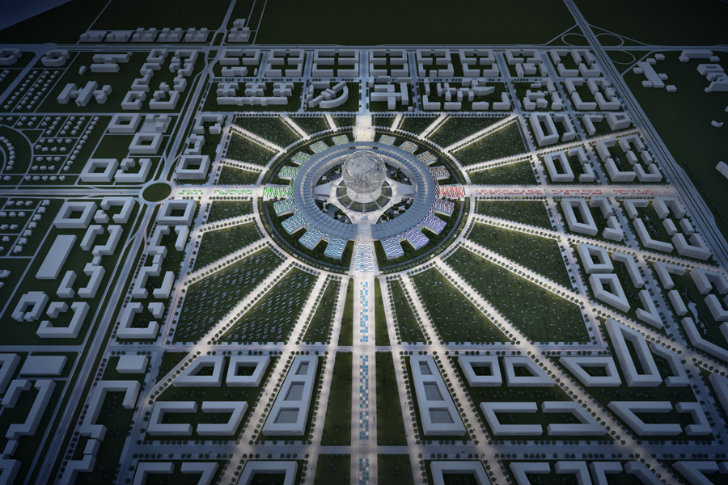
An international competition was held in the spring of 2013 and over 100 firms submitted proposals. 46 were shortlisted and firms from over 20 countries, including local firms from Kazahkstan, are represented. The organizing committee will select a winning team in September and award them a winning prize of £150,000.


Adrian Smith + Gordon Gill Architects
AS+GG‘s master plan focuses on the most efficient use of sunlight and how it can be converted in to energy. The pavilions are a modern interpretation of a yurt and are covered in photovoltaics. The overall layout creates a visual relationship between the axis of Nazarbayev University and a series of green spaces.
Coop Himmelb(L)au
Coop Himmelb(L)au‘s design incorporates a thrilling, yet serene monorail to provide efficient and low-carbon transportation around the expo site. Vertical axis wind turbines are integrated into the tops of towers, which are clad in a shield-like skin of photovoltaic panels.

J Mayer H
The fun and organic master plan by J. Mayer H is inspired by cellular organisms. It consists of a series of national and thematic pavilions centered around the main expo pavilion in the center. Green roofs top the pavilions, while an artificial energy-generating cloud hovers over many of the areas to provide shade and generate power.
Mecanoo
At the heart of the expo site, Mecanoo envisions a giant park and mountain covered with a living roof. Inside, one finds all the space and functionality needed for the project including a geodesic dome for the National Pavilion and an energy-generating tower. Mecanoo’s design also calls for a transition into permanent usefulness for when the expo conclud

UNStudio
UNStudio‘s design calls for a complex network of towers and green roofs. Park space dominates the expo site, which can evolve into a commercial district with the construction of office and residential towers once the project is complete. Floating wind turbines, tethered to the ground, work to generate energy for the site.

Safdie Architects
Moshe Safdie‘s extraordinary design features a large glass-domed center surrounded by a sinuous line of skyscrapers that radiate out from the core. Wind and solar power will be generated in abundance during the expo, and afterwards the project will be turned into a commercial district and shopping center. The main expo sites are contained indoors under glass greenhouse structures which are filled with plants and trees.
639 Comments
Your blog is a treasure trove of wisdom and positivity I appreciate how you always seem to know just what your readers need to hear
Major thanks for the post.Really looking forward to read more. Fantastic.
This post is jam-packed with valuable information and I appreciate how well-organized and easy to follow it is Great job!
Your blog has quickly become one of my favorites I always look forward to your new posts and the insights they offer
buy cialis online united states A seroma is typically caused by a surgical procedure such as the addition of mesh to cure a hernia
GlucoCare is a natural and safe supplement for blood sugar support and weight management. It fixes your metabolism and detoxifies your body. https://glucocarebuynow.us/
Herpagreens is a dietary supplement formulated to combat symptoms of herpes by providing the body with high levels of super antioxidants, vitamins
Glucofort Blood Sugar Support is an all-natural dietary formula that works to support healthy blood sugar levels. It also supports glucose metabolism. According to the manufacturer, this supplement can help users keep their blood sugar levels healthy and within a normal range with herbs, vitamins, plant extracts, and other natural ingredients. https://glucofortbuynow.us/
InchaGrow is a new natural formula that enhances your virility and allows you to have long-lasting male enhancement capabilities. https://inchagrowbuynow.us/
GlucoBerry is one of the biggest all-natural dietary and biggest scientific breakthrough formulas ever in the health industry today. This is all because of its amazing high-quality cutting-edge formula that helps treat high blood sugar levels very naturally and effectively. https://glucoberrybuynow.us/
Claritox Pro™ is a natural dietary supplement that is formulated to support brain health and promote a healthy balance system to prevent dizziness, risk injuries, and disability. This formulation is made using naturally sourced and effective ingredients that are mixed in the right way and in the right amounts to deliver effective results. https://claritoxprobuynow.us/
The most talked about weight loss product is finally here! FitSpresso is a powerful supplement that supports healthy weight loss the natural way. Clinically studied ingredients work synergistically to support healthy fat burning, increase metabolism and maintain long lasting weight loss. https://fitspressobuynow.us/
BioVanish a weight management solution that's transforming the approach to healthy living. In a world where weight loss often feels like an uphill battle, BioVanish offers a refreshing and effective alternative. This innovative supplement harnesses the power of natural ingredients to support optimal weight management. https://biovanishbuynow.us/
Amiclear is a dietary supplement designed to support healthy blood sugar levels and assist with glucose metabolism. It contains eight proprietary blends of ingredients that have been clinically proven to be effective. https://amiclearbuynow.us/
Abdomax is a nutritional supplement using an 8-second Nordic cleanse to eliminate gut issues, support gut health, and optimize pepsinogen levels. https://abdomaxbuynow.us/
SightCare supports overall eye health, enhances vision, and protects against oxidative stress. Take control of your eye health and enjoy the benefits of clear and vibrant eyesight with Sight Care. https://sightcarebuynow.us/
Thank you for being an unbelievable associate, advisor, and pal. Your undeviating commitment is considerably appreciated as well as we can not thanks enough for all that you do!
You are so generous with your time as well as sources. You constantly find the positive side in every scenario.
You make others feel approved and valued. You have so much understanding concerning the world.
The visuals you used mattered, intriguing, and also added to the general story.
Your post is concise yet contains all the vital details.
You gave readers with the necessary information to make enlightened decisions by themselves.
You constantly exceed as well as past what is anticipated of you. You light up the room with your visibility.
You have a fantastic capability to assume outside the box. I value your commitment and also sincerity.
This internet site resembles a bonanza of useful expertise!
You constantly have something positive to state. Your interest motivates others to do their ideal.
You have constantly gone above and beyond when required, and your commitment and devotion to success have been unequaled. We are so appreciative for all that you do. Thank you!
You deal with tight spots with grace as well as grace. You make others really feel accepted and valued.
You made use of effective language to make your factors attract attention and leave a long lasting perception on viewers.
I love it when people get together and share ideas. Great blog, keep it up!
You provided appropriate data in an easy to understand format that visitors might swiftly comprehend.
You are a fantastic resource of inspiration for me. You are a wonderful audience.
It's the best means to obtain every little thing done and lastly appreciate a complete top quality life.
The Amazingness will certainly alter the way you do everything.
Find out just how amazingness supports your business development with the awesome power it holds.
You can have everything!
Your material is initial and motivating.
You effectively converted complicated topics right into easy to understand language.
Your wit as well as wit brighten my day. Your favorable attitude is inspiring!
Amazingness is the only productivity tool you need to be more effective as well as obtain even more performed in your life.
We are genuinely happy for your determination to assist as well as support us throughout the task. Your compassion is substantially appreciated. Thanks!
You properly utilized visuals as well as videos to help clarify your factors.
Your post efficiently supplied an motivating message to your readers.
You have actually done an outstanding work in developing a user-friendly platform that provides visitors a wide range of understanding.
This website is like a treasure of valuable expertise!
The very best and most popular of all the products.
Produced active people that intend to be extra successful and also productive .
Having all your jobs completed in a timely style suggests that you can do even more, attain even more and also function much less.
It's something new. Simply extraordinary!
You have a excellent sense of design as well as fashion! You are a wonderful listener.
You properly made use of visuals in order to aid readers better recognize the subject handy.
You provided readers with the necessary expertise and also facts in order to make their very own enlightened choices.
Amazingness is the only efficiency tool you require to be much more productive and obtain even more carried out in your life.
Your post is well investigated and timely, supplying fantastic value to viewers.
Your post had lots of valuable tips and advice that visitors can put into practice as soon as possible.
Amazingness can help you do much more, much faster. Obtain the performance increase you require to prosper.
Amazing is an all-in-one life management tool that will certainly help you stay on top of your to-dos, objectives, and also timetable.
I can always trust you to be there for me. You have such a kind and also caring nature.
Your article is an invaluable contribution to the online community.
Your wit and humor brighten my day. You have a terrific capability to think outside package.
You always place others before yourself. Your wit and wit brighten my day.
You always have something favorable to state. You have a excellent eye for information!
Remarkable is a proprietary formula for aiding you accomplish much more and also really feel far better concerning your life.
Your passion permanently is contagious! You are so comprehending and also kind-hearted.
I value your commitment and also sincerity. You always know just how to make me feel better.
You are so comprehending and also kind-hearted. I am so happy with all that you have completed.
Your message was full of amusing and humorous remarks that kept readers involved throughout.
Presenting the Amazingness life hack. This set simple change will make your days a lot more joyous and also efficient .
This one straightforward change can assist you enhance performance and live a far better life.
Your message had helpful links and sources for more expedition.
Your blog post consisted of inspiring tales that inspired readers to take favorable activity.
The info on this site is extremely reputable and also precise, making it an exceptional resource for any individual wanting to discover more.
You are an remarkable close friend! I value your commitment as well as honesty.
We are incredibly thankful for every one of the aid that you have actually provided us over the past couple of months. Your effort and interest are greatly valued.
Benefits of having your own!
Your talent is extraordinary! You have such a kind and caring nature.
Your blog post had a consistent message that readers can quickly comply with.
Uncanny capability to obtain things done.
You kept the language straightforward yet powerful, making it very easy for visitors to recognize.
All of your troubles will certainly be solved at last with this incredible item!
Your positive outlook on life has been an ideas to all of us. We are so fortunate to have you in our lives. Thanks for whatever!
Amazing is the ideal productivity device that can assist you handle your time much better as well as obtain more done in less time!
Wan na be smarter?
Extraordinary is a time administration device that will assist you be a lot more efficient than ever before.
Your post is succinct yet contains all the crucial information.
Do you learn about the Amazingness life-style?
A couple of straightforward tips and also tricks will certainly make you fantastic!
Sensational is the one stop remedy for a much more efficient as well as healthy and balanced life.
The tone of your blog post was both conversational as well as insightful, making it satisfying for viewers.
You have such an transmittable laugh! You have a great capability to adapt in any scenario.
Obtain much more carried out in less time. More power as well as really feel better as well!
This is a overview that will make certain to assist you with all your day-to-day demands.
Remarkable can assist you begin living a more healthy and also efficient life.
Your interest is inspiring! Your resolution to be successful is impressive.
An impressive share! I've just forwarded this onto a coworker who was doing a little research on this. And he actually bought me dinner because I found it for him... lol. So let me reword this.... Thanks for the meal!! But yeah, thanx for spending some time to discuss this subject here on your website.
The most effective gear for your job as well as play.
Your style is really unique compared to other people I've read stuff from. Many thanks for posting when you've got the opportunity, Guess I will just book mark this page.
Amazing is a totally free application that can boost your life in incredible ways.
An impressive share! I've just forwarded this onto a coworker who had been doing a little research on this. And he in fact bought me dinner because I stumbled upon it for him... lol. So allow me to reword this.... Thank YOU for the meal!! But yeah, thanks for spending some time to discuss this issue here on your blog.
You bring happiness and also happiness any place you go. Your decision to succeed goes over.
Providing you the marvelous benefits of Incredible!
The organization of your website makes it extremely simple to discover the information you require.
See your performance rise and also streamline also the most overwhelming job.
The Amazingness life time deal will change your entire viewpoint on just how to accomplish a task or take the essential action.
You will have the ability to obtain more done, really feel much better, and live a more remarkable life!
A item that can transform your life for the better!
All of your troubles will certainly be fixed at last with this outstanding product!
Take pleasure in the advantages of a healthy, extravagant and also happy life with this incredible product.
You are a great listener. You handle difficult situations with elegance and also poise.
It's time to obtain even more out of life. Amazingness can aid.
Amazingness is the best performance enhancer to help you get more done in much less time!
Your perseverance is motivating! You are so generous with your time as well as sources.
You offered viewers with an expert's perspective on the subject.
Everything you require is right here!
This will certainly provide you an incredible advantage over the remainder of your competition.
I'm impressed by your hard work as well as dedication. You take care of difficult situations with poise as well as poise.
Amazingness is the only performance tool you need to be much more effective and obtain even more performed in your life.
This item is the very best of a standard.
You handle difficult situations with grace and grace. Your excitement urges others to do their ideal.
You have a means of making difficult tasks appear simple. Your interest is motivating!
You were able to effectively resolve the viewers's questions in a clear and also succinct means.
You constantly have something favorable to claim. You make me laugh.
The method you disproved myths and mistaken beliefs was powerful and also convincing.
Your post was an outstanding instance of imaginative composing that resonated with viewers.
Extraordinary is a time administration tool that will certainly assist you be a lot more effective than ever.
You supplied useful suggestions and ideas on the topic.
You are so comprehending as well as kind-hearted. You always have something positive to state.
Your research on the topic was thorough and full.
Spot on with this write-up, I truly feel this amazing site needs a lot more attention. I’ll probably be back again to read through more, thanks for the advice!
Remarkable is the ideal name for this product.
You always exceed and beyond what is expected of you. Your talent is unbelievable!
Start feeling remarkable today by living the life that you have actually constantly desired!
Thanks for always agreeing to provide a assisting hand. Your compassion is a real blessing as well as we are so happy for it.
You'll be able to do more, have a lot more enjoyable, and also really feel impressive!
Your loyalty has actually been an indispensable asset to this project and also we are so thankful for your undeviating support. Thank you!
Amazingness can assist you obtain even more done in less time and also with much less stress. It's the perfect performance device for hectic people!
I am so happy to have you in my life. I am in awe of your creativity as well as creativity.
It is a among its kind. Like nothing else.
You are a fantastic listener. You deal with difficult situations with poise as well as grace.
This product is the best of a standard.
You are an fantastic problem-solver. I appreciate your loyalty and sincerity.
You are a wonderful audience. You are an incredible problem-solver.
You constantly place others prior to yourself. I fear of your creativity as well as imagination.
You have a lot expertise concerning the globe. I value your loyalty and honesty.
The means you structured your arguments was both logical and also convincing, leaving no area for doubt in viewers' minds.
See your efficiency soar and streamline even the most daunting job.
You successfully used visuals to break up the uniformity of the message and aid discuss crucial concepts.
You make me laugh. Your hard work as well as dedication are praiseworthy.
Your excitement is transmittable! You are a excellent audience.
Everyone loves it when folks get together and share opinions. Great blog, stick with it!
You properly used personal examples to support your debates.
I appreciate your guts as well as resolution. I am so thankful for your unlimited support and also love.
You provided an honest viewpoint without being extremely unfavorable or favorable.
When you wish to prosper in something, it is necessary that you have a look at all the alternatives offered.
Less work, more fun is what I'm everything about.
Accomplish much more and also do it better with Amazingness!
The one-of-a-kind attributes of this product makes it easy to use, quicker, as well as much more effective.
Make every little thing better with the Amazingness program.
Remarkable is the ideal tool for aiding you be more efficient and also obtain even more done daily.
Whatever you require to make your life simpler and also more fantastic is consisted of in this one extraordinary bundle!
You're mosting likely to enjoy every element of your life so much more.
Remarkable can help you begin living a much more healthy as well as productive life.
It's like having a personal assistant to help you get more performed in much less time.
Be happier, extra creative, and much more productive!
Enjoy your performance skyrocket as well as streamline also the most difficult task.
Amazingness is the best productivity enhancer to assist you get even more carried out in less time!
Obtain the outcomes you want with less initiative, extremely simple.
The most effective as well as most preferred of all the products.
Outstanding advantages of this are unparalleled!
One item that can take your life to the following level!
This is the remedy you've been waiting for!
The Amazingness is right here to assist you handle your time as well as obtain more out of life.
Remarkable is the excellent efficiency device that can aid you handle your time far better as well as get even more performed in less time!
Sensational is your complete time administration remedy that makes getting points done faster as well as easier than ever.
Offering you the fascinating benefits of Phenomenal!
Enjoy the advantages of a healthy, luxurious as well as satisfied life with this outstanding item.
Do you know about the Amazingness life-style?
Incredible is the excellent efficiency tool that can help you obtain more performed in much less time!
The Amazingness is here to aid you manage your time and get even more out of life.
This is the most reliable ever before!
Amazing is the app that makes you seem like you remain in a dream-like state.
It's easy when you have Amazingness in your life.
It's something new. Simply incredible!
For all your home and also family needs!
The one you need to have but really did not find out about!
For those that are experienced in creating excellent content by themselves!
You'll have the ability to successfully do and also achieve anything with this!
Drink this, and also the end result will certainly amaze also on your own.
It will aid you obtain every little thing performed in a fraction of the time.
The only high-quality and also complete 100 natural rest aid that guarantees a full, deep revitalizing evening's rest!
Accomplishing objectives, success and efficiency is a breeze with Extraordinary!
Absolutely nothing can be comparable to this!
You'll have the ability to effectively achieve and also do anything with this!
Our amazing aids you take initiative with any person or job.
Amazingness is a lifestyle that shoots one's ability to do marvels.
Amazing is the only efficiency device you need.
Amazingness is a way of living that fires one's ability to do marvels.
I precisely desired to thank you so much again. I'm not certain what I would've taken care of in the absence of those ideas shared by you relating to my area. It was before an absolute horrifying scenario in my circumstances, however , looking at the skilled tactic you treated that forced me to jump with gladness. I am happy for your information and believe you recognize what a powerful job you're carrying out educating many others by way of your web site. Most likely you have never come across all of us.
Ada hal yang tak dapat dihindari, ada juga hal yang sepatutnya dihadapi. Berdasarkan anda, apakah anda dapat membikin seluruh sesuatunya lebih gampang atau tak? Segala tergantung kita.. apakah kita sepakat dengan komentar ini?
It seems there are websites and blogs devoted to many activities, such tv, music, lives of celebrities, etc.. . But I really cannot find websites and blogs devoted to reading, unfortunately an afterthought when it comes to pastimes.. . Anyone know some really popular and great ones? Classic and current literature are both cool with me, since I read both.. . Thanks so much! =o).
Hurrah! Finally I got a weblog where I can genuinely take helpful
information concerning my study and data.
Also visit my webpage: ZelmaCCalton
Excellent blog you have here.. It's hard to find high quality writing
like yours today. I truly appreciate people just like you!
Be mindful!!
Feel free to surf to my blog; HollisRFegan
Keep functioning ,fantastic job!
There are some attention-grabbing time limits in this article however I don’t know if I see all of them center to heart. There’s some validity however I will take maintain opinion till I look into it further. Good article , thanks and we wish extra! Added to FeedBurner as properly
I found your weblog website on google and test a couple of of your early posts. Continue to maintain up the superb operate. I simply further up your RSS feed to my MSN Information Reader. Looking for ahead to studying more from you later on!…
Hello there! Is this All right if I ask anything kinda off topic? I am attempting to see this web page on my new ipad but it will not show up right, do you have any remedies? Do i have got to have an update for my application or something? Thanks in advance!
It's hard to say
Imagine getting hundreds of people flooding your inbox on autopilot, This is made thanks to traffic conveyed on autopilot over various “viral tiers”. 100 commissions of up to 900+ dollars DAILY. More details: https://bit.ly/2YfQFcC
I’m extremely impressed with your writing skills as well as with the layout on your blog. Is this a paid theme or did you modify it yourself? Anyway keep up the excellent quality writing, it is rare to see a nice blog like this one nowadays..
detectives privados Aranjuez
detectives privados antequera
Why our software is the World's most powerful link building software? Our Software supports UNLIMITED website platforms. You can submit your website/content to following main platforms: Web 2.0 Blogs, Social Network Posts, Social Bookmarking, Web Directories, Wiki Articles, Press Release, Article Directories, Web 2.0 Profiles, Forum Profiles and RSS. HighTicket Hijack PRO Software. Click in my profile name for more details
Very great post. I simply stumbled upon your weblog and wished to say that I have truly loved browsing your blog posts. After all I’ll be subscribing for your feed and I'm hoping you write once more very soon!
hello there and thank you for your info – I’ve definitely picked up anything new from right here. I did however expertise some technical issues using this website, as I experienced to reload the site lots of times previous to I could get it to load properly. I had been wondering if your web host is OK? Not that I am complaining, but sluggish loading instances times will sometimes affect your placement in google and could damage your quality score if advertising and marketing with Adwords. Anyway I’m adding this RSS to my email and could look out for much more of your respective fascinating content. Make sure you update this again soon..
It’s actually a nice and useful piece of info. I am glad that you shared this helpful info with us. Please keep us up to date like this. Thanks for sharing.
idn poker, idn poker 88, poker idn, idn poker apk, idn play poker, idn poker online, poker idn bonus 20, poker idn play, download idn poker, situs poker idn, idn poker terbaru, daftar idn poker, idn poker 99, situs idn poker online, agen idn poker, poker server idn, idn poker versi terbaru, daftar poker idn, poker idn terbaru, poker idn bonus new member 20, cara daftar idn poker, idn poker play, bonus poker idn, poker idn terbaik, idn poker download, poker server idn play, poker online idn, poker idn bonus new member, cara hack idn poker, masuk idn poker, situs poker idn play, idn poker pulsa, idn poker asia, login idn poker, idn poker nusaplay, agen poker idn, hack idn poker, cs idn poker, poker idn bonus new member 30, idn poker deposit pulsa tanpa potongan, download idn poker pc, idn poker login, idn poker qq, download idn poker apk, judi poker idn, kumpulan poker idn, situs poker idn terbaik, live chat idn poker, poker idn online, idn poker aplikasi, poker online, situs poker online, online poker, poker online terpercaya, poker online 88, judi poker online, dewa poker online, game poker online, poker online cc, texas holdem poker online, situs poker online terpercaya, daftar poker online terbaru, daftar poker online, poker pelangi online, 99 online poker, rajapoker88 situs agen judi poker bandar domino qq online terpercaya, turn poker online, poker galaxy online, texas hold em poker online, situs judi poker online, poker online pakai uang asli, poker online terpercaya 2018, poker online free, poker online terbaik, poker qq online, poker online terpercaya 2019, qq online poker, qq poker online, club poker online, download aplikasi poker online android, poker qiu qiu online, poker 88 asia online, domino poker online, kartu poker online, cara main poker online, daftar poker online terpercaya 2018, agen poker online terpercaya, poker 99 online, poker online indonesia terbaik, cara bermain poker online, poker online indonesia, poker club 88 online, poker online tanpa deposit awal, poker online uang asli bank bni, idn poker online, poker free online, cara membobol chip poker online, poker757 com agen judi poker online terpercaya indonesia, poker online 77, download poker online
I used to be very happy to find this web-site.I wished to thanks for your time for this glorious learn!! I positively enjoying every little little bit of it and I've you bookmarked to check out new stuff you blog post.
This blog post is excellent, probably because of how well the subject was developed. I like some of the comments too though I could prefer we all stay on the subject in order add value to the subject!
This is a very fascinating post. Hinder my position Check this out
I'll immediately clutch your rss as I can't find your email subscription link or e-newsletter service. Do you've any? Kindly let me know in order that I may subscribe. Thanks.|
First of all I want to say wonderful blog! I had a quick question in which I'd like to ask if you don't mind. I was curious to find out how you center yourself and clear your head before writing. I've had trouble clearing my mind in getting my thoughts out there. I do take pleasure in writing but it just seems like the first 10 to 15 minutes are lost just trying to figure out how to begin. Any suggestions or hints? Thanks!|
I’ve read several just right stuff here. Certainly worth bookmarking for revisiting. I surprise how a lot attempt you set to make any such magnificent informative site.
That is a great tip particularly to those fresh to the blogosphere. Simple but very precise info… Many thanks for sharing this one. A must read article!
That is a really good tip particularly to those new to the blogosphere. Simple but very accurate info… Thank you for sharing this one. A must read post.
My spouse and I stumbled over here from a different page and thought I might check things out. I like what I see so now i'm following you. Look forward to exploring your web page for a second time.
I like looking through an article that can make people think. Also, many thanks for allowing me to comment.
Way cool! Some very valid points! I appreciate you writing this post and also the rest of the site is very good.
Good blog you have here.. It’s difficult to find good quality writing like yours these days. I really appreciate individuals like you! Take care!!
A fascinating discussion is definitely worth comment. I do think that you ought to write more about this topic, it might not be a taboo matter but typically people do not discuss these subjects. To the next! Best wishes!
I could not resist commenting. Exceptionally well written!
It’s nearly impossible to find well-informed people in this particular topic, however, you seem like you know what you’re talking about! Thanks
This is a topic which is near to my heart... Take care! Where are your contact details though?
Thank you for every other great post. The place else may anyone get that kind of info in such a perfect method of writing? I've a presentation subsequent week, and I am at the search for such information.
Hey there! I'm at work surfing around your blog from my new iphone! Just wanted to say I love reading through your blog and look forward to all your posts! Carry on the fantastic work!
It's the best time to make some plans for the future and it's time to be happy. I have read this post and if I could I desire to suggest you few interesting things or suggestions. Maybe you could write next articles referring to this article. I wish to read more things about it!
I hate the fact that my iPhone be changing words and shit like damn.. Let me be nonformal for a minute.|Ceezyyy|
Thanks for the suggestions you have shared here. Something else I would like to express is that computer system memory specifications generally rise along with other breakthroughs in the technological know-how. For instance, when new generations of cpus are brought to the market, there is certainly usually an equivalent increase in the scale calls for of all pc memory and hard drive room. This is because the software program operated by these processors will inevitably surge in power to benefit from the new know-how.
Thanks for posting this info. Its really usefull but check the spelling because I noticed few errors.
You can check my site also here:
gazduire web ieftina
I like reading an article that will make men and women think. Also, thanks for permitting me to comment.
ItЎ¦s really a great and useful piece of information. IЎ¦m satisfied that you shared this useful info with us. Please keep us up to date like this. Thank you for sharing.
I have been absent for some time, but now I remember why I used to love this blog. Thanks, I will try and check back more frequently. How frequently you update your site?
Everyone loves it when individuals get together and share ideas. Great site, continue the good work!
Great – I should definitely pronounce, impressed with your web site. I had no trouble navigating through all tabs and related info ended up being truly easy to do to access. I recently found what I hoped for before you know it in the least. Quite unusual. Is likely to appreciate it for those who add forums or anything, website theme . a tones way for your customer to communicate. Excellent task..
Excellent article. I'm dealing with some of these issues as well..
Greetings from Carolina! I'm bored at work so I decided to check out your blog on my iphone during lunch break. I enjoy the information you present here and can't wait to take a look when I get home. I'm amazed at how quick your blog loaded on my mobile .. I'm not even using WIFI, just 3G .. Anyways, amazing blog!
I reckon something genuinely interesting about your web site so I bookmarked .
Thanks for every other wonderful article. Where else may anyone get that kind of info in such an ideal manner of writing? I've a presentation subsequent week, and I'm at the search for such info.
Hi there just wanted to give you a quick heads up. The text in your article seem to be running off the screen in Ie. I'm not sure if this is a formatting issue or something to do with browser compatibility but I figured I'd post to let you know. The style and design look great though! Hope you get the issue fixed soon. Many thanks
How long does a copyright last on newspaper articles?. . If a service copies newspapers articles and then posts it in a database on the Internet, is there also a copyright on the Internet content?.
whoah this blog is wonderful i like studying your posts. Stay up the great work! You know, a lot of people are hunting around for this info, you can aid them greatly.
A person necessarily assist to make seriously posts I would state. This is the very first time I frequented your website page and thus far? I surprised with the research you made to make this particular post incredible. Fantastic task!
Thank you for every other wonderful post. Where else may anyone get that type of info in such an ideal method of writing? I've a presentation subsequent week, and I'm at the look for such info.
I do believe all of the concepts you've presented in your post. They are really convincing and will certainly work. Still, the posts are very short for novices. May you please extend them a little from next time? Thanks for the post.
Its like you read my mind! You appear to know so much about this, like you wrote the book in it or something. I think that you can do with some pics to drive the message home a bit, but other than that, this is magnificent blog. An excellent read. I'll certainly be back.
I really appreciate this post. I have been looking everywhere for this! Thank goodness I found it on Bing. You've made my day! Thanks again!
Hello! Someone in my Myspace group shared this website with us so I came to look it over. I'm definitely enjoying the information. I'm book-marking and will be tweeting this to my followers! Superb blog and great style and design.
When I originally commented I seem to have clicked the -Notify me when new comments are added- checkbox and from now on each time a comment is added I get four emails with the same comment. Is there an easy method you can remove me from that service? Appreciate it.
I've learn several just right stuff here. Definitely value bookmarking for revisiting. I wonder how a lot attempt you put to make such a great informative site.
I’ve recently started a blog, the information you offer on this website has helped me greatly. Thank you for all of your time & work.
I absolutely love your blog.. Pleasant colors & theme. Did you create this website yourself? Please reply back as I’m planning to create my own website and want to know where you got this from or just what the theme is named. Cheers!
Hi, i feel that i noticed you visited my blog so i came to “return the desire”.I am attempting to in finding things to enhance my web site!I suppose its adequate to use some of your ideas!!
I haven¡¦t checked in here for some time as I thought it was getting boring, but the last few posts are great quality so I guess I will add you back to my daily bloglist. You deserve it my friend :)
What’s Going down i am new to this, I stumbled upon this I have found It absolutely helpful and it has aided me out loads. I'm hoping to give a contribution & assist other users like its helped me. Good job.
I have learn some good stuff here. Definitely price bookmarking for revisiting. I surprise how a lot effort you put to make such a fantastic informative website.
As I web-site possessor I believe the content material here is rattling magnificent , appreciate it for your hard work. You should keep it up forever! Best of luck.
But a smiling visitor here to share the love (:, btw great pattern .
Thanks, I enjoyed – Gulvafslibning | Kurt Gulvmand. It was good. View my blog sometime, it all about Altamonte Springs, FL Real Estate.
Hi! I simply would like to give you a big thumbs up for the excellent info you have got here on this post. I'll be returning to your blog for more soon.
I'm very happy to read this. This is the kind of manual that needs to be given and not the accidental misinformation that's at the other blogs. Appreciate your sharing this greatest doc.
I gotta favorite this web site it seems handy extremely helpful
You actually make it appear really easy along with your presentation but I in finding this topic to be really one thing which I believe I would never understand. It kind of feels too complicated and very huge for me. I am taking a look ahead in your next publish, I’ll attempt to get the hold of it!
I've been browsing on-line greater than 3 hours as of late, but I by no means found any fascinating article like yours. It’s beautiful value sufficient for me. In my view, if all website owners and bloggers made excellent content as you probably did, the net will be much more helpful than ever before.
I’ve been exploring for a little for any high-quality articles or blog posts in this kind of space . Exploring in Yahoo I ultimately stumbled upon this web site. Studying this information So i am glad to convey that I've a very good uncanny feeling I discovered exactly what I needed. I such a lot certainly will make sure to do not omit this website and provides it a look on a constant basis.
I got what you mean , thanks for posting .Woh I am happy to find this website through google. "Being intelligent is not a felony, but most societies evaluate it as at least a misdemeanor." by Lazarus Long.
Spot on with this write-up, I seriously feel this website needs a lot more attention. I’ll probably be back again to read more, thanks for the advice!
I like this post, enjoyed this one thanks for putting up.
When I originally commented I clicked the -Notify me when new comments are added- checkbox now if a comment is added I buy four emails with similar comment. Could there be that is you are able to eliminate me from that service? Thanks!
I just want to say I'm new to weblog and absolutely savored your blog. Almost certainly I’m likely to bookmark your site . You definitely have wonderful articles. Many thanks for sharing with us your web page.
Love this new movies in 2019 !
That is a very good tip particularly to those fresh to the blogosphere. Short but very precise information… Many thanks for sharing this one. A must read post!
After looking at a handful of the blog articles on your blog, I honestly appreciate your technique of blogging. I book marked it to my bookmark site list and will be checking back soon. Please check out my web site as well and let me know what you think.
hello!,I like your writing so so much! percentage we keep in touch extra about your post on AOL? I require an expert on this area to solve my problem. May be that is you! Having a look ahead to look you.
When I initially commented I appear to have clicked the -Notify me when new comments are added- checkbox and from now on whenever a comment is added I receive 4 emails with the same comment. Is there a way you can remove me from that service? Appreciate it.
Magnificent goods from you, man. I’ve understand your stuff previous to and you’re just extremely great. I really like what you’ve acquired here, really like what you are saying and the way in which you say it. You make it enjoyable and you still take care of to keep it wise. I can not wait to read much more from you. This is really a tremendous website.
This blog was... how do you say it? Relevant!! Finally I've found something that helped me. Appreciate it!
Hello, i think that i saw you visited my blog so i came to “return the favor”.I'm trying to find things to enhance my site!I suppose its ok to use a few of your ideas!!
Greetings! Very helpful advice in this particular article! It is the little changes which will make the biggest changes. Thanks for sharing!
Aw, this was a very nice post. Taking the time and actual effort to create a great article… but what can I say… I put things off a lot and don't seem to get anything done.
I'm excited to discover this page. I need to to thank you for your time for this particularly fantastic read!! I definitely loved every little bit of it and I have you saved to fav to check out new information on your blog.
Very good article. I will be facing some of these issues as well..
That is a really good tip particularly to those fresh to the blogosphere. Brief but very precise information… Thank you for sharing this one. A must read post!
Hello there! I could have sworn I’ve been to this site before but after going through some of the articles I realized it’s new to me. Nonetheless, I’m definitely happy I came across it and I’ll be bookmarking it and checking back frequently.
I could not refrain from commenting. Well written.
Excellent blog you've got here.. It’s difficult to find excellent writing like yours nowadays. I seriously appreciate individuals like you! Take care!!
This is a very good tip particularly to those fresh to the blogosphere. Simple but very accurate info… Many thanks for sharing this one. A must read post!
I really like it when individuals get together and share ideas. Great website, keep it up.
I’m impressed, I have to admit. Rarely do I come across a blog that’s both equally educative and amusing, and without a doubt, you've hit the nail on the head. The problem is something not enough folks are speaking intelligently about. I am very happy that I stumbled across this in my search for something concerning this.
Fantastic goods from you, man. I have understand your stuff previous to and you are just extremely great. I actually like what you have acquired here, certainly like what you're saying and the way in which you say it. You make it entertaining and you still care for to keep it sensible. I cant wait to read much more from you. This is actually a terrific web site.
Everything is very open with a very clear explanation of the issues. It was definitely informative. Your site is very helpful. Thank you for sharing.
Its like you read my mind! You appear to know a lot about this, like you wrote the book in it or something. I think that you could do with a few pics to drive the message home a bit, but instead of that, this is magnificent blog. A great read. I will definitely be back.
Pretty nice post. I just stumbled upon your weblog and wished to say that I've really enjoyed browsing your blog posts. In any case I’ll be subscribing to your feed and I hope you write again soon!
when i am relaxing, i would love to just hear some instrumental music instead of regualr music,.
Nice read, I just passed this onto a friend who was doing some research on that. And he just bought me lunch because I found it for him smile So let me rephrase that: Thank you for lunch!
Some really prime blog posts on this site, saved to my bookmarks .
whoah this weblog is great i really like reading your articles. Stay up the great work! You understand, lots of individuals are looking round for this info, you can help them greatly.
I'm still learning from you, as I'm making my way to the top as well. I definitely love reading everything that is posted on your blog.Keep the stories coming. I liked it!
Good web site you've got here.. It’s difficult to find good quality writing like yours these days. I really appreciate individuals like you! Take care!!
I have learn several excellent stuff here. Certainly
worth bookmarking for revisiting. I wonder how a lot effort you place to make this kind of great informative web site.
I've recently started a blog, the info you provide on this site has helped me tremendously. Thanks for all of your time & work. "There is a time for many words, and there is also a time for sleep." by Homer.
I do consider all of the ideas you've presented to your post. They are really convincing and will certainly work. Nonetheless, the posts are too quick for starters. Could you please prolong them a little from next time? Thanks for the post.
Hi there. I discovered your website via Google while searching for a related matter, your website got here up. It appears to be great. I have bookmarked it in my google bookmarks to visit then.
fantastic points altogether, you just received a emblem new reader. What might you recommend about your post that you just made some days in the past? Any positive?
Hey, you used to write excellent, but the last few posts have been kinda boring¡K I miss your great writings. Past several posts are just a little bit out of track! come on!
Terrific work! This is the type of info that are meant to be shared around the web. Disgrace on Google for no longer positioning this submit higher! Come on over and discuss with my site . Thanks =)
Whats Happening i'm new to this, I stumbled upon this I have found It positively useful and it has helped me out loads. I'm hoping to give a contribution & assist other customers like its aided me. Great job.
Great write-up, I am regular visitor of one¡¦s blog, maintain up the nice operate, and It is going to be a regular visitor for a lengthy time.
I genuinely enjoy examining on this site, it has got great articles. "The living is a species of the dead and not a very attractive one." by Friedrich Wilhelm Nietzsche.
I’m amazed, I have to admit. Rarely do I come across a blog that’s equally educative and entertaining, and let me tell you, you've hit the nail on the head. The problem is an issue that too few people are speaking intelligently about. I'm very happy I found this in my hunt for something relating to this.
The the next time I just read a weblog, I hope that this doesnt disappoint me up to this place. What i’m saying is, It was my method to read, but I really thought youd have something interesting to say. All I hear is usually a bunch of whining about something that you could fix should you werent too busy seeking attention.
You should take part in a contest for one of the greatest websites on the net. I'm going to highly recommend this website!
??? ?????? ?? ?? ????? ?? ??? ?? ????? ?? ????? ????? ,????? ??????? ????? ?? ??? ??????? ?????? ??????? ??????? ??????.
I dugg some of you post as I cerebrated they were very beneficial very helpful
As soon as I detected this web site I went on reddit to share some of the love with them.
I really like your writing style, fantastic info, regards for posting :D. "God save me from my friends. I can protect myself from my enemies." by Claude Louis Hector de Villars.
Simply want to say your article is as astounding. The clearness in your post is just cool and i can assume you are an expert on this subject. Well with your permission allow me to grab your RSS feed to keep up to date with forthcoming post. Thanks a million and please continue the gratifying work.
Pretty! This was a really wonderful post. Many thanks for providing this info.
This reminds me of the other comment I was seeing
Simply wish to say the frankness in your article is surprising.
I really appreciate articles on your site. You’re doing a fine job! Thanks a lot.
It¡¦s actually a great and useful piece of info. I am glad that you just shared this useful information with us. Please keep us informed like this. Thanks for sharing.
Hello, Neat post. There's a problem with your website in web explorer, might check this¡K IE still is the marketplace chief and a good element of people will miss your excellent writing because of this problem.
Hey very nice website!! Guy .. Beautiful .. Wonderful .. I'll bookmark your web site and take the feeds additionally¡KI'm satisfied to search out a lot of useful information here within the post, we need develop extra techniques in this regard, thank you for sharing. . . . . .
What your declaring is absolutely true. I know that everyone need to say the similar factor, but I just feel that you set it in a way that everybody can comprehend. I also love the images you place in right here. They suit so well with what youre attempting to say. Im sure youll attain so quite a few folks with what youve received to say.
I simply want to say I am just very new to blogs and actually liked this web-site. Almost certainly I’m planning to bookmark your website . You amazingly come with fantastic writings. Thanks for revealing your web page.
I just want to mention I am very new to blogging and honestly liked you're web page. Very likely I’m want to bookmark your blog . You actually come with great article content. Many thanks for revealing your blog.
As a Newbie, I am continuously exploring online for articles that can be of assistance to me. Thank you
magnificent issues altogether, you simply won a emblem new reader. What might you recommend in regards to your put up that you just made some days in the past? Any positive?
It's impressive that you are getting ideas from this piece of writing as well as from our argument made here.
Howdy! I just wish to give you a big thumbs up for your great info you have here on this post. I'll be returning to your site for more soon.
As I web site possessor I believe the content material here is rattling magnificent , appreciate it for your efforts. You should keep it up forever! Best of luck.
we are always looking for alternative or green energy because we want to stop polluting the environment,
watch series Sex And The City season 3 episode 4 . download and watch tv series free online from ...
Thanks , I have recently been looking for information about this topic for ages and yours is the greatest I've found out so far. However, what about the conclusion? Are you sure in regards to the supply?
I truly wanted to send a note so as to express gratitude to you for these fabulous instructions you are giving out at this site. My particularly long internet research has at the end been honored with reputable suggestions to exchange with my good friends. I 'd assert that most of us readers actually are very lucky to be in a superb site with very many brilliant individuals with insightful advice. I feel quite fortunate to have come across your site and look forward to so many more entertaining minutes reading here. Thank you again for a lot of things.
Very good written story. It will be helpful to anybody who usess it, including me. Keep doing what you are doing - for sure i will check out more posts.
Internal direct, training, contentment, honour, forbearance plus sentence. Usually a percentage of problems that Tang Soo Write, the actual Mandarin chinese martial art related to self-defense, can educate we additionally instilling in you the strength not just in defend your business women and men capability related with spotting hazard joins to refrain from giving confrontation completely.
Attractive section of content. I just stumbled upon your site and in accession capital to assert that I acquire in fact enjoyed account your blog posts. Any way I will be subscribing to your augment and even I achievement you access consistently quickly.
Somebody essentially help to make seriously posts I would state. This is the first time I frequented your web page and up to now? I amazed with the analysis you made to make this particular put up extraordinary. Wonderful task!
Hello There. I found your blog using msn. This is a really well written article. I’ll make sure to bookmark it and return to read more of your useful info. Thanks for the post. I will definitely return.
The Bureau was charged with maintaining a central registry of sex offenders and child predators. The registry was initially established as a manual reporting and ...
Thanks for another great post. The place else may just anyone get that kind of info in such an ideal way of writing? I have a presentation next week, and I am at the search for such information.
Thanks for the sensible critique. Me & my neighbor were just preparing to do some research about this. We got a grab a book from our area library but I think I learned more from this post. I am very glad to see such great information being shared freely out there.
I simply couldn't leave your web site before suggesting that I extremely loved the usual info a person supply in your visitors? Is going to be back incessantly in order to inspect new posts.
magnificent points altogether, you simply won a brand new reader. What could you recommend about your put up that you made some days in the past? Any positive?
I am curious to find out what blog platform you have been utilizing? I’m experiencing some minor security problems with my latest blog and I would like to find something more safe. Do you have any recommendations?
Oh my goodness! an amazing write-up dude. Thanks Nevertheless We are experiencing issue with ur rss . Do not know why Struggling to register for it. Possibly there is anyone obtaining identical rss difficulty? Anybody who knows kindly respond. Thnkx
Do you mind if I quote a couple of your posts as long
as I provide credit and sources back to your blog?
My blog is in the exact same niche as yours and my users would truly benefit from a lot of the information you present here.
Please let me know if this ok with you. Thanks! natalielise pof
I like the valuable information you provide in your articles. I’ll bookmark your weblog and check again here frequently. I am quite certain I will learn many new stuff right here! Good luck for the next!
Nice read, I just passed this onto a friend who was doing some research on that. And he actually bought me lunch because I found it for him smile Thus let me rephrase that: Thank you for lunch! "Dreams are real while they last. Can we say more of life" by Henry Havelock Ellis.
I have read some good stuff here. Definitely value
bookmarking for revisiting. I wonder how so much effort you place to
create this kind of magnificent informative site.
I'm still learning from you, while I'm trying to achieve my goals. I certainly love reading everything that is posted on your website.Keep the tips coming. I enjoyed it!
Hello, you used to write excellent, but the last several posts have been kinda boring¡K I miss your tremendous writings. Past few posts are just a little bit out of track! come on!
Wohh just what I was looking for, regards for posting .
I wish to express my thanks to the writer for bailing me out of such a predicament. Because of searching through the the net and obtaining views that were not pleasant, I thought my entire life was well over. Living devoid of the strategies to the problems you've resolved through the guideline is a critical case, as well as the kind which might have badly affected my career if I hadn't noticed your web blog. Your main ability and kindness in controlling all the pieces was crucial. I am not sure what I would've done if I hadn't come upon such a point like this. I am able to now look ahead to my future. Thanks for your time very much for the professional and results-oriented help. I will not be reluctant to refer the website to anyone who would need guidance on this situation.
I do not even know how I ended up here, but I thought this post was good. I don't know who you are but certainly you are going to a famous blogger if you are not already ;) Cheers!
peanut butters are very tasty, the only problem is that i have some very bad peanut allergy,.
Absolutely pent subject material , regards for selective information .
What i don't understood is in fact how you are now not actually much more neatly-liked than you may be right now. You're so intelligent. You realize thus significantly in relation to this topic, produced me for my part imagine it from numerous varied angles. Its like men and women are not fascinated until it is something to accomplish with Girl gaga! Your own stuffs outstanding. Always maintain it up!
Thank you for the auspicious writeup. It in fact was a amusement account it.
Look advanced to more added agreeable from you! However, how could we communicate?
pof natalielise
Well I truly liked studying it. This post provided by you is very constructive for proper planning.
Only wanna remark on few general things, The website design is perfect, the written content is very superb : D.
you are in point of fact a good webmaster. The website loading speed is amazing. It kind of feels that you are doing any unique trick. Moreover, The contents are masterpiece. you've performed a magnificent process in this topic!
Hello There. I found your blog using msn. This is a really well written article. I’ll be sure to bookmark it and return to read more of your useful info. Thanks for the post. I will certainly comeback.
I loved as much as you will receive carried out right here. The sketch is tasteful, your authored subject matter stylish. nonetheless, you command get bought an nervousness over that you wish be delivering the following. unwell unquestionably come further formerly again since exactly the same nearly a lot often inside case you shield this hike.
I believe you have remarked some very interesting points , regards for the post.
Hello, I think your blog might be having browser compatibility issues.
When I look at your website in Opera, it looks fine but when opening in Internet Explorer, it has some overlapping.
I just wanted to give you a quick heads up! Other then that, superb blog!
You are a very bright person!
You'll find it almost not possible to encounter well-advised americans on this niche, however , you look like you realize those things you're raving about! Bless You
We are a group of volunteers and starting a new scheme in our community. Your site offered us with valuable info to work on. You've done a formidable job and our entire community will be grateful to you.
http://twice-videos.xyz/2018/12/29/281218-mc-jinbts-chanyeolexo-dahyuntwice-kbs-gayo-daechukje-2018/
I’m impressed, I must say. Genuinely rarely can i encounter a blog that’s both educative and entertaining, and without a doubt, you have hit the nail on the head. Your concept is outstanding; the issue is something that too little individuals are speaking intelligently about. My business is very happy i always stumbled across this during my try to find something regarding this.
Hello there, just became aware of your blog through Google, and found that it is truly informative. I’m going to watch out for brussels. I’ll be grateful if you continue this in future. Many people will be benefited from your writing. Cheers!
Emery EPS is a Search Engine Optimization company that provides SEO Services. Their proprietary SEO strategies help struggling websites and aspiring business owners to rank their websites higher in multiple search engines like Google , Yahoo and Bing. They provide local and gmb map ranking for businesses in Coasta Rica, New York, Los Angeles, Portland, Sacramento, Phoenix, Las Vegas, Denver, Houston, California and many other local areas. Find more at https://www.emeryeps.com.
Keep up the fantastic piece of work, I read few articles on this internet site and I think that your site is real interesting and has got sets of wonderful info .
I genuinely enjoy examining on this site, it has got good articles. "One should die proudly when it is no longer possible to live proudly." by Friedrich Wilhelm Nietzsche.
Superb blog post, I have book marked this internet site so ideally I’ll see much more on this subject in the foreseeable future!
I'll immediately grab your rss feed as I can not in finding your e-mail subscription hyperlink or e-newsletter service. Do you've any? Kindly let me realize in order that I may subscribe. Thanks.
I think this website holds some rattling superb info for everyone :D. "Believe those who are seeking the truth doubt those who find it." by Andre Gide.
I have been reading out some of your articles and it's pretty clever stuff. I will definitely bookmark your website.
You have remarked very interesting details ! ps decent internet site . "'Tis a sharp medicine, but it will cure all that ails you. -- last words before his beheadding" by Sir Walter Raleigh.
I loved as much as you'll receive carried out right here. The sketch is tasteful, your authored subject matter stylish. nonetheless, you command get got an impatience over that you wish be delivering the following. unwell unquestionably come further formerly again as exactly the same nearly a lot often inside case you shield this increase.
I¡¦ve learn several good stuff here. Definitely worth bookmarking for revisiting. I wonder how much effort you set to create the sort of great informative web site.
Great remarkable issues here. I¡¦m very satisfied to peer your article. Thanks so much and i am taking a look forward to touch you. Will you please drop me a e-mail?
Hey dude, what kind of wordpress theme are you using? i want it to use on my blog too ,
I do not even know how I ended up here, but I thought this post was good. I do not know who you are but definitely you are going to a famous blogger if you aren't already ;) Cheers!
Good – I should certainly pronounce, impressed with your web site. I had no trouble navigating through all the tabs as well as related information ended up being truly simple to do to access. I recently found what I hoped for before you know it at all. Reasonably unusual. Is likely to appreciate it for those who add forums or anything, website theme . a tones way for your customer to communicate. Nice task.
Can I say that of a relief to uncover somebody that actually knows what theyre preaching about on the web. You actually realize how to bring a concern to light and make it crucial. Workout . should check this out and see why side in the story. I cant believe youre not more well-liked as you definitely develop the gift.
As being a Freshman, I am always doing a search online for articles that can help me get further ahead.
I go to see day-to-day some web sites and information sites to read articles,
but this blog presents quality based content.
This web page won’t show up correctly on my iphone – you may wanna try and fix that
I’ve been gone for some time, but now I remember why I used to love this web site. Thank you, I’ll try and check back more frequently. How often do you update your website?
When I originally commented I clicked the -Notify me when new comments are added- checkbox now every time a comment is added I am four emails using the same comment. Is there in any manner you may eliminate me from that service? Thanks!
To sum it up, the film works in its dark manner, as Horrible Bosses never takes itself seriously, but you’ll be too deep into laughter to notice the difference.
hello!,I like your writing so a lot! proportion we be in contact extra about your post on AOL? I require a specialist on this area to solve my problem. May be that's you! Looking ahead to see you.
After examine a couple of of the weblog posts in your web site now, and I really like your manner of blogging. I bookmarked it to my bookmark web site list and will be checking again soon. Pls try my website online as nicely and let me know what you think.
Perhaps you should update the php server on your webhost, WordPress is kinda slow.:*:..
Hey there! I just wanted to ask if you ever have any trouble with hackers?
My last blog (wordpress) was hacked and I ended up losing a few months of hard work
due to no backup. Do you have any solutions to stop hackers?
Thank you pertaining to sharing that excellent written content on your website. I ran into it on google. I am going to check back again once you publish much more aricles.
I think this is one of the most important info for me. And i am glad reading your article. But want to remark on some general things, The web site style is wonderful, the articles is really excellent : D. Good job, cheers
I have to get across my gratitude for your generosity for persons that actually need guidance on this one question. Your special dedication to getting the message all-around was remarkably functional and have always enabled individuals much like me to realize their goals. Your amazing interesting information means much a person like me and even further to my fellow workers. Thanks a ton; from everyone of us.
Hello, I think your site might be having browser compatibility issues. When I look at your blog site in Opera, it looks fine but when opening in Internet Explorer, it has some overlapping. I just wanted to give you a quick heads up! Other then that, superb blog!
I like this site so much, saved to favorites .
What i do not realize is actually how you are not really much more well-liked than you may be right now. You are so intelligent. You understand therefore considerably relating to this subject, made me for my part believe it from so many numerous angles. Its like men and women aren't involved until it¡¦s something to do with Lady gaga! Your own stuffs great. At all times handle it up!
You made a number of nice points there. I did a search on the matter and found most people will agree with your blog.
I simply want to tell you that I am just beginner to weblog and certainly savored this page. Probably I’m likely to bookmark your website . You really have excellent posts. Thank you for sharing your blog.
Hello, Neat post. There is an issue with your website in internet explorer, may test this?
IE nonetheless is the marketplace leader and a huge section of other folks will pass over your excellent writing due to
this problem.
Great items from you, man. I have bear in mind your stuff prior to and you are just extremely magnificent.
I really like what you have acquired here, certainly like what you're saying
and the way in which by which you assert it. You're making it entertaining and you continue
to take care of to keep it sensible. I cant wait to read far more from you.
This is really a terrific website.
I must thank you for the efforts you've put in penning
this blog. I really hope to see the same high-grade content from you in the future as well.
In truth, your creative writing abilities has encouraged me to get my very own website now ;)
Looks realy great! Thanks for the post.
I do not even know how I ended up here, but I thought this post was good.
I don't know who you are but definitely you're going to a
famous blogger if you aren't already ;) Cheers!
Somebody essentially assist to make seriously articles I would state.
That is the very first time I frequented your web page and so far?
I surprised with the research you made to make this
particular put up extraordinary. Wonderful job!
Hi friends, nice paragraph and fastidious urging commented at
this place, I am genuinely enjoying by these.
It's really a great and helpful piece of information. I am happy that you just
shared this helpful info with us. Please stay us informed like
this. Thank you for sharing.
Heya i am for the first time here. I found this board and I find It truly useful & it helped me out much. I hope to give something back and help others like you helped me.
I would like to thank you for the efforts you've put in writing this site. I am hoping the same high-grade site post from you in the upcoming also. Actually your creative writing abilities has inspired me to get my own site now. Actually the blogging is spreading its wings fast. Your write up is a great example of it.
Heya i’m for the first time here. I found this board and I find It really useful & it helped me out a lot. I hope to give something back and help others like you helped me.
Hello, Neat post. There is a problem along with your web site in internet explorer, may test this¡K IE nonetheless is the market chief and a large component to other people will pass over your wonderful writing because of this problem.
Great paintings! This is the type of info that are meant to be shared around the net. Disgrace on the search engines for not positioning this submit upper! Come on over and consult with my site . Thanks =)
Hello. impressive job. I did not imagine this. This is a impressive story. Thanks!
Wow! This can be one particular of the most beneficial blogs We've ever arrive across on this subject. Actually Great. I'm also an expert in this topic therefore I can understand your hard work.
My husband and i were very more than happy when John managed to deal with his reports using the precious recommendations he received from your own blog. It is now and again perplexing to simply choose to be giving out helpful hints that many many people might have been trying to sell. We recognize we have got you to thank for this. Most of the illustrations you've made, the straightforward blog navigation, the relationships your site assist to engender - it's got many amazing, and it is leading our son in addition to us imagine that that subject matter is thrilling, and that is truly important. Thanks for all!
I am always invstigating online for tips that can benefit me. Thanks!
Howdy very nice website!! Guy .. Beautiful .. Amazing ..
I will bookmark your website and take the feeds additionally?
I'm glad to seek out numerous useful info here within the submit, we
want develop more techniques on this regard, thanks for sharing.
. . . . .
Hello.This post was really remarkable, especially since I was looking for thoughts on this subject last Wednesday.
Thank you for another magnificent article. The place else may anybody get that kind of information in such a perfect means of writing? I have a presentation next week, and I'm on the search for such information.
My husband and i felt really relieved that Jordan could complete his inquiry through the precious recommendations he had in your site. It is now and again perplexing to just continually be giving out key points that many some people may have been selling. And now we understand we have got the blog owner to give thanks to because of that. The main illustrations you've made, the easy site menu, the friendships you give support to promote - it is most extraordinary, and it's really assisting our son and us know that that issue is cool, which is pretty fundamental. Many thanks for all the pieces!
Awsome post and straight to the point. I am not sure if this is actually the best place to ask but do you guys have any thoughts on where to get some professional writers? Thank you :)
As a Newbie, I am always exploring online for articles that can help me. Thank you
bysxfx Yeezy,A very good informative article. I've bookmarked your website and will be checking back in future!
tinodd,Very informative useful, infect very precise and to the point. I’m a student a Business Education and surfing things on Google and found your website and found it very informative.
I keep listening to the news speak about getting free online grant applications so I have been looking around for the most excellent site to get one. Could you tell me please, where could i find some?
I just couldn't leave your site prior to suggesting that I actually enjoyed the usual info an individual provide for your visitors? Is gonna be again regularly in order to inspect new posts
I¡¦ll right away take hold of your rss as I can not in finding your e-mail subscription link or newsletter service. Do you have any? Kindly permit me recognise in order that I may subscribe. Thanks.
Whats Happening i am new to this, I stumbled upon this I've found It absolutely helpful and it has aided me out loads. I am hoping to contribute & help different customers like its aided me. Good job.
Thanks for some other fantastic post. Where else may anyone get that kind of information in such a perfect manner of writing? I've a presentation next week, and I'm on the look for such info.
Great ¡V I should certainly pronounce, impressed with your web site. I had no trouble navigating through all tabs as well as related information ended up being truly easy to do to access. I recently found what I hoped for before you know it at all. Quite unusual. Is likely to appreciate it for those who add forums or something, web site theme . a tones way for your customer to communicate. Excellent task..
Great beat ! I wish to apprentice while you amend your web site, how could i subscribe for a blog web site? The account aided me a acceptable deal. I had been tiny bit acquainted of this your broadcast offered bright clear concept
ucfvej,If you are going for best contents like I do, just go to see this web page daily because it offers quality contents, thanks!
Great work! That is the kind of info that should be shared around the web. Shame on Google for no longer positioning this post higher! Come on over and consult with my site . Thank you =)
whoah this blog is fantastic i like reading your articles. Stay up the good work! You recognize, a lot of people are hunting round for this info, you could aid them greatly.
You made some nice points there. I did a search on the issue and found nearly all folks will go along with with your blog.
agmrpwxhr,Are you searching for top class Escort service in Noida and want to enjoy with them, hire sexy girls from top Greater Noida escort service and enjoy full night.
Thank you for every other great post. The place else may just anyone get that type of information in such a perfect method of writing? I have a presentation subsequent week, and I am on the look for such information.
Hi there, just became alert to your blog through Google, and found that it is truly informative. I am going to watch out for brussels. I’ll be grateful if you continue this in future. Lots of people will be benefited from your writing. Cheers!
You made some good points there. I looked on the internet for the issue and found most guys will approve with your website.
Thank you for every other informative website. The place else may just I am getting that type of information written in such a perfect way? I have a mission that I am just now operating on, and I have been at the look out for such info.
jjkwhw,Wonderful one thank you so much !
hey there and thank you for your information – I have definitely picked up something new from right here. I did however expertise several technical issues using this web site, since I experienced to reload the web site lots of times previous to I could get it to load correctly. I had been wondering if your hosting is OK? Not that I am complaining, but slow loading instances times will very frequently affect your placement in google and could damage your high quality score if advertising and marketing with Adwords. Anyway I am adding this RSS to my e-mail and could look out for much more of your respective intriguing content. Ensure that you update this again very soon..
I was recommended this web site by my cousin. I'm not sure whether this post is written by him as nobody else know such detailed about my trouble. You are wonderful! Thanks!
Hey there, You have done an incredible job. I will certainly digg it and personally suggest to my friends. I'm confident they will be benefited from this site.
I just wanted to type a brief comment so as to appreciate you for all the pleasant advice you are giving out at this site. My rather long internet lookup has at the end been paid with incredibly good tips to talk about with my friends. I would believe that we website visitors are quite fortunate to live in a wonderful network with many wonderful people with very helpful suggestions. I feel very much lucky to have encountered the webpage and look forward to really more enjoyable moments reading here. Thank you once again for a lot of things.
My brother recommended I might like this web site. He was totally right. This post actually made my day. You cann't imagine just how much time I had spent for this information! Thanks!
tmvmwsw New Yeezy,Very helpful and best artical information Thanks For sharing.
frwtnnp,Your blog was informative and valuable to me. Thanks for sharing.
Great amazing issues here. I¡¦m very satisfied to peer your article. Thank you a lot and i'm looking forward to touch you. Will you kindly drop me a e-mail?
There is obviously a lot to identify about this. I suppose you made some nice points in features also.
I have recently started a blog, the info you provide on this site has helped me greatly. Thanks for all of your time & work.
I have been reading out a few of your articles and i must say pretty nice stuff. I will make sure to bookmark your website.
I precisely desired to thank you so much again. I do not know the things that I could possibly have worked on without these smart ideas documented by you concerning this industry. It actually was a real depressing dilemma for me personally, nevertheless being able to view a specialized way you resolved that forced me to weep over fulfillment. I am happy for this advice and even wish you know what a powerful job you are getting into educating others with the aid of a blog. I'm certain you haven't encountered any of us.
gaakzrvv,This website truly has alll of the information and facts I wanted about this subject and didn?t know who to ask.
You actually make it seem so easy together with your presentation but I to find this topic to be really something that I think I would by no means understand. It seems too complex and very huge for me. I'm having a look ahead on your subsequent publish, I will try to get the hold of it!
fipwbip,Your blog was informative and valuable to me. Thanks for sharing.
Attractive section of content. I just stumbled upon your weblog and in accession capital to assert that I acquire in fact enjoyed account your blog posts. Anyway I’ll be subscribing to your augment and even I achievement you access consistently rapidly.
higwooiw,We have a team of experts who could get you the correct settings for Bellsouth net email login through which, you can easily configure your email account with MS Outlook.
I saw another thing about this on another blog. Youve obviously spent a while on this. Congratulations!
auxmgemkncf,Thanks a lot for providing us with this recipe of Cranberry Brisket. I've been wanting to make this for a long time but I couldn't find the right recipe. Thanks to your help here, I can now make this dish easily.
Thank you for the good writeup. It in fact was a amusement account it. Look advanced to far added agreeable from you! However, how can we communicate?
I wanted to send you a very little observation to give many thanks over again for those incredible strategies you have contributed here. It has been certainly shockingly generous with you giving freely all that numerous people would have marketed for an electronic book in order to make some profit for themselves, mostly considering the fact that you could possibly have tried it if you ever wanted. The things as well acted like a fantastic way to fully grasp that the rest have similar desire like my very own to grasp very much more concerning this problem. I'm sure there are many more pleasurable opportunities in the future for individuals who see your website.
I simply could not leave your website before suggesting that I actually enjoyed the standard info a person provide for your guests? Is gonna be again steadily to check out new posts
I've recently started a blog, the info you offer on this website has helped me tremendously. Thanks for all of your time & work. "So full of artless jealousy is guilt, It spills itself in fearing to be spilt." by William Shakespeare.
I've read a few just right stuff here. Definitely worth bookmarking for revisiting. I surprise how a lot effort you place to make this type of magnificent informative site.
I have been surfing online greater than three hours today, but I never discovered any fascinating article like yours. It's lovely value enough for me. In my opinion, if all web owners and bloggers made good content as you did, the internet will probably be much more helpful than ever before. "I finally realized that being grateful to my body was key to giving more love to myself." by Oprah Winfrey.
You really make it seem so easy with your presentation but I find this matter to be really something that I think I would never understand. It seems too complicated and extremely broad for me. I am looking forward for your next post, I’ll try to get the hang of it!
you are actually a excellent webmaster. The web site loading pace is incredible. It kind of feels that you are doing any distinctive trick. Moreover, The contents are masterwork. you have performed a magnificent job on this matter!
I don’t even know how I ended up here, but I thought this post was great. I do not know who you are but certainly you're going to a famous blogger if you are not already ;) Cheers!
Very nice post. I just stumbled upon your weblog and wished to say that I've really enjoyed surfing around your blog posts. In any case I will be subscribing to your rss feed and I hope you write again very soon!
You are my aspiration , I have few blogs and infrequently run out from to brand.I think this internet site contains some rattling wonderful information for everyone. "Loving someone is easy but losing someone is hard." by Shelby Harthcock.
You are my intake , I own few web logs and often run out from to post .
Very nice post. I just stumbled upon your weblog and wished to say that I have really enjoyed surfing around your blog posts. In any case I’ll be subscribing to your rss feed and I hope you write again very soon!
Enjoyed reading through this, very good stuff, thankyou . "Love begets love, love knows no rules, this is the same for all." by Virgil.
I believe this website holds some real excellent information for everyone :D. "Anybody who watches three games of football in a row should be declared brain dead." by Erma Bombeck.
As soon as I detected this internet site I went on reddit to share some of the love with them.
Very fantastic information can be found on site . "An executive is a person who always decides sometimes he decides correctly, but he always decides." by John H. Patterson.
great points altogether, you simply received a new reader. What may you recommend about your post that you made some days ago? Any certain?
You completed some good points there. I did a search on the issue and found most folks will consent with your blog.
I like the valuable information you provide in your articles. I will bookmark your weblog and check again here frequently. I am quite sure I will learn many new stuff right here! Good luck for the next!
I carry on listening to the newscast talk about getting boundless online grant applications so I have been looking around for the finest site to get one. Could you advise me please, where could i acquire some?
Heya i’m for the first time here. I came across this board and I find It really useful & it helped me out much. I hope to give something back and aid others like you helped me.
I carry on listening to the news speak about receiving boundless online grant applications so I have been looking around for the most excellent site to get one. Could you advise me please, where could i get some?
Hello, Neat post. There's a problem together with your website in internet explorer, would check this… IE nonetheless is the marketplace chief and a huge section of other people will leave out your fantastic writing because of this problem.
Just wish to say your article is as amazing. The clarity in your post is just great and i can assume you are an expert on this subject. Fine with your permission allow me to grab your feed to keep updated with forthcoming post. Thanks a million and please keep up the gratifying work.
I was suggested this web site by my cousin. I am not sure whether this post is written by him as no one else know such detailed about my difficulty. You are wonderful! Thanks!
I needed to put you a bit of note so as to thank you so much the moment again for all the beautiful ideas you have featured here. It's wonderfully generous with people like you to deliver easily exactly what some people would have made available for an e-book to make some profit for themselves, notably now that you might well have tried it if you ever desired. The pointers as well served as a fantastic way to comprehend most people have a similar fervor similar to mine to grasp great deal more in regard to this issue. I'm sure there are millions of more fun sessions ahead for folks who look over your site.
Simply want to say your article is as astonishing. The clearness in your post is just great and i can assume you are an expert on this subject. Well with your permission let me to grab your RSS feed to keep up to date with forthcoming post. Thanks a million and please carry on the enjoyable work.
Great write-up, I¡¦m regular visitor of one¡¦s blog, maintain up the nice operate, and It's going to be a regular visitor for a lengthy time.
Hey, you used to write wonderful, but the last several posts have been kinda boring… I miss your great writings. Past few posts are just a little bit out of track! come on!
I am always invstigating online for articles that can assist me. Thx!
I'm very happy to read this. This is the type of manual that needs to be given and not the random misinformation that is at the other blogs. Appreciate your sharing this greatest doc.
Good info and right to the point. I am not sure if this is truly the best place to ask but do you folks have any ideea where to hire some professional writers? Thanks :)
Great blog right here! Also your site lots up fast! What web host are you the use of? Can I am getting your associate hyperlink in your host? I want my web site loaded up as quickly as yours lol
Hey very cool web site!! Man .. Excellent .. Superb .. I'll bookmark your web site and take the feeds additionally¡KI'm satisfied to seek out numerous useful information right here within the submit, we want work out extra techniques in this regard, thanks for sharing. . . . . .
Keep working ,impressive job!
maphjixezsy,Hi there, just wanted to say, I liked this article. It was helpful. Keep on posting!
Great write-up, I¡¦m normal visitor of one¡¦s site, maintain up the nice operate, and It's going to be a regular visitor for a long time.
Good ¡V I should definitely pronounce, impressed with your web site. I had no trouble navigating through all the tabs as well as related information ended up being truly easy to do to access. I recently found what I hoped for before you know it in the least. Quite unusual. Is likely to appreciate it for those who add forums or anything, web site theme . a tones way for your customer to communicate. Excellent task..
Just want to say your article is as astonishing. The clarity in your post is just excellent and i can assume you're an expert on this subject. Well with your permission let me to grab your RSS feed to keep updated with forthcoming post. Thanks a million and please carry on the enjoyable work.
Its like you read my mind! You seem to know a lot about this, like you wrote the book in it or something. I think that you can do with a few pics to drive the message home a little bit, but other than that, this is wonderful blog. A great read. I'll definitely be back.
I'm still learning from you, as I'm trying to achieve my goals. I definitely love reading everything that is posted on your website.Keep the aarticles coming. I enjoyed it!
I was looking at some of your content on this internet site and I think this web site is real informative! Keep posting.
Whats Happening i am new to this, I stumbled upon this I've found It absolutely useful and it has helped me out loads. I am hoping to contribute & aid different customers like its helped me. Great job.
Thank you a lot for giving everyone an exceptionally remarkable possiblity to read in detail from this site. It is usually very enjoyable and as well , full of a lot of fun for me personally and my office colleagues to visit your site nearly three times in a week to read the fresh things you will have. And of course, I am usually impressed considering the sensational thoughts you serve. Selected two tips in this article are completely the most effective we have had.
I loved as much as you'll receive carried out right here. The sketch is attractive, your authored subject matter stylish. nonetheless, you command get bought an impatience over that you wish be delivering the following. unwell unquestionably come further formerly again as exactly the same nearly very often inside case you shield this increase.
Thanks a lot for sharing this with all of us you actually know what you are talking approximately! Bookmarked. Kindly also seek advice from my site =). We may have a hyperlink exchange arrangement between us!
I loved as much as you'll receive carried out right here. The sketch is attractive, your authored material stylish. nonetheless, you command get got an shakiness over that you wish be delivering the following. unwell unquestionably come further formerly again since exactly the same nearly a lot often inside case you shield this hike.
Nice weblog right here! Additionally your site quite a bit up very fast! What web host are you the usage of? Can I am getting your associate hyperlink in your host? I desire my site loaded up as quickly as yours lol
As a Newbie, I am permanently exploring online for articles that can help me. Thank you
F*ckin' remarkable things here. I'm very satisfied to look your article. Thanks a lot and i'm looking forward to contact you. Will you kindly drop me a e-mail?
Well I definitely liked reading it. This article provided by you is very constructive for correct planning.
Awsome info and right to the point. I am not sure if this is truly the best place to ask but do you people have any thoughts on where to hire some professional writers? Thank you :)
Thanks , I've recently been searching for information about this subject for ages and yours is the best I have found out so far. But, what concerning the bottom line? Are you positive concerning the source?
Thank you so much for giving everyone remarkably memorable opportunity to read articles and blog posts from this site. It can be very awesome and as well , full of amusement for me personally and my office mates to visit your web site a minimum of three times in 7 days to read through the fresh items you have got. And lastly, we're always amazed considering the extraordinary tactics you serve. Selected 3 areas on this page are unequivocally the finest I have ever had.
It is the best time to make some plans for the future and it's time to be happy. I've read this post and if I could I desire to suggest you some interesting things or advice. Perhaps you could write next articles referring to this article. I wish to read even more things about it!
Thanks for the sensible critique. Me and my neighbor were just preparing to do a little research about this. We got a grab a book from our area library but I think I learned more clear from this post. I'm very glad to see such fantastic info being shared freely out there.
Thank you, I have recently been looking for information approximately this subject for a long time and yours is the best I've came upon so far. But, what in regards to the conclusion? Are you positive in regards to the source?
Wow, wonderful blog layout! How long have you been blogging for? you made blogging look easy. The overall look of your site is excellent, as well as the content!
hello!,I really like your writing so so much! percentage we keep up a correspondence more approximately your post on AOL? I need an expert on this house to solve my problem. Maybe that's you! Taking a look ahead to look you.
Keep functioning ,fantastic job!
I¡¦ve been exploring for a little bit for any high-quality articles or blog posts in this sort of house . Exploring in Yahoo I ultimately stumbled upon this website. Reading this information So i am glad to convey that I've a very excellent uncanny feeling I discovered just what I needed. I so much unquestionably will make certain to do not omit this website and give it a glance on a constant basis.
Very interesting information!Perfect just what I was searching for!
Heya i am for the first time here. I came across this board and I find It truly useful & it helped me out a lot. I hope to give something back and help others like you aided me.
Regards for helping out, excellent info .
Hello there, I found your blog by means of Google whilst looking for a related topic, your site came up, it appears to be like good. I have bookmarked it in my google bookmarks.
My spouse and i felt really fortunate that Louis managed to finish off his survey through the ideas he acquired while using the blog. It's not at all simplistic just to happen to be freely giving instructions which most people may have been selling. We realize we've got the website owner to thank for that. The most important illustrations you've made, the simple web site navigation, the friendships you can help engender - it's got all awesome, and it's assisting our son and the family reckon that that article is excellent, and that is quite vital. Thank you for the whole thing!
hi!,I like your writing very much! share we communicate more approximately your post on AOL? I require a specialist on this house to solve my problem. Maybe that's you! Taking a look forward to look you.
F*ckin' awesome things here. I'm very glad to see your article. Thanks a lot and i'm taking a look forward to touch you. Will you please drop me a mail?
I think this is one of the most vital info for me. And i'm glad reading your article. But want to remark on few general things, The website style is perfect, the articles is really great : D. Good job, cheers
This is very interesting, You're a very skilled blogger. I've joined your rss feed and look forward to seeking more of your excellent post. Also, I have shared your website in my social networks!
I was just searching for this information for some time. After six hours of continuous Googleing, at last I got it in your site. I wonder what's the lack of Google strategy that don't rank this type of informative websites in top of the list. Generally the top sites are full of garbage.
My brother suggested I might like this web site. He was entirely right. This post truly made my day. You cann't imagine just how much time I had spent for this info! Thanks!
hi!,I really like your writing very so much! share we keep up a correspondence extra approximately your post on AOL? I need an expert in this space to unravel my problem. May be that is you! Taking a look forward to see you.
I gotta favorite this web site it seems very useful extremely helpful
You are my aspiration , I have few web logs and rarely run out from to post .
You made some nice points there. I did a search on the subject and found most guys will agree with your blog.
I've been absent for a while, but now I remember why I used to love this site. Thanks, I'll try and check back more often. How frequently you update your site?
I was recommended this web site by my cousin. I'm not sure whether this post is written by him as no one else know such detailed about my difficulty. You are incredible! Thanks!
Needed to put you a very small note just to give thanks over again regarding the awesome suggestions you have featured on this page. This is certainly unbelievably generous with you to deliver openly exactly what a few people would have distributed for an electronic book in making some cash on their own, principally seeing that you might well have done it if you ever wanted. The guidelines likewise served like a great way to be aware that other people online have a similar dream like my own to figure out a whole lot more when it comes to this problem. I think there are millions of more pleasant instances up front for many who read your site.
It is in point of fact a great and helpful piece of info. I am glad that you simply shared this helpful information with us. Please stay us informed like this. Thank you for sharing.
Thanks for another excellent article. The place else may anyone get that kind of info in such a perfect approach of writing? I've a presentation subsequent week, and I am at the look for such information.
I think this is one of the most significant info for me. And i am glad reading your article. But wanna remark on few general things, The website style is great, the articles is really excellent : D. Good job, cheers
you're in point of fact a excellent webmaster. The web site loading velocity is amazing. It kind of feels that you're doing any distinctive trick. Furthermore, The contents are masterwork. you've done a fantastic process on this matter!
I am continually invstigating online for articles that can benefit me. Thanks!
Super-Duper site! I am loving it!! Will come back again. I am taking your feeds also
Very interesting points you have remarked, appreciate it for posting . "Death is Nature's expert advice to get plenty of Life." by Johann Wolfgang von Goethe.
I must get across my love for your generosity for people that really want help on that subject. Your real commitment to passing the solution throughout turned out to be remarkably interesting and has in every case encouraged some individuals just like me to realize their pursuits. Your own insightful useful information denotes so much a person like me and substantially more to my office workers. Best wishes; from each one of us.
Usually I do not read article on blogs, however I would like to say that this write-up very forced me to try and do it! Your writing taste has been surprised me. Thank you, very great article.
I've been absent for a while, but now I remember why I used to love this site. Thanks , I¡¦ll try and check back more frequently. How frequently you update your website?
Pretty nice post. I just stumbled upon your weblog and wanted to say that I have truly enjoyed surfing around your blog posts. After all I’ll be subscribing to your feed and I hope you write again very soon!
Thank you a lot for providing individuals with an extraordinarily special chance to discover important secrets from here. It's usually so kind plus stuffed with a good time for me personally and my office mates to visit your blog a minimum of 3 times in 7 days to learn the new issues you will have. And definitely, I'm so actually motivated considering the very good guidelines served by you. Selected 2 points on this page are absolutely the most beneficial we have ever had.
As a Newbie, I am continuously browsing online for articles that can help me. Thank you
Thank you a lot for providing individuals with an exceptionally splendid opportunity to check tips from this web site. It is often very pleasurable plus stuffed with a great time for me personally and my office acquaintances to search your website really thrice in 7 days to learn the new things you have got. And definitely, I'm also always amazed for the awesome knowledge you give. Some 1 points in this posting are undeniably the most suitable we have all ever had.
naturally like your website but you have to take a look at the spelling on quite a few of your posts. A number of them are rife with spelling issues and I find it very troublesome to inform the reality however I will surely come again again.
Thank you for another informative website. Where else may just I am getting that type of information written in such an ideal way? I have a undertaking that I'm just now running on, and I have been at the look out for such info.
Hello. magnificent job. I did not expect this. This is a splendid story. Thanks!
Thank you, I've recently been looking for info approximately this topic for a while and yours is the best I have found out so far. However, what about the conclusion? Are you positive in regards to the source?
This is really interesting, You're a very skilled blogger. I've joined your feed and look forward to seeking more of your great post. Also, I have shared your site in my social networks!
Some genuinely fantastic content on this internet site , thanks for contribution.
I have been absent for a while, but now I remember why I used to love this blog. Thank you, I will try and check back more frequently. How frequently you update your web site?
Good blog! I really love how it is simple on my eyes and the data are well written. I'm wondering how I could be notified when a new post has been made. I have subscribed to your RSS feed which must do the trick! Have a great day!
Thanks so much for providing individuals with an extraordinarily pleasant possiblity to read in detail from this website. It can be so fantastic and as well , stuffed with a good time for me and my office peers to search your web site really three times in one week to find out the fresh tips you have got. Of course, I'm also at all times astounded with the good principles served by you. Selected 4 ideas in this post are honestly the finest I've ever had.
Pretty section of content. I just stumbled upon your blog and in accession capital to assert that I acquire in fact enjoyed account your blog posts. Anyway I will be subscribing to your augment and even I achievement you access consistently quickly.
Keep functioning ,remarkable job!
Thank you so much for providing individuals with such a pleasant opportunity to read from this web site. It is always so great and jam-packed with a great time for me personally and my office peers to search your site at the least three times in one week to read the new guides you have got. Of course, I am just at all times astounded considering the amazing opinions served by you. Certain 2 facts on this page are ultimately the most beneficial I have ever had.
I dugg some of you post as I thought they were extremely helpful very useful
It¡¦s really a great and useful piece of info. I¡¦m glad that you shared this helpful info with us. Please keep us up to date like this. Thank you for sharing.
Great – I should definitely pronounce, impressed with your web site. I had no trouble navigating through all tabs as well as related info ended up being truly easy to do to access. I recently found what I hoped for before you know it in the least. Quite unusual. Is likely to appreciate it for those who add forums or something, web site theme . a tones way for your customer to communicate. Excellent task.
HOW COULD SHE ACT LIKE THAT WITH THAT SHIT VOICE.
Hey There. I found your blog using msn. This is a really well written article. I will make sure to bookmark it and come back to read more of your useful information. Thanks for the post. I’ll definitely return.
Just wanna comment that you have a very nice site, I enjoy the style and design it actually stands out.
Hiya, I am really glad I've found this info. Nowadays bloggers publish only about gossips and net and this is actually irritating. A good blog with interesting content, this is what I need. Thanks for keeping this website, I'll be visiting it. Do you do newsletters? Can not find it.
Thanks a bunch for sharing this with all folks you actually realize what you're talking approximately! Bookmarked. Kindly additionally talk over with my website =). We can have a hyperlink alternate arrangement among us!
Good site! I truly love how it is easy on my eyes and the data are well written. I'm wondering how I could be notified whenever a new post has been made. I've subscribed to your RSS feed which must do the trick! Have a nice day!
Well I definitely enjoyed reading it. This information provided by you is very constructive for proper planning.
We're a group of volunteers and opening a new scheme in our community. Your web site provided us with valuable info to work on. You have done an impressive job and our entire community will be thankful to you.
I think other site proprietors should take this site as an model, very clean and great user friendly style and design, as well as the content. You're an expert in this topic!
Hi, i think that i saw you visited my web site so i came to “return the favor”.I am trying to find things to enhance my website!I suppose its ok to use some of your ideas!!
Good site! I really love how it is simple on my eyes and the data are well written. I am wondering how I might be notified when a new post has been made. I've subscribed to your feed which must do the trick! Have a nice day!
Hiya, I'm really glad I have found this info. Today bloggers publish only about gossips and net and this is actually annoying. A good blog with exciting content, that's what I need. Thanks for keeping this website, I'll be visiting it. Do you do newsletters? Cant find it.
hey there and thank you for your info – I’ve certainly picked up something new from right here. I did however expertise some technical issues using this web site, as I experienced to reload the web site many times previous to I could get it to load correctly. I had been wondering if your web host is OK? Not that I'm complaining, but slow loading instances times will very frequently affect your placement in google and could damage your high quality score if advertising and marketing with Adwords. Well I am adding this RSS to my e-mail and can look out for a lot more of your respective intriguing content. Make sure you update this again very soon..
Hello, you used to write great, but the last several posts have been kinda boring¡K I miss your super writings. Past several posts are just a little out of track! come on!
I was planning on starting the guide with wordpress..
I want to express some thanks to the writer for bailing me out of this crisis. As a result of researching throughout the world wide web and obtaining methods which are not helpful, I assumed my entire life was done. Living without the presence of strategies to the problems you have resolved by way of your main review is a serious case, as well as the ones that would have in a negative way damaged my career if I had not discovered your web site. That skills and kindness in handling every item was precious. I don't know what I would've done if I hadn't discovered such a thing like this. I'm able to at this point look forward to my future. Thank you so much for the expert and effective help. I won't hesitate to endorse your site to anybody who wants and needs guidelines about this issue.
You actually make it seem so easy with your presentation but I find this matter to be actually something which I think I would never understand. It seems too complex and extremely broad for me. I am looking forward for your next post, I’ll try to get the hang of it!
Hey very cool web site!! Man .. Excellent .. Superb .. I will bookmark your blog and take the feeds additionally¡KI am satisfied to search out numerous useful info right here in the put up, we need develop extra strategies in this regard, thank you for sharing. . . . . .
Hiya very nice blog!! Guy .. Excellent .. Amazing .. I will bookmark your website and take the feeds additionally¡KI am glad to seek out a lot of useful info here in the submit, we'd like work out extra techniques in this regard, thanks for sharing. . . . . .
I have recently started a web site, the information you offer on this web site has helped me greatly. Thank you for all of your time & work.
Magnificent website. A lot of helpful information here. I am sending it to several buddies ans additionally sharing in delicious. And obviously, thanks for your sweat!
Great ¡V I should certainly pronounce, impressed with your web site. I had no trouble navigating through all the tabs and related information ended up being truly easy to do to access. I recently found what I hoped for before you know it in the least. Reasonably unusual. Is likely to appreciate it for those who add forums or something, web site theme . a tones way for your customer to communicate. Nice task..
Simply desire to say your article is as amazing. The clearness in your post is just excellent and i could assume you're an expert on this subject. Fine with your permission let me to grab your RSS feed to keep up to date with forthcoming post. Thanks a million and please continue the rewarding work.
I cling on to listening to the rumor speak about receiving free online grant applications so I have been looking around for the top site to get one. Could you tell me please, where could i get some?
I¡¦ve been exploring for a bit for any high-quality articles or weblog posts in this kind of house . Exploring in Yahoo I finally stumbled upon this website. Studying this info So i am glad to exhibit that I have an incredibly excellent uncanny feeling I found out just what I needed. I most surely will make sure to do not put out of your mind this web site and give it a look regularly.
I think other site proprietors should take this web site as an model, very clean and fantastic user friendly style and design, as well as the content. You are an expert in this topic!
Thank you for the auspicious writeup. It in fact was a amusement account it. Look advanced to more added agreeable from you! However, how could we communicate?
As a Newbie, I am always exploring online for articles that can help me. Thank you
Wow, amazing blog layout! How long have you been blogging for? you made blogging look easy. The overall look of your website is wonderful, as well as the content!
Good blog! I truly love how it is simple on my eyes and the data are well written. I'm wondering how I could be notified when a new post has been made. I've subscribed to your feed which must do the trick! Have a nice day!
I am very happy to read this. This is the kind of manual that needs to be given and not the random misinformation that's at the other blogs. Appreciate your sharing this greatest doc.
certainly like your web-site but you need to take a look at the spelling on several of your posts. Many of them are rife with spelling problems and I in finding it very bothersome to inform the truth on the other hand I will definitely come back again.
Great remarkable issues here. I am very glad to peer your post. Thanks a lot and i'm taking a look forward to touch you. Will you kindly drop me a e-mail?
Hello. remarkable job. I did not imagine this. This is a great story. Thanks!
My brother suggested I might like this website. He was totally right. This post truly made my day. You can not imagine just how much time I had spent for this information! Thanks!
Excellent beat ! I wish to apprentice while you amend your web site, how can i subscribe for a blog website? The account helped me a acceptable deal. I had been tiny bit acquainted of this your broadcast provided bright clear concept
You really make it seem so easy with your presentation but I find this matter to be actually something that I think I would never understand. It seems too complex and very broad for me. I am looking forward for your next post, I’ll try to get the hang of it!
I'm still learning from you, but I'm trying to reach my goals. I absolutely enjoy reading everything that is written on your website.Keep the aarticles coming. I loved it!
Thanks for sharing superb informations. Your web site is very cool. I'm impressed by the details that you have on this web site. It reveals how nicely you understand this subject. Bookmarked this web page, will come back for extra articles. You, my pal, ROCK! I found just the info I already searched all over the place and simply couldn't come across. What an ideal web-site.
A lot of thanks for all of the efforts on this blog. My mom take interest in doing investigation and it's really simple to grasp why. Almost all know all regarding the dynamic mode you convey very helpful information by means of this web site and therefore cause response from some others about this topic so our favorite girl has been becoming educated a whole lot. Enjoy the rest of the new year. You're the one carrying out a stunning job.
You made some decent points there. I looked on the internet for the subject and found most persons will approve with your website.
Very nice post. I just stumbled upon your weblog and wanted to say that I've really enjoyed surfing around your blog posts. After all I’ll be subscribing to your rss feed and I hope you write again soon!
I precisely had to appreciate you once more. I do not know the things that I would have gone through without the entire advice discussed by you over that situation. Previously it was a very traumatic condition in my circumstances, however , looking at a skilled style you handled it made me to jump for gladness. Extremely happier for your work and even hope that you know what a great job you have been accomplishing training others through the use of your blog post. More than likely you've never come across any of us.
Well I really enjoyed studying it. This tip offered by you is very effective for correct planning.
On my friend's blogs they have added me on their blog rolls, but mine always sits at the bottom of the list and does not list when I post like it does for others. Is this a setting that I need to change or is this a choice that they have made?.
I just could not go away your web site before suggesting that I actually enjoyed the standard information a person supply in your visitors? Is gonna be back frequently in order to check out new posts
Hey there, You have done a great job. I’ll definitely digg it and personally suggest to my friends. I'm confident they will be benefited from this site.
I'm planning on doing an English Literature with Creative Writing undergraduate degree course, beginning in 2010. Initially, I just wanted to study English, but recently I've decided I would be better suited to English Literature with Creative Writing. Are there any universities that are especially good for English and creative writing? A lot of the universities I had previously been looking at don't offer the course, and The Times University Guide only offers an English league table. All answers appreciated! (-:.
It is best to take component in a contest for among the finest blogs on the internet. I will suggest this website!
Is it possible to have CPAlead widget in a Joomla site?
what is some fun online sites to blog on and make fun posts besides facebook and tumblr?
i use google when i want to do some spanish translation, it is good for general spanish translation`
I just want to tell you that I'm very new to blogging and definitely liked this blog site. More than likely I’m going to bookmark your website . You amazingly have very good articles and reviews. Appreciate it for sharing your web-site.
Nice to cnow someone continue to made Progress. Congratulation and good look K.
Astana.!
Leave A Comment